When OpenAI publicly launched ChatGPT on Nov. 30, 2022, Nvidia's (NVDA +1.34%) market cap was just $345 billion. Today, Nvidia is the most valuable company in the world -- worth a staggering $4.6 trillion.
The catalyst behind Nvidia's meteoric ascent was its first-mover advantage in high-performance chipsets, called graphics processing units (GPUs). Three years into the artificial intelligence (AI) revolution, however, a new gold rush is forming.
Generative AI workloads are no longer constrained purely by raw compute and capacity needs. The new bottleneck weighing on the AI infrastructure economy is memory. Below, I'll break down why Micron Technology (MU -2.05%) is the chip stock you'll want on your radar as demand for high-bandwidth memory (HBM) begins to surge.

Image source: Micron Technology.
The AI memory chip market is about to go parabolic
Back in December, Goldman Sachs published a report indicating that AI hyperscalers could spend roughly $500 billion on capital expenditures (capex) in 2026. Considering Meta Platforms is guiding to spend up to $135 billion on AI capex this year, I think Goldman's forecast is already looking conservative.
On the surface, rising AI infrastructure costs might lead you in the direction of Nvidia, Advanced Micro Devices, or Broadcom as data centers continue to feature the newest GPUs, accelerators, and networking equipment. While these ideas aren't off base, there's another pocket of the chip realm that is about to go parabolic.
Next-generation products featuring agentic AI, autonomous systems, and robotics are fueling AI model training and inference deployments. From a budgeting standpoint, this means developers cannot afford to over-index spending on general-purpose chips alone.
Rather, expanding AI workloads requires enhanced memory and storage solutions. According to TrendForce, prices for dynamic random access memory (DRAM) and NAND chips could increase by as much as 60% and 38%, respectively, over the coming months.
These dynamics allow Micron to command enormous pricing power as customers race to procure HBM solutions to complement their existing chip stacks.

NASDAQ: MU
Key Data Points
Could Micron be the new Nvidia?
Three years into the AI revolution, Micron's market cap has surged almost tenfold. However, investors can see that most of the company's valuation expansion has occurred over just the last six months.
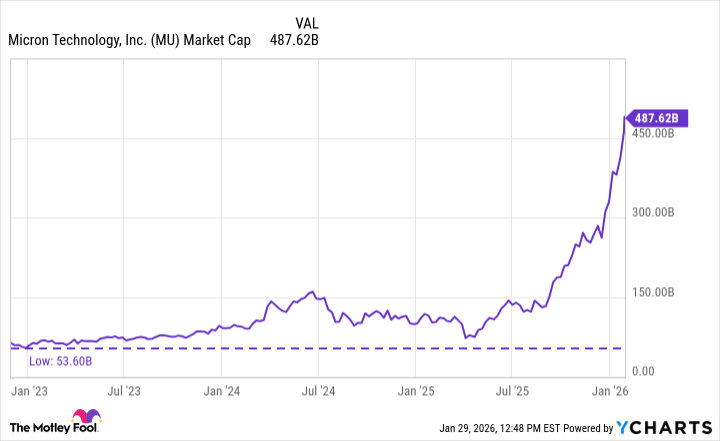
MU Market Cap data by YCharts
Even after such a meteoric rise, Micron's valuation is absurdly reasonable -- sporting a forward price-to-earnings (P/E) multiple of just 14. Companies that dominate adjacent pockets of the AI chip and data center market trade at forward P/E ratios that are double or even triple that of Micron.
Given its current market cap relative to where Nvidia traded at ChatGPT's launch, I can't help but draw a comparison between the two companies. With that said, perspective is important, and it's crucial to understand that Micron stock has already experienced a historic run-up.
This is all to say that Micron may not surge 10x from here and become the "next Nvidia." However, given the secular tailwinds fueling its growth, I do think Micron is on the cusp of having an "Nvidia moment" and could experience another breakout.