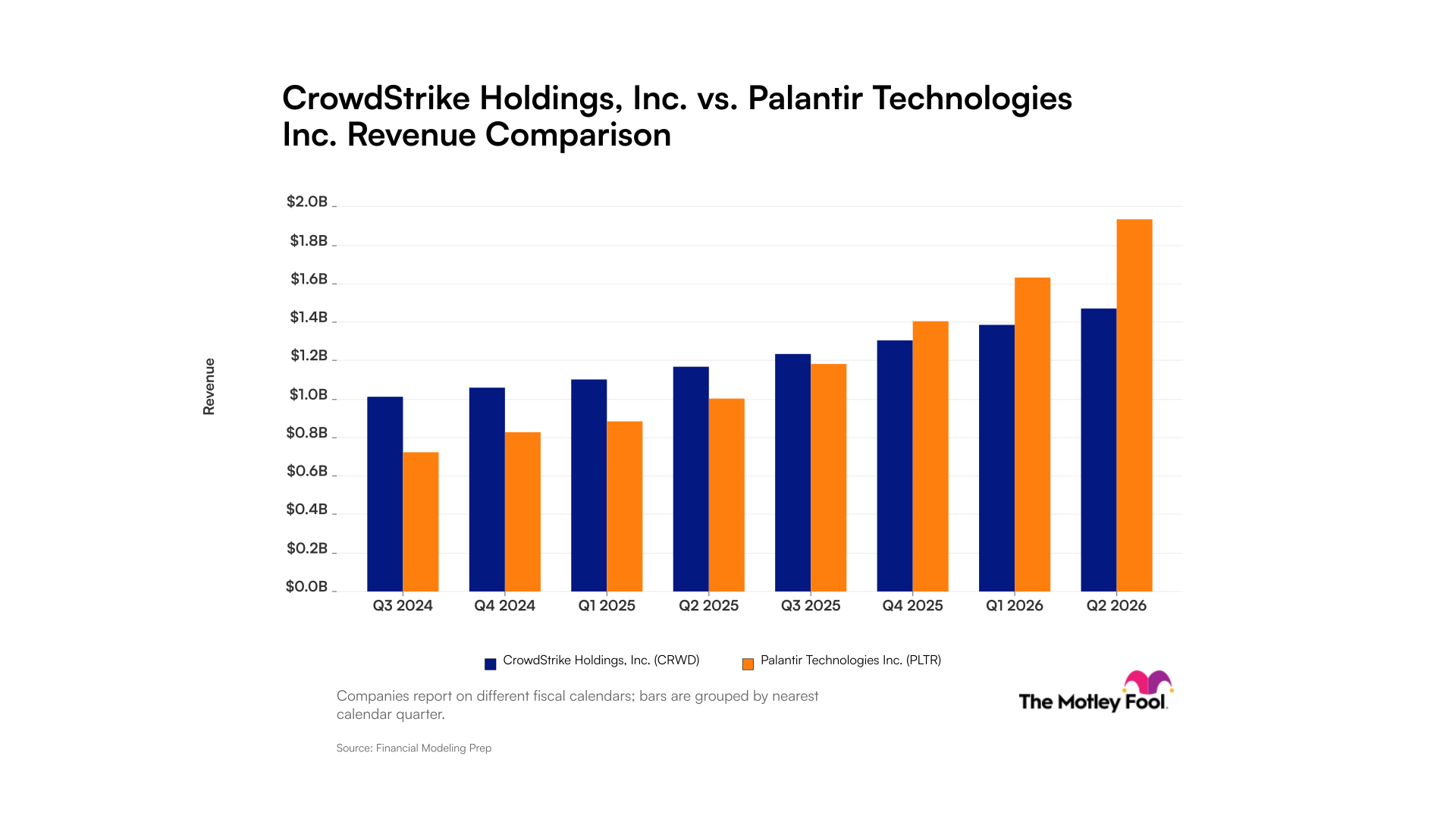
Palantir Technologies (PLTR -0.16%) CEO Alex Karp proclaimed that his company's fourth-quarter 2025 results prove that Palantir is "an n of 1." The numbers that excited Karp so much were indeed stellar. Palantir's revenue soared 70% year over year to $1.4 billion. Its U.S. commercial revenue skyrocketed 137% year over year to $507 million.
During Palantir's Q4 earnings call, management seemed to take a few swipes against companies such as Nvidia (NVDA +0.97%). For example, Palantir's Chief Revenue Officer and Chief Legal Officer, Ryan Taylor, said, "The next step is for the market to differentiate between those who are supplying the commoditization of cognition and those who are scaling the leverage made possible by it."
No company is, to borrow Taylor's words, "supplying the commoditization of cognition" more than Nvidia is. However, I have a contrarian take: Palantir has a much bigger problem than Nvidia.
Image source: Getty Images.
A tale of two constraints
To be sure, Palantir and Nvidia share a similar top challenge. Neither company can keep up with demand. That's a great problem to have for both Palantir and Nvidia.
Nvidia CFO Colette Kress told analysts in the company's third-quarter earnings call in November 2025, "The clouds are sold out, and our GPU installed base, both new and previous generations, including Blackwell, Hopper, and Ampere, is fully utilized." Nvidia is selling every GPU it can make. And the company appears to be chasing a moving target, with Kress mentioning that "demand for AI infrastructure continues to exceed our expectations."
On a similar note, Palantir's Karp stated in his company's recent earnings call, "[W]e really don't have the bandwidth to do anything that's difficult outside of America." While Palantir's overall Q4 revenue growth was impressive, its international commercial revenue increased only 8% year over year.
Granted, there also seemed to be a deeper issue with Palantir's sluggish international growth. Karp acknowledged "a real hesitance" to adopt Palantir's products in Western nations outside of the U.S. He added that America's allies "tend to want to buy products from themselves." Still, Palantir no doubt faces a significant capacity restraint -- and it's related to not having enough skilled staff to implement and support its technology.

NASDAQ: PLTR
Key Data Points
The harder problem to fix
While Palantir and Nvidia have similar challenges, I think that one problem is much harder to fix. Manufacturing greater volumes of AI chips should be a piece of cake compared to finding qualified engineers and support staff that meet Palantir's needs.
Nvidia is taking concrete actions to solve its main issue. The GPU maker's inventory increased by 32% quarter over quarter in Q3, but its supply commitments jumped 63% sequentially. This suggests that Nvidia is aggressively trying to lock down supply to keep up with customer demand.
On the other hand, Palantir can't throw money at its problem so easily. So, what is the software company doing? We've already discussed that Palantir is, to some extent, writing off international opportunities because of a lack of resources. That's not a good solution long-term.
Palantir CFO David Glazer said the company's expenses increased 34% year over year in Q4, in part due to "elite technical hiring." Chief Technology Officer Shyam Sankar hinted at another strategy in his Q4 update, reference to Palantir "launching an American tech fellowship" to teach users working for suppliers and shipyards to develop AI applications.
Some tech companies would help solve a staffing shortage by buying other companies to raid their talent. However, that doesn't appear to be a viable option for Palantir. Karp noted in the Q4 call, "We don't do acquisitions because we are a thick, dense culture, which means you'd have to fit in."

NASDAQ: NVDA
Key Data Points
Investors' easy choice
I don't think Karp's argument that Palantir is "an n of 1" fully holds up. As impressive as Palantir's growth is, Nvidia is growing even faster. As a case in point, Palantir projects sequential revenue growth of 9% in its next quarter, while Nvidia expects 14% quarter-over-quarter revenue growth.
Nvidia's valuation is also much more attractive. Its shares trade at less than 25 times forward earnings. Palantir's forward earnings multiple is nearly 164.
If my contrarian take is right, Nvidia should also have an easier task in addressing its biggest challenge than Palantir will. When you put all this together, I think investors looking for an actual "n of 1" between these two AI stocks have an easy choice.