Shares of D-Wave Quantum (QBTS 8.04%) were on a tear over the past 12 months through the week ending Jan. 30, with the stock up more than 250% in that time. Investor excitement over quantum computing technology fueled D-Wave's ascent, which eventually reached a 52-week high of $46.75 in October before falling back down to earth.
D-Wave has been busy in the first month of 2026 with a flurry of major announcements. It also decided to move its headquarters out of California to Florida this year.
With the stock price down more than half from its October high, now is a good time to take a look at D-Wave and evaluate whether the company is a worthwhile long-term investment in the nascent quantum computing industry.

Image source: Getty Images.
Key D-Wave accomplishments in 2026
D-Wave kicked off 2026 with a Jan. 7 announcement that it was acquiring Quantum Circuits, a peer in the quantum computing sector. This acquisition is meaningful because the two companies specialize in different quantum technologies. Combining their approaches can expand D-Wave's total addressable market.
Quantum Circuits focuses on superconducting gate-model quantum computers, a widely used method in the field, employed by competitors such as Rigetti Computing and IBM. D-Wave utilizes annealing quantum computers, which are useful for solving complex optimization problems, but not ideal for general computing tasks.
The business combination strengthens D-Wave significantly. In fact, it boasts that it's "the only dual-platform quantum computing company."
Following the completion of the Quantum Circuits acquisition on Jan. 20, D-Wave sold one of its quantum computers to Florida Atlantic University for $20 million. Additionally, the company is collaborating with the school to aid its development into a quantum computing center. Perhaps the partnership contributed to D-Wave's decision to move to Florida.
On Jan. 27, the same day it announced its deal with Florida Atlantic University, D-Wave reported a $10 million, two-year contract with a major corporation. The sale represents an endorsement of its quantum computing technology beyond small proofs-of-concept.
D-Wave's financial situation
These deals are significant because D-Wave has produced slim sales over the past year. Although it saw 235% year-over-year revenue growth through the first three quarters of 2025, that amounted to just $21.8 million.
Over the same period, the company's operating expenses were $84.1 million, up from $61.1 million in 2024, resulting in an operating loss of $65.5 million.
The January sales are an encouraging sign, but for its business to achieve long-term viability, D-Wave must dramatically accelerate revenue growth, reduce operating costs, or both.
Weighing whether to buy D-Wave stock
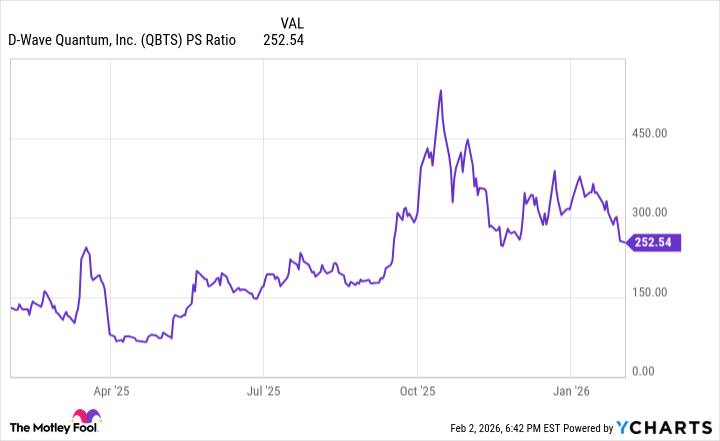
Although D-Wave shares are down substantially from their October high, the company's small sales and high operating loss suggest its stock is overvalued.
Data by YCharts.
The chart reinforces this idea, given its stock's sky-high price-to-sales ratio, which indicates the cost to investors for every dollar of revenue generated by the company over the last 12 months.
Consequently, the ideal strategy is to wait for shares to drop further, or for D-Wave's upcoming quarterly earnings results to justify its elevated valuation. For now, only investors with a high risk tolerance should consider D-Wave stock.