It's no secret that the stock market's returns in recent years have been fueled by technology stocks. Companies like Nvidia (NVDA 1.53%), Meta Platforms (META 2.52%), and Broadcom (AVGO 1.63%) have performed extraordinarily well, and are a big reason why the Nasdaq-100 has gained more than 500% in the past decade alone.
With the massive buildout of artificial intelligence (AI) infrastructure currently underway, and the rapid advancement of AI as well as several other exciting technologies, such as autonomous vehicles, Internet of Things, and more, there's a solid case to be made that a Nasdaq-100 index fund like the Invesco QQQ ETF (QQQ 1.72%) could still be an excellent addition to your portfolio.

Image source: Getty Images.
To be clear, it's entirely possible that the Nasdaq-100 will have some excellent years ahead of it. And even if it has a rough patch, investors are highly likely to create significant wealth over the long term with this ETF. But there's one big caveat to keep in mind before you buy.
About the Invesco QQQ ETF
The Invesco QQQ ETF is the largest exchange-traded fund, or ETF, that tracks the Nasdaq-100 benchmark index. It has about $395 billion of investor assets under management, and its expense ratio (annual investment fee expense) of 0.18% is well below what the average technology-heavy index fund charges.
One thing you need to know
Here's one important point you need to know. The Invesco QQQ ETF is a weighted index fund, meaning that companies with the highest market capitalizations make up a greater percentage of the fund's assets.
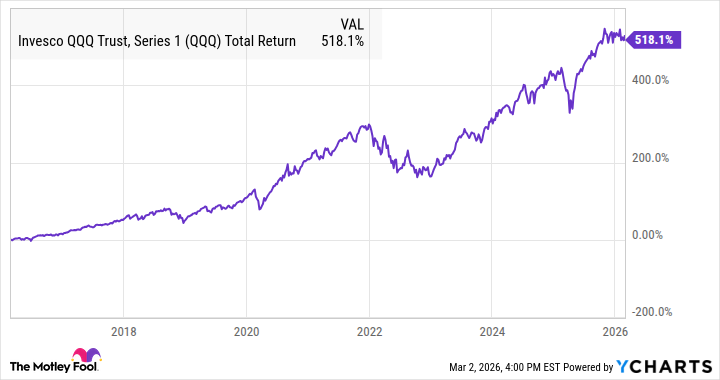
QQQ Total Return Level data by YCharts
In other words, the ETF owns shares of all 100 companies that comprise the Nasdaq-100 index. But it doesn't invest in each of them equally. In fact, the largest holding (Nvidia) accounts for 8.4% of the ETF's assets. On the other hand, the smallest company in the Nasdaq-100, Atlassian (TEAM 2.74%), only gets a 0.07% allocation.
This means that a disproportionate amount of your money is invested in just a few mega-cap companies. In fact, the 10 largest holdings in the Invesco QQQ ETF make up a staggering 47% of the portfolio.
To be clear, this concentration can certainly be a good thing if companies like Nvidia, Apple (AAPL 1.93%), Microsoft (MSFT 0.73%), and the rest of the trillion-dollar tech giants continue to deliver strong returns. But it's also a big risk factor. If the largest tech companies perform poorly, it can cause your investment to lose value -- even if the other 90 companies in the index are performing quite well.