Investing in the latest technology has helped many investors outperform the S&P 500 over the long run. Buying into e-commerce and smartphone stocks early produced tremendous returns, and artificial intelligence (AI) looks like the next big opportunity.
Tech giants spend billions of dollars on AI every month, and all of that money has to go somewhere. These three AI stocks could become millionaire-makers for patient investors.

Image source: Getty Images.
1. Vertiv provides liquid cooling solutions
AI chips are the main gravitational force driving AI spending, and any companies that align with AI chip production and maintenance have the potential to outperform the S&P 500 over many years.
Vertiv (VRT +3.27%) is one of those companies. Its liquid-cooling solutions are critical for AI data centers, enabling AI chips to operate without overheating. Vertiv has a direct partnership with Nvidia, and each of Nvidia's new chips is tested to ensure they work with Vertiv.

NYSE: VRT
Key Data Points
Time is precious for hyperscalers, and many are comfortable spending more for a guaranteed solution rather than cutting corners and risking a liquid-cooling solution that won't work.
Sales growth has accelerated in recent years. While revenue increased by 16.7% in 2024, its top line surged by 27.7% year over year in 2025. Vertiv also anticipates 27% to 29% year-over-year growth in 2026. Those previous growth rates, combined with future guidance, imply Vertiv is still gaining market share in one of the hottest industries.
2. Iren's new order of GPU chips signals higher demand for its services
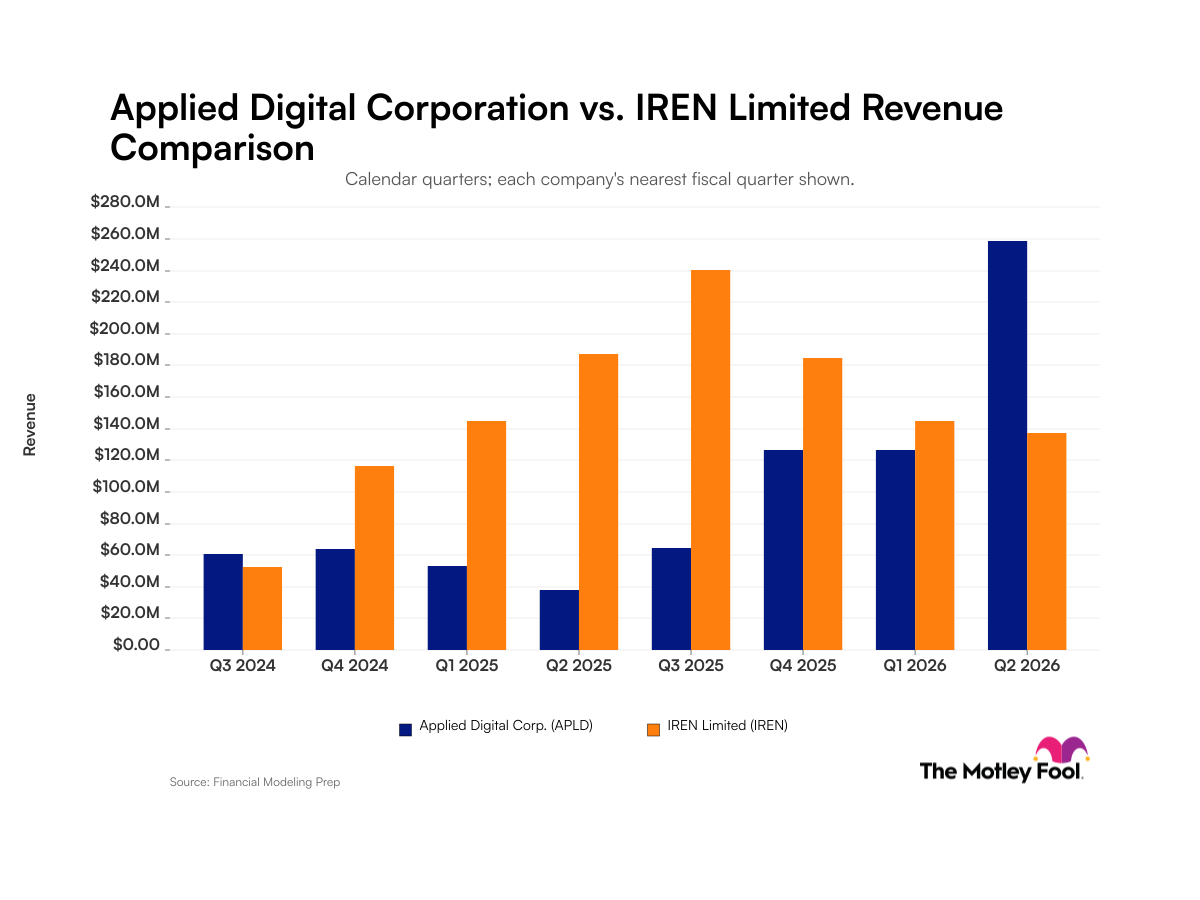
IREN (IREN +7.36%) is a neocloud firm that creates AI data centers and offers that infrastructure to tech companies. A five-year, $9.7 billion deal with Microsoft for 200 megawatts in its Childress, Texas, AI data center captured investors' imaginations in November, but no additional deals have been announced since.

NASDAQ: IREN
Key Data Points
Iren stock has trended downward ever since that deal, especially since no deals with new customers have been announced. However, Iren has been laying the groundwork that implies these types of deals will be more common in the future.
The company announced the addition of a 1.6 gigawatt site in Oklahoma in Q2 FY26, bringing its total secured power to over 4.5 gigawatts. That's a significant catalyst for future revenue, since the Microsoft deal covers only 200 megawatts. Iren has the energy capacity to support more than 20 agreements like the Microsoft one after it builds all of the AI data centers. That implies Iren could earn more than $40 billion in annual recurring revenue after it has customers for its entire energy capacity.
Power is scheduled to ramp up at the Oklahoma site in 2028, and Iren's Sweetwater 1 site remains on pace to be energized in April. This Sweetwater 1 site will have 1.4 gigawatts ready to go, which will make Iren highly desirable among hyperscalers.
A recent news release shows that demand is surging even though a new deal hasn't been announced yet. Iren entered into purchase agreements for an additional 50,000 Nvidia chips, bringing its total to 150,000 Nvidia GPUs. Companies only increase their fleets at that type of rate if demand is surging.
Based on the Microsoft contract, a single new deal could add billions of dollars to Iren's annual recurring revenue. The Sweetwater 1 facility sets the stage for a record-breaking deal or several deals like the arrangement with Microsoft.
3. Micron's pivot out of the consumer business lets it fully capitalize on AI infrastructure
Micron Technology's (MU +3.92%) memory storage products are a key part of AI chips. Without this technology, AI chips can't perform and handle high workloads, making Micron an integral enabler of artificial intelligence.

NASDAQ: MU
Key Data Points
Upbeat guidance and a 57% revenue surge in the first quarter of fiscal 2026 offer the backdrop for what could be a market-beating run for the AI stock. Micron said it is on pace to beat various records in the second quarter while delivering higher profit margins.
Most of the opportunities are coming from AI, which was a big reason Micron said it would part ways with its consumer business segment. This shift will be finalized in the second quarter, and it will give Micron more resources and capital to commit to the higher-margin AI infrastructure build-out.
Micron shares have more than quadrupled over the past year, and despite that growth, the stock only trades at a 0.6 PEG ratio, which indicates that it is still undervalued.