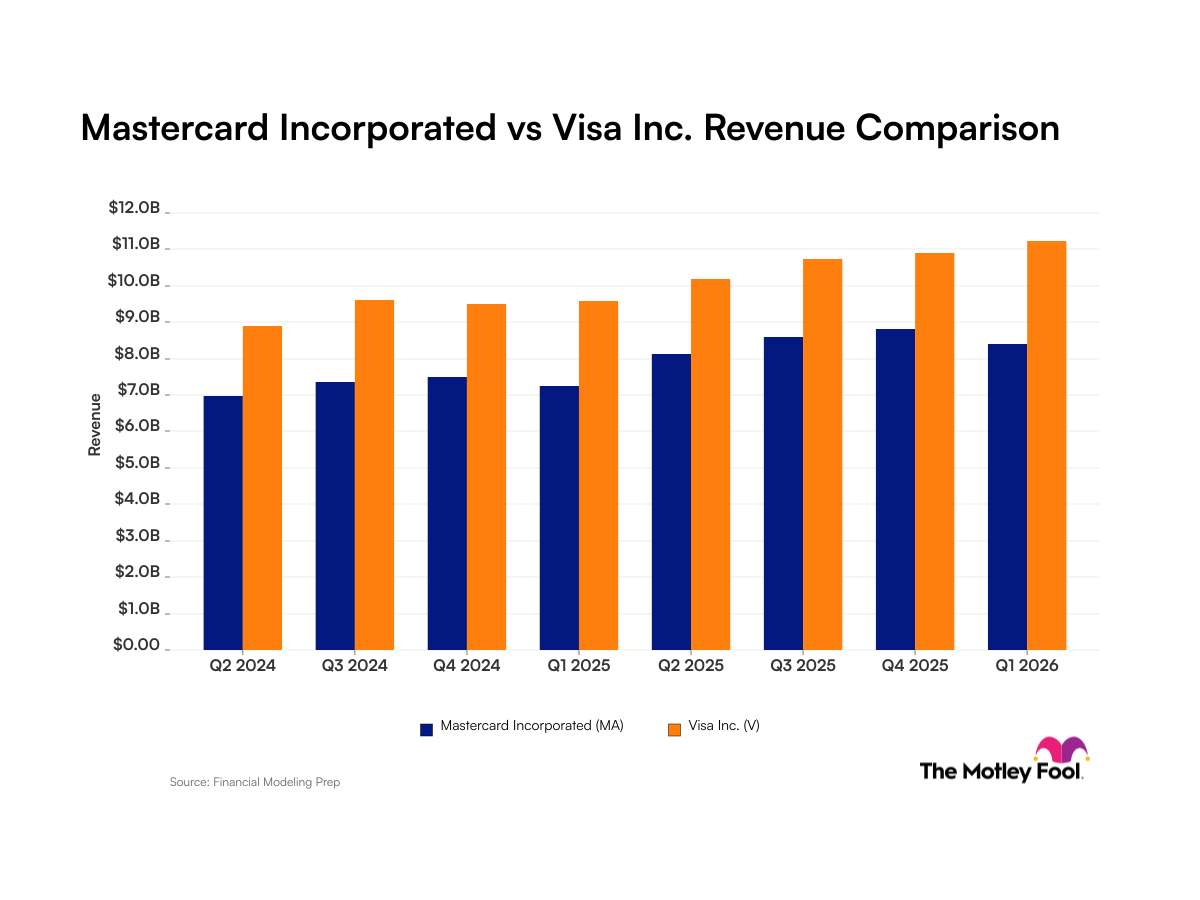
From competitive and financial standpoints, some industries are just better than others. For example, the payments market has many businesses operating in it that are developing moats and that produce exceptional profits. This might be a good place for investors to go searching for new ideas.
One of these companies is a dominant force that's worth taking the time to learn more about. And it's the payments stock that benefits every time someone swipes a card at checkout.
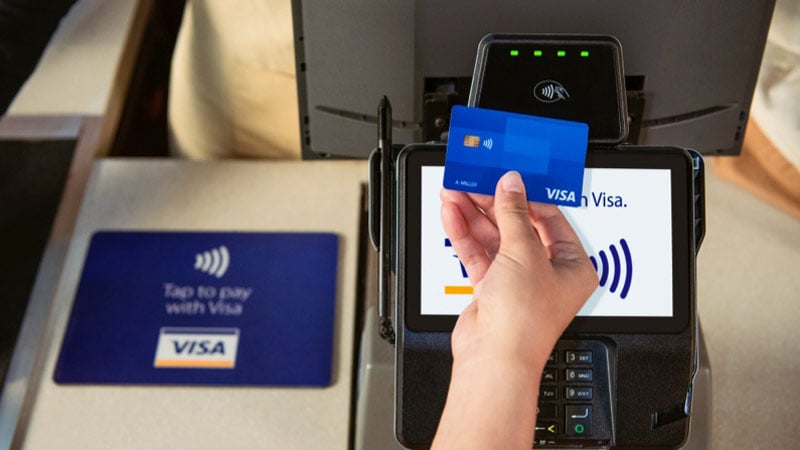
Image source: Visa.
This powerful business enables commerce across the globe
In the past three months of 2025, Visa (V +1.68%) handled $4.5 trillion in total payment volume. It has 5 billion cards in circulation around the world. There are more than 175 million merchant locations that accept these cards. And Visa has a presence in 220 countries and territories. These figures are mind-boggling.
All these data points demonstrate how valuable Visa is to global commerce. The company generates revenue anytime its cards get used at checkout. Visa earns a tiny amount, known as an assessment fee, that's typically less than 0.2% of the transaction total. There can also be a fixed fee. On any single swipe, the total value received is certainly trivial.
However, in its fiscal 2025 (ended Sept. 30, 2025), Visa collected $9.7 billion in revenue just from facilitating payments activities. And because it's a scaled platform with low marginal costs, profits are exceptional. Visa's quarterly net profit margin averaged 47.6% in the past decade.

NYSE: V
Key Data Points
What returns can investors expect?
Visa is a massive entity, sporting a market value approaching $600 billion. Based on research from The Motley Fool, this makes Visa one of the largest financial companies in the world. The size might be an obstacle to winning returns. In the past five years, the company's shares have produced a total return of 45% (as of April 14). This underperforms the S&P 500 index.
It's impossible to know what the broad benchmark will do in the future. However, Visa still deserves a closer look right now. Its shares trade at a price-to-earnings (P/E) ratio of 29.5. This multiple is close to the cheapest valuation in the trailing-five-year period. So the current entry point can be appealing.
In the past five years, adjusted earnings per share climbed at a compound annual rate of 123%. Between fiscal 2025 and fiscal 2028, sell-side analysts expect this figure to increase at a yearly clip of 43%. I believe a low-teens growth rate is reasonable for the next five years and beyond.
If we assume the P/E ratio in 2031 is the same as it is today, then Visa's share-price performance can resemble the growth of its profits. That's not a bad possible return coming from a dominant payments stock.