Did you know that it has been more than seven years since Canada legalized marijuana for recreational use? At the time, there was euphoria and excitement in the industry. Tilray Brands (TLRY +3.05%) was a prominent player in the cannabis space, and it's arguably the most recognizable one today.
However, despite the Canadian cannabis market being open for business, it's been anything but a smooth ride for the cannabis company, and that's evident through its crashing share price. In just five years, it has fallen an incredible 96% -- wiping out almost all its value. How can that happen given that it operates in a legal marijuana market?

Image source: Getty Images.
Cannabis stocks as a whole have struggled
In fairness to Tilray, it is by no means the only cannabis stock that has been a bad investment. Look at any pot stock, and you'll see a consistent pattern: companies looking to get leaner and smaller, pulling back from markets, all in an effort to reduce costs and improve their prospects for profitability.
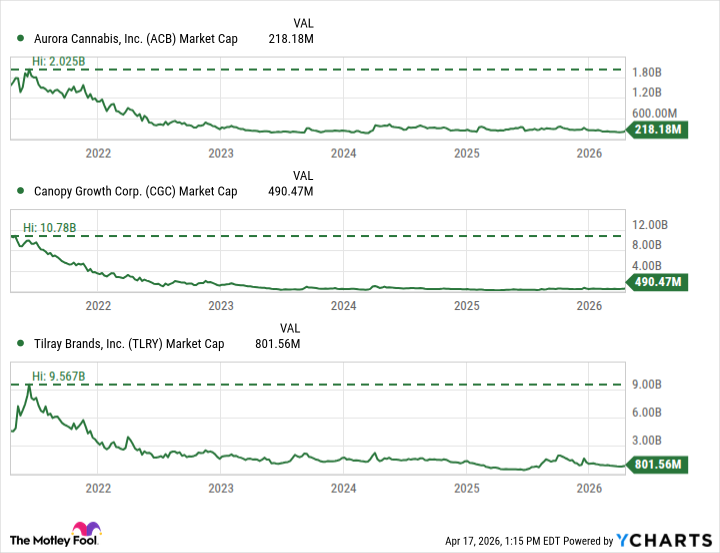
Five years ago, the big three in the cannabis industry were Tilray Brands, Canopy Growth, and Aurora Cannabis. At their peaks during that stretch, they all commanded valuations of at least $2 billion, all on their own. Combined, they would have been worth well over $20 billion. Today, however, their total combined market cap is just $1.5 billion.
ACB, TLRY, CGC Market Cap data by YCharts
What went wrong for the industry?
I could sum up the industry's problems in just a single word: regulation. And more specifically, poor regulation. While cannabis has been legal in Canada for years, the red tape that's in place makes it difficult for a company to succeed. There are significant restrictions on any advertising or branding. Packaging is standardized and plain; it's not like walking into a grocery store and seeing brands like Coca-Cola or Pepsi on the store shelves, easily identifiable. Those kinds of limitations make it incredibly difficult for a business like Tilray to build brand loyalty.
Exacerbating these problems are the sheer number of cannabis companies that are in the industry today, resulting in intense competition and minimal margins. There are roughly 1,000 licensed cultivators, processors, and sellers, based on the latest government data. The aggressive rollout and ease with which competitors can obtain licenses have made it difficult for companies to succeed. Plus, while the black market has been declining in size, it remains a thorn in the side of licensed producers such as Tilray, as illicit dealers avoid taxes and offer lower prices.

NASDAQ: TLRY
Key Data Points
Investing in Tilray's stock comes with big risks
There's the occasional rally in Tilray's share price when there are encouraging developments about the U.S. potentially rescheduling marijuana or when there's talk of reform in the sector, as it gives investors hope that Tilray might one day be able to enter the highly coveted U.S. pot market. In the meantime, the company has been diversifying its operations by expanding into alcohol and pursuing international cannabis markets. While those moves have enabled Tilray to grow its business, the problem is that it's costly to make them, markets aren't all that big, and the end result is limited organic growth and, arguably, still no sight of long-term profitability. Over its past three quarters, the company's net revenue has risen by just 6%, and its operating loss remains high at around $47 million.
Tilray has been making efforts to be less dependent on the Canadian cannabis market, but it has a long way to go in proving that it's a safe investment, or even that it can generate consistent organic growth. And hoping on the U.S. legalizing marijuana is proving to be quite the waiting game, with no clear indication of when or even if it might ever happen.
Investing based on hopes of government reform is incredibly risky, given that marijuana legalization just isn't a priority in the U.S. right now, and even if it were, it could be an extremely long process. This is why even if you're tempted to invest in Tilray now, it's important to be aware of the risks and uncertainty ahead. While it may seem like a cheap stock to own, that doesn't mean it has bottomed out and can't go any lower.