Last summer, Clorox (CLX +0.42%) increased its quarterly dividend to $1.24 per share, marking its 48th consecutive annual dividend increase. That puts Clorox on track to reach the coveted 50-year dividend streak milestone and join a list of fewer than 60 other companies that can rightly be called Dividend Kings.
Clorox's aspirational regal standing, paired with its whopping 5.7% dividend yield, makes it a seemingly no-brainer buy for passive income. But Clorox has a lot of work to do if it wants to attain and retain its status as a Dividend King.
Clorox could be an incredible value stock for patient investors, but it has some red flags that are worth considering before you buy.

Image source: Getty Images.
Not all Dividend Kings stay on the throne
To consistently raise a dividend year after year, a company has to grow its earnings and free cash flow (FCF). If earnings growth stalls or declines, the dividend will eventually become unaffordable, and a company will either have to stop raising its payout or cut the dividend.
3M (MMM -0.39%) is a recent example of a former Dividend King that slashed its payout in 2024. The decision to do so turned out to be the right one, as 3M freed up much-needed cash to turn the business around, and the stock has rebounded accordingly. In comparison, Coca-Cola (KO -0.01%) is about as reliable a Dividend King as you can find, thanks to its elite brand recognition, global exposure, high margins from an efficient supply chain, and consistent demand regardless of the market cycle.
Clorox continues to raise its dividend despite falling earnings and FCF -- making it more like 3M prior to its dividend cut than a stable stalwart like Coca-Cola. In the nine months ended March 31, 2026, Clorox paid $452 million in dividends but only generated $161 million in FCF. When adjusting for a one-time $476 million purchase for a larger interest in its Glad bags and wraps business, Clorox generated $637 billion in FCF, which easily covers the dividend. Similarly, adjusted earnings per share of $1.64 exceed the $1.24 dividend payment.
But as you can see in the following chart, Clorox's sales have been declining (partially due to divestitures), and its margin recovery has reversed course.
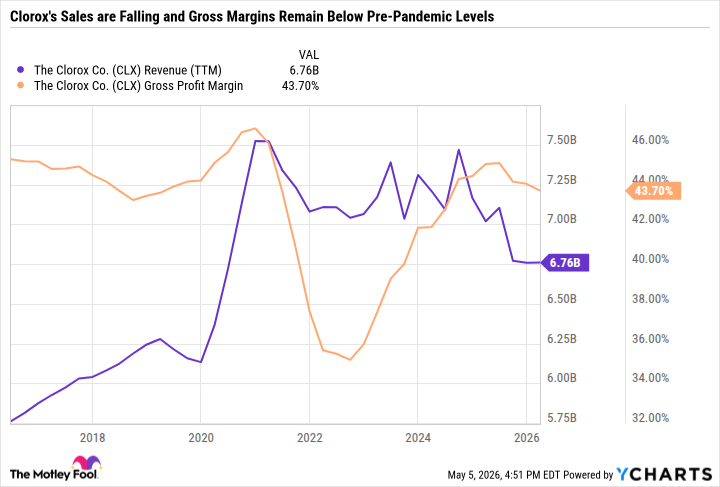
CLX Revenue (TTM) data by YCharts.
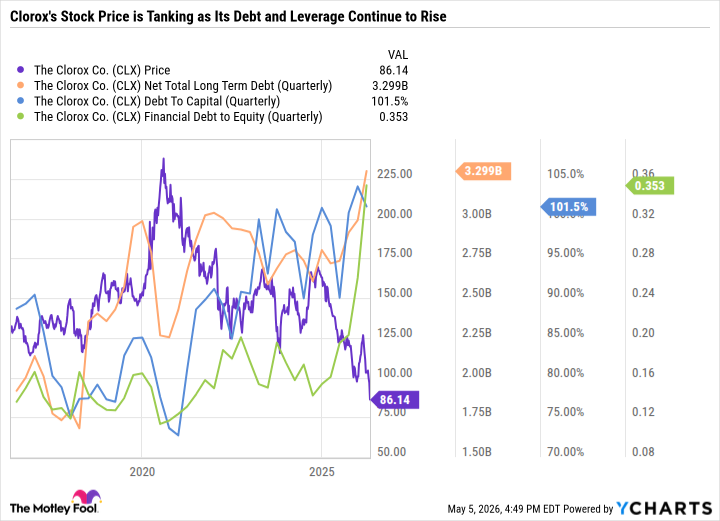
Although margins have recovered from their lows, they are still down from pre-pandemic levels. In the meantime, Clorox's balance sheet is in its worst shape in a decade, as net long-term debt and leverage ratios have skyrocketed -- corresponding with its falling stock price.
A shaky reign in the making
Clorox is doing a good job with its cost-cutting efforts, such as lower advertising investments and selling and administrative expenses to offset higher manufacturing and logistics costs. In February, Clorox completed its five-year, $580 million transition to a new enterprise resource planning system to boost efficiency. Those efforts are a step in the right direction to make Clorox a better-run company. But ultimately, its long-term growth depends on how its brands resonate with consumers, and if they are differentiated enough to retain pricing power despite competition from other name brands and private labels.
CLX Clorox
NYSE · As of 4:00 PM ET 10/26/26

At just 15.7 times forward earnings, value investors who are confident in the staying power of Clorox's brands may want to buy the stock. However, Clorox has a long way to go to gain the credibility of rock-solid stocks like Coca-Cola, even if it technically becomes a Dividend King in the next 15 months.