Stocks gave up early gains on Thursday as promising signs for negotiations between the U.S. and Iran seemed to fade.
This afternoon, reports came out that the Trump administration was looking to restart "Project Freedom" as its operation to shepherd ships safely through the Strait of Hormuz is known.
The move seems to be a sign that negotiations between the two sides aren't progressing as hoped, and oil prices rose as a result.
All three major indexes moved lower over the course of the day as yesterday's enthusiasm over a deal faded. The S&P 500 finished the day down 0.4%; the Dow Jones Industrial Average gave up 0.6%, and the Nasdaq Composite closed down 0.1% after gaining 0.8% in morning trading.
However, small-cap stocks fell especially hard today, with the Russell 2000 closing down 1.6%.

Image source: Getty Images.
Why small-cap stocks are tumbling
The return of tensions in the Middle East sent both interest rates and oil prices rising, which is a signal that inflation is likely to keep going up.
Small-cap stocks tend to be more sensitive to interest rates and inflation, which offers one explanation for the decline in the Russell 2000 this year. Over the previous two sessions, the Russell 2000 jumped more than 3% in response to hopes for a resolution in Iran.
Earnings season also weighed on the index, with a number of its top holdings pulling back. Bloom Energy, the biggest holding in the index, fell nearly 10%, which seemed to be momentum-driven, tracking with the broader Russell 2000 index.
Among the other losers were Shake Shack and Beyond Meat, which fell sharply on earnings.
Are small-cap stocks an opportunity?
Small-caps have badly lagged the S&P 500 since the AI boom began as the biggest winners have been large-cap AI stocks like Nvidia and the rest of the "Magnificent Seven." However, in the semiconductor sector, investors have rotated into stocks that are now just starting to benefit from the AI boom, and we could see a similar rotation from large caps into small caps, which has been anticipated due to the valuation gap between large caps and small caps.
The iShares Russell 2000 ETF (IWM +1.37%), the biggest small-cap ETF, now trades at a price-to-earnings ratio of 19.4, which compares to a P/E of 27.5 at a comparable S&P 500 ETF. The Russell 2000 has also outperformed the S&P 500 this year, as the chart below shows.
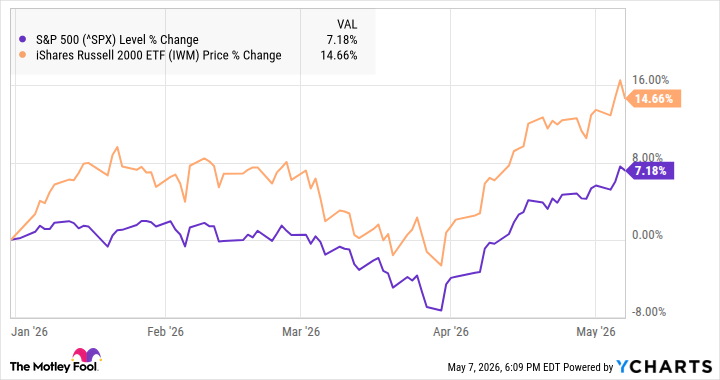
Diversifying into small-cap stocks makes sense if you only have exposure to large-caps, given the significantly lower valuations. Meanwhile, large-cap valuations look stretched after the recent surge to all-time highs.
Predicting the next development in the Iran war isn't easy, but investors seem to believe the Strait will eventually reopen as the ceasefire continues to hold.
Small-cap stocks are more sensitive to macro events, as well as interest rates, but that cuts both ways. If expectations for interest rates and inflation improve, small-cap stocks look well-positioned to outperform.