As arguably the most well-known investor in stock market history, it makes sense that people tend to follow Warren Buffett's philosophies and advice when it comes to picking great stocks. No investor is perfect, but Buffett's sustained success over decades before his retirement is, to put it lightly, impressive.
Buffett himself isn't the biggest fan of tech stocks, but there are a few artificial ingelligence (AI) stocks that fit the qualities that Buffett looks for in a business. Yes, he has owned Apple stock for over a decade, but Microsoft (MSFT +1.14%) is another notable business that checks the boxes. And now could be a good time to invest.

Image source: Microsoft.
A sustainable competitive moat
Buffett always preached the importance of a competitive moat. It's what allows a business to remain consistent and profitable over the long term. Buffett himself once said, "The most important thing in evaluating businesses is figuring out how big the moat is around the business."
Microsoft's competitive moat is the reach of its enterprise software. Between Windows, Office 365 (Excel, Word, Outlook, Teams, etc.), and its cloud platform, Azure, Microsoft is ingrained in the daily operations of millions of businesses globally. There are more than 1.6 billion monthly active Windows devices alone.
Because of how ingrained Microsoft is, switching costs are high. A company could decide to ditch Windows for Mac, but it would mean undergoing a massive IT makeover, buying new equipment, and retraining employees. Some could switch from Office 365 to Alphabet's Google, but that would require migrating data and carry the risk of something going wrong in the process. And if a company is already integrated with Azure, the logistics of switching might not be worth the trouble.

NASDAQ: MSFT
Key Data Points
This doesn't mean Microsoft can get complacent, but it has shown it can keep adapting. It's why, even at its size, it has been able to impressively grow its finances over the years.
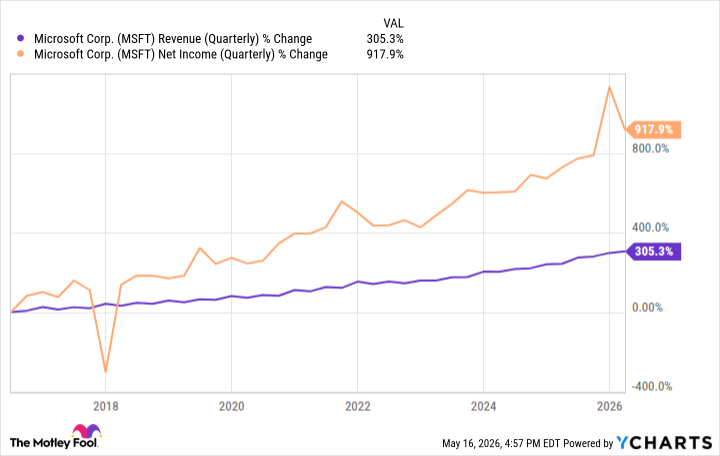
MSFT Revenue (Quarterly) data by YCharts
Consistently returning shareholder value
Buffett values companies with stable cash flows and attractive dividends. Now, Microsoft isn't a dividend stock by general standards, but it does, in fact, pay one. Its dividend yield is only 0.8%, and it has only averaged a 1.2% yield over the past decade, but that's not what long-term investors should focus on.
What's more important is that Microsoft has increased its annual dividend for the past 21 years. Over the past 10 years, Microsoft's dividend has increased by more than 152% to $0.91 per quarter. With how much money Microsoft continues to make, there's no reason to believe it'll stop increasing its dividend anytime in the foreseeable future.
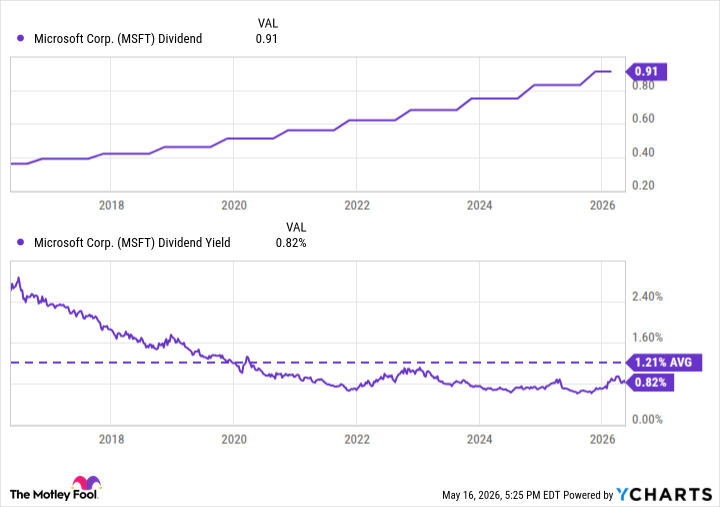
MSFT Dividend data by YCharts
Aside from dividends, Microsoft continues to reward investors by spending billions on share buybacks ($4.6 billion in the most recent quarter). It's not a cash payout like a dividend, but it increases shareholders' ownership in the company because there are fewer shares on the market.
Here's what Buffett had to say in his 1999 Berkshire Hathaway shareholder letter:
There is only one combination of facts that makes it advisable for a company to repurchase its shares: First, the company has available funds -- cash plus sensible borrowing capacity -- beyond the near-term needs of the business and, second, finds its stock selling in the market below its intrinsic value, conservatively calculated.
Microsoft undoubtedly checks the first box. Regarding the stock being below its intrinsic value, Microsoft's stock hasn't historically been "cheap," but many would argue it was trading fairly based on its business standing.
Reliable and predictable cash flow
Generating a lot of revenue is great, but Buffett consistently made it clear that he cared about cash flow because it's what matters most to shareholders. If a company's earnings must go entirely toward maintaining its business and staying competitive, it isn't doing any good as a cash generator.
In Microsoft's most recent quarter (ended March 31), its free cash flow was around $15.8 billion (it had $30.9 billion in capital expenditures). Microsoft's free cash flow can be cyclical, but it's always well into the billions.
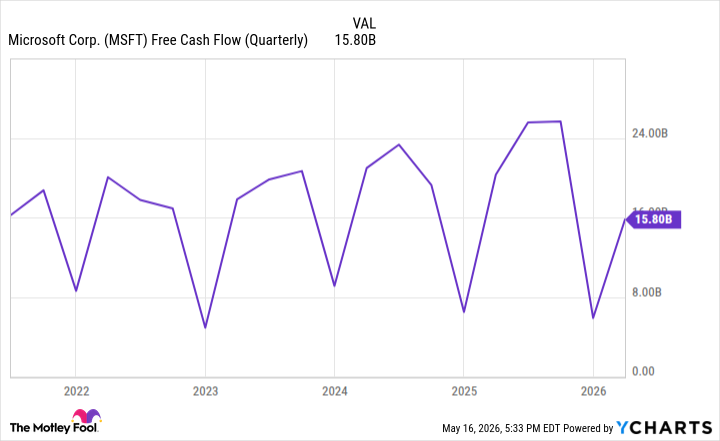
MSFT Free Cash Flow (Quarterly) data by YCharts
Microsoft's subscription model helps bring reliable cash flow that you don't always get with more hardware-focused tech companies. Hardware is more sensitive to broader economic conditions (people don't upgrade their phones or laptops when money is tight), so it can be a bit more unpredictable.
It's been a rough start to the year for Microsoft (down around 10.8% year to date through market close on May 15), but it remains one of the best tech stocks you could own going forward.