Depending on who you talked to, and on what day you talked to them, the stock market last week (the week starting on May 11) was either euphorically uplifting, or concernedly jittery.
Indeed, despite a sharp 1.2% pullback on Friday, May 15, the iShares Core S&P 500 ETF (IVV +1.92%) managed to squeeze out a modest 0.1% gain for the week. That tiny gain says nothing, however, of the multiple mid-week record-breaking highs driven in large part by renewed chipmaker fervor and the impressive double-digit market gain of market-debuting Cerebras Systems.
The juggernaut of enthusiasm -- however invincible it seemed on Thursday -- was blindsided by spiking bond yields on Thursday night. This rattled the market over fears of worsening inflation, and triggered a tech sell-off that sent all three major stock market indexes down over 1%.

Image source: Getty Images.
Up close, this jumpy swing may seem puzzling. But from a distance, it really isn't. The world continues changing day by day -- wars in the Middle East, artificial intelligence (AI) -- and fast change over short periods isn't good for the nervous system.
History is pretty clear on what happens when the market is especially jittery. Take the S&P 500 Shiller CAPE index, for example. This valuation metric divides an index's price by the last 10 years of earnings, offering a clear-sighted view of the stock market's current valuation. If the last 100 years of history say anything, it's that the stock market might be setting itself up for a setback.
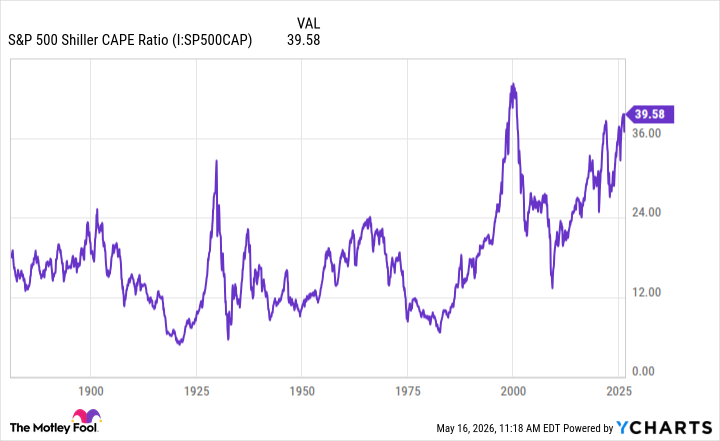
Data by YCharts.
A CAPE ratio of 39.5 isn't the highest the S&P 500 index has ever hit. Veteran investors will remember when this metric hit nearly 45 during the dot-com era -- just before the bubble popped.
Does that mean the stock market will crush records like it's 2000 all over again? Not necessarily. These are different times, and the market is being driven by different factors. But the gap between fundamentals and valuation is getting wider. That means today's winners will need to be those who can outlast temporary hype to deliver long-term value.