Tech stocks have provided the largest part of the market's gains for several years now, with only a few hiccups along the way. However, those intermittent rough patches have represented great buying opportunities, and one has recently opened up for a well-known name: Microsoft (MSFT +2.38%).
Microsoft rarely sells off, and historically, every time it has, it has been a great time to buy the stock.

Image source: Getty Images.
Large sell-offs aren't normal for Microsoft
Microsoft was founded over half a century ago, but in a meaningful sense, the current iteration of the company has only existed for about a decade. This incarnation of the tech player is primarily driven by subscription software and cloud computing.
Before it entered this phase of its existence, Microsoft's overall results weren't as influenced by recurring revenue businesses, so analyzing it today based on comparisons to events of more than a decade ago doesn't make sense. So, I'll focus here only on the past decade.
Over that time, Microsoft stock has sold off by 30% or more exactly twice.
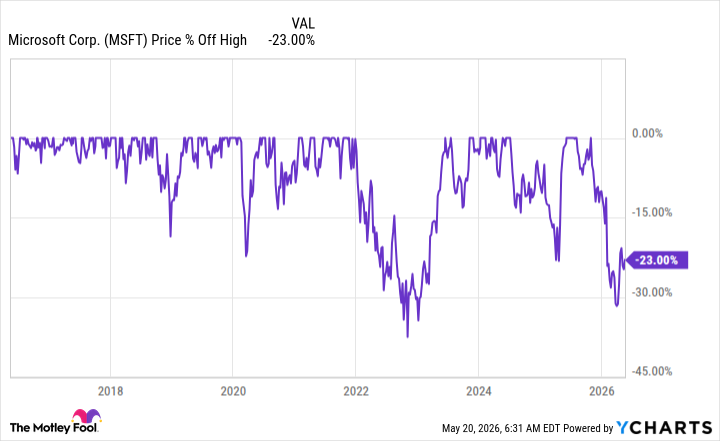
While Microsoft has rallied from its recent lows, even sell-offs of 25% or so have only occurred a couple of times. So, the company is in fairly rare territory. However, after reaching the troughs of such deep sell-offs, Microsoft stock has notched new all-time highs in about six months to a year. There's no guarantee that pattern will repeat, but history offers investors a good reason to expect that Microsoft stock won't remain depressed forever.

NASDAQ: MSFT
Key Data Points
Still, some other factors seem to be associated with Microsoft's sell-offs.
Microsoft's stock sells off once it hits a key valuation level
To value Microsoft stock, I think the best metric to use is the price-to-cash-flow-from-operations ratio. The cash from operations (CFO) metric, also called operating cash flow (OCF), measures exactly what you'd expect: the cash a business generates specifically from its operations. It ignores things like rising or falling values for a company's investments, or how much it's laying out on capital expenditures. It gauges how a business is doing at its core.
Over the past 10 years, every time Microsoft's valuation has hit 30 times operating cash flow (or came close), a sell-off has followed.
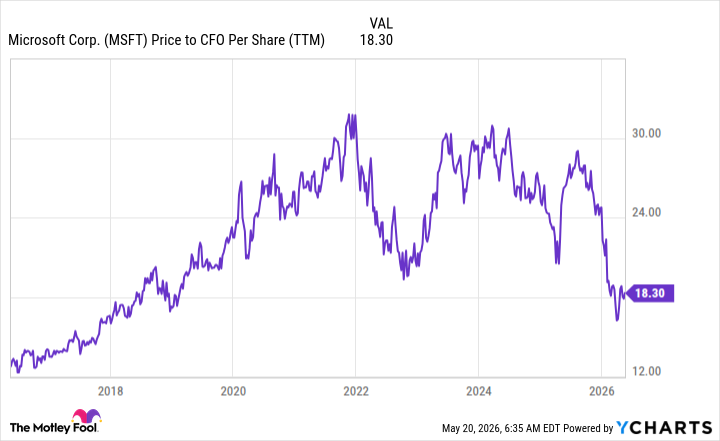
MSFT Price to CFO Per Share (TTM) data by YCharts.
This chart negatively correlates with the other chart and should give investors hope that Microsoft's business is still doing well; it's just not being valued as highly as it once was. The pattern is pretty clear here: Microsoft's stock gets overvalued and then sells off to a relative low. After its valuation bottoms out, it rallies back toward a new high.
As a result, I think investors should look at the latest sell-off not as a curse but as a gift. Should Microsoft rally to around 30 times operating cash flow before its next sell-off (or at least, that's where the trend tends to terminate), that would result in more than a 50% upside based on valuation and its current operating cash flow alone. The actual return potential is even greater, because Microsoft is doing quite well as a business right now, with revenue rising 18% during its most recent quarter.
I'm bullish on Microsoft's prospects to rally throughout 2026 and 2027, and I believe it could be one of the top-performing big tech stocks this year. After many of its peers have had strong starts to 2026, it may be time to take some of your gains from those investments and reallocate them into a stock like Microsoft that's primed for a major rally.