Small-cap stocks are hot right now. The iShares Russell 2000 ETF (IWM +0.88%), which tracks the performance of the Russell 2000 index of small-cap U.S. stocks, is up 22.3% year to date at recent prices. That's better performance than the Vanguard S&P 500 ETF (VOO +0.65%), which tracks the benchmark S&P 500 index and has gained about 7.5%so far in 2026.
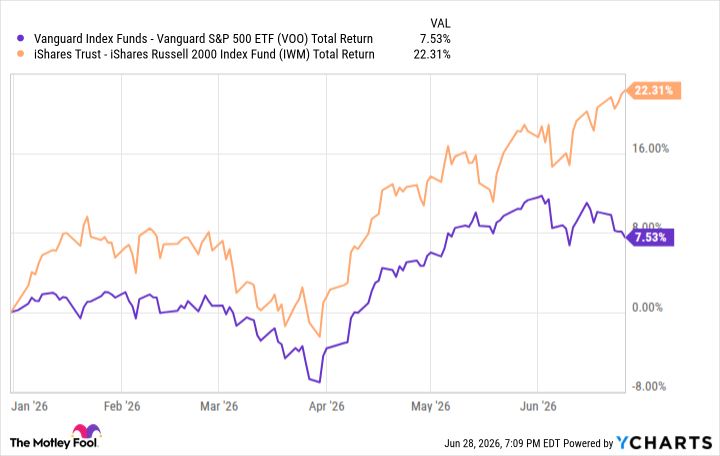
VOO Total Return Level data by YCharts
Both exchange-traded funds (ETFs) have been attracting investor attention recently. The Vanguard S&P 500 ETF was already the largest ETF in the world when it made headlines in June as the first ETF to surpass $1 trillion of investor assets. The fund's ticker, VOO, has become a shorthand among investors for buying the S&P 500 at an ultralow cost.
The iShares Russell 2000 ETF has been getting interest from investors based on concerns about high valuations in S&P 500 tech stocks and relatively cheap-looking small caps. A white paper from Fidelity published in April stated that recent low valuations and stronger earnings among small-caps have "increased the historical odds of small-caps outperforming large caps over the next five to 10 years."
Which ETF should you buy: small caps (IWM) or large caps (VOO)? Let's look at these two popular funds and see which could be a better buy for your portfolio.

Image source: Getty Images.
Vanguard S&P 500 ETF (VOO): 505 stocks; 15 years of 15.18% annualized returns
The Vanguard S&P 500 ETF offers one of the easiest, lowest-cost ways for investors to own the entire S&P 500 index. If you're not trying to beat the market and you want to earn the long-term return of America's largest 500 publicly traded companies, VOO is hard to beat.
This fund holds 505 stocks and charges an ultralow expense ratio of 0.03%. In the 15-plus years since VOO launched, it has delivered average annual returns of 15.18% at recent prices. Its recent returns have been even stronger, with a three-year annualized return of 23.6%, and a one-year return of 29.74% (by net asset value).

NYSEMKT: VOO
Key Data Points
Why would anyone not want to buy this fund? Some investors are concerned that the S&P 500 has grown too top-heavy with highly valued tech stocks. The top five holdings of the Vanguard S&P 500 ETF are all major tech names: Nvidia (NVDA +1.64%), Apple (AAPL +0.80%), Alphabet (GOOG +1.68%)(GOOGL +1.54%), Microsoft (MSFT +0.42%) and Amazon (AMZN +1.01%) combine for about 30.3% of the fund.
If you're worried that the S&P 500 is getting too concentrated around major tech businesses and the AI trade, buying a small-cap ETF could help diversify your portfolio.
iShares Russell 2000 ETF (IWM): More than 2,000 stocks; 1-year return of 42.9%
The Russell 2000 index is the stock market benchmark of 2,000 small-cap companies, and the iShares Russell 2000 ETF, or IWM, lets you own all 2,000 of those small-caps. This ETF holds a portfolio of 2,021 small-cap stocks and charges a low expense ratio of 0.19%.
Small caps don't always outperform the big companies of the S&P 500 -- since VOO's inception, IWM has lagged with annualized returns just under 12%. But in the past year, the iShares Russell 2000 ETF has delivered a 42.9% total return.

NYSEMKT: IWM
Key Data Points
Unlike the S&P 500, the top five stock holdings of the iShares Russell 2000 ETF are not household names. They are:
- Hut 8 (HUT +2.96%) (tech)
- Moog (MOGA +0.31%) (industrial)
- Brightspring Health Services (BTSG +4.21%) (healthcare)
- Cytokinetics (CYTK -1.29%) (healthcare)
- UMB Financial Corporation (UMBF +0.73%) (financial)
Because this ETF is so well diversified across more than 2,000 stocks, none of these top five holdings makes up more than 0.40% of the fund's assets. The iShares Russell 2000 ETF can let you own what might become the fastest-growing household name companies of the future.
IWM vs. VOO: why buy one over the other
I don't own either of these funds. But both are good choices for what they do. The Vanguard S&P 500 ETF (VOO) is so popular for a reason: It ranks among the best S&P 500 ETFs. With its low fees and broad diversification, the iShares Russell 2000 ETF (IWM) is one of the best small-cap ETFs.
If I had to choose one, I might go with the Vanguard S&P 500 ETF. It's hard to bet against the biggest, most successful companies in America. But I understand why some investors are concerned about the S&P 500 index's high valuations of major tech names and excessive concentration among just a few AI-related stocks. If you want to diversify beyond the S&P 500, buying small-cap ETFs such as the iShares Russell 2000 ETF could be a good choice.
What if you don't have to choose? If you want a more diversified portfolio, you could buy both ETFs: VOO large caps and IWM small caps. Another option could be to buy an even broader total stock market ETF that includes small caps, mid-caps, and large caps.