The S&P 500, as we know it today, has been around since 1957 and has consistently been one of the most popular ways to invest in stocks. It tracks around 500 of the largest American companies on the market and checks three key boxes: diversification, performance, and low cost.
There are a few S&P 500 ETFs to choose from, but my go-to is the Vanguard S&P 500 ETF (VOO -0.06%) because of its size (the largest ETF by assets under management) and low 0.03% expense ratio. VOO has been a lucrative investment over the past 20 years, but investing is about looking forward.
So, with that said, what can investors expect over the next 20 years?

Image source: Getty Images.
What does VOO offer?
Investing in VOO is betting on the long-term growth of the U.S. economy. Yes, it may be only about 500 companies, but they drive significant economic growth and activity. And historically, that has been one of the better bets investors could take in the market. Even Warren Buffett is on record saying investing in the S&P 500 is what "makes the most sense practically all of the time."
VOO holds stocks (including virtually all blue chip stocks) from all 11 major U.S. sectors, but tech stocks now make up a large percentage of it:
- Information Technology: 38.6%
- Financials: 11.3%
- Communication Services: 10.4%
- Consumer Discretionary: 9.7%
- Healthcare: 8.3%
- Industrials: 8.3%
- Consumer Staples: 4.6%
- Energy: 3.1%
- Utilities: 2.1%
- Materials: 1.8%
- Real Estate: 1.8%
The percentages will inevitably change over time as companies grow and decrease in value, but you can bank on it continuing to hold a very diverse set of companies.

NYSEMKT: VOO
Key Data Points
What is VOO capable of in the next 20 years?
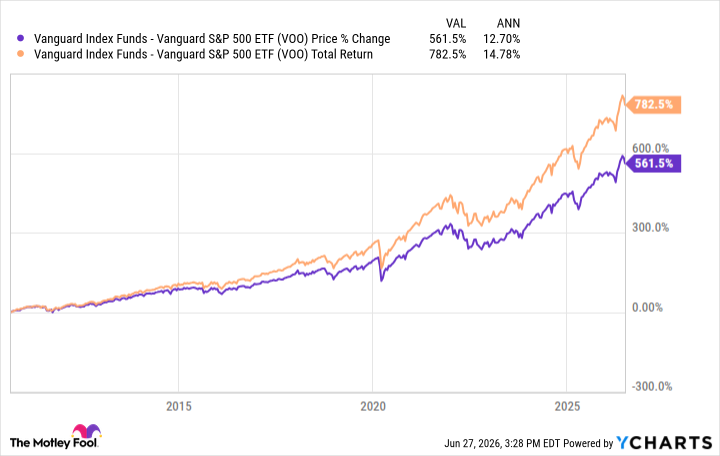
Past results don't guarantee future performance, but to see what VOO is capable of, let's take a look at its performance over the past 20 years. In that time, it has averaged 12.7% annualized returns (14.8% when including dividends). If we assume (huge emphasis on "assume") 12% to 14% annual returns continue, here is roughly how much different annual investments in VOO would grow to in 20 years:
| Annual Investment | Total Averaging 12% | Total Averaging 14% |
|---|---|---|
| $6,000 ($500 monthly) | $430,800 | $544,200 |
| $12,000 ($1,000 monthly) | $861,600 | $1.08 million |
| $18,000 ($1,500 monthly) | $1.29 million | $1.63 million |
Table by author. Returns reflect VOO's 0.03% expense ratio. Totals rounded down to the nearest hundred.
Expecting VOO to maintain those annual returns over the next 20 years is a tough ask, so let's consider 8% to 10%. Those are much closer to the long-term average for the S&P 500, and it's generally better to underestimate and be pleasantly surprised than to overestimate and fall short.
| Annual Investment | Total Averaging 8% | Total Averaging 10% |
|---|---|---|
| $6,000 ($500 monthly) | $273,600 | $342,400 |
| $12,000 ($1,000 monthly) | $547,300 | $684,900 |
| $18,000 ($1,500 monthly) | $820,900 | $1.02 million |
Table by author. Returns reflect VOO's 0.03% expense ratio. Totals rounded down to the nearest hundred.
Nobody can predict exactly how VOO (or any stock or ETF) will perform over the next 20 years, but history shows that VOO is one of the more reliable ways to grow wealth over time. The key is to remain consistent through the inevitable ups and downs and trust the power of compound interest.