Now that the dust has settled a bit from the massive June IPO of Space Exploration Technologies (SPCX +7.36%), or SpaceX, it looks like the company's $2 trillion-plus valuation isn't going anywhere anytime soon.
Does that mean the company could be a buy in July? Here's what investors should consider before jumping in.

Image source: Getty Images.
Beyond space
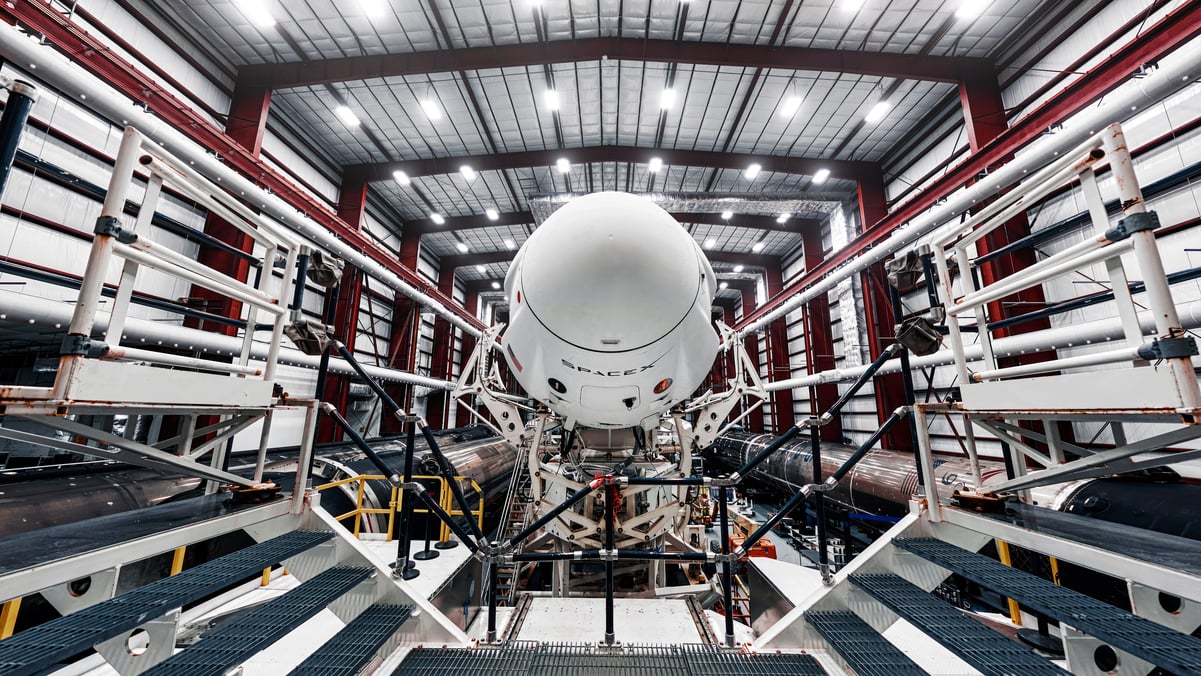
SpaceX is the leading space launch company in the world, and while it has a few noteworthy competitors, it dominates the launch market.
But that's not the big reason investors got so excited about SpaceX. Instead, they're banking on the company's pivot to artificial intelligence (AI). By entering what the company claims is a $26.5 trillion market for AI solutions, SpaceX has massive growth potential. This is true, as far as it goes: Obviously, any company entering a vast, untapped market has the potential to capture a massive share of said market.
The problem is that SpaceX isn't currently priced as though it has a massive potential market to tap; it's priced as though it's already captured a big share of that market.

NASDAQ: SPCX
Key Data Points
Over the trailing 12 months (TTM), SpaceX brought in revenue of $19.3 billion. It also generated TTM operating cash flow of $7.1 billion. Those aren't terrible numbers, but the company is currently being valued at over $2 trillion on the basis of those numbers, which is way out of line with any other company's valuation ... even companies already operating in the red-hot AI sector.
SpaceX's growth is already priced in
If SpaceX could rapidly grow its revenue and operating cash flow fivefold, its revenue and operating cash flow would indeed just surpass those of Broadcom (AVGO +3.35%), which currently has a $1.8 trillion valuation. But it still wouldn't be anywhere close to other similarly valued companies:
| Company | Market Cap | TTM Revenue | TTM Cash from Operations | TTM Net Income (Loss) |
|---|---|---|---|---|
| Meta Platforms (META +0.30%) | $1.51 trillion | $215 billion | $124 billion | $70.6 billion |
| Broadcom | $1.77 trillion | $75.5 billion | $33.6 billion | $29.3 billion |
| SpaceX | $2.1 trillion | $19.3 billion | $7.1 billion | ($8.7 billion) |
| TSMC (TSM +2.96%) | $2.38 trillion | $132.9 billion | $79.3 billion | $62.4 billion |
| Amazon (AMZN +1.32%) | $2.61 trillion | $742.8 billion | $148.5 billion | $90.8 billion |
| Microsoft (MSFT +0.92%) | $2.87 trillion | $318.3 billion | $170.1 billion | $125.2 billion |
TTM = trailing 12 months.
SpaceX would have to grow its revenue and operating cash flow tenfold to be roughly even with TSMC, and would have to grow them further to catch up to the other companies in the table above. And of course, it would have to achieve profitability, which the others already have.
In other words, why would you pay $2.1 trillion for SpaceX when, even if it grows tenfold, it still won't be bringing in as much revenue, cash, or profits as Meta or Microsoft is now?
Smart investors should avoid SpaceX until the company can show a clear pathway to the kind of explosive growth that would justify its sky-high valuation.