Is America still the best place in the world for Americans to invest? Recent research from Vanguard suggests that international stocks might offer stronger opportunities in the next few years.
The company's 2026 economic and market outlook said that "ex-U.S. equities" -- international stocks not including the U.S. -- are expected to deliver 4.9% to 6.9% average annual returns for the next 10 years, while U.S. stocks are expected to deliver only 4% to 5% returns. Another Vanguard report in June predicted that some of the best long-term gains from the artificial intelligence (AI) boom might go not to AI stocks, but to "developed markets outside the U.S." as global companies use AI to improve their operations.
Although Vanguard's research doesn't recommend any specific stocks or exchange-traded funds (ETFs), if you agree with this forecast, buying international dividend stocks could be a good strategy. That's because international stocks that pay high dividend yields tend to come from developed markets such as Japan, Canada, and Western Europe.
The Vanguard International High Dividend Yield ETF (VYMI +0.82%) and the Vanguard International Dividend Appreciation ETF (VIGI +1.33%) are two Vanguard ETFs that offer exposure to international dividend stocks. Both hold portfolios that include the types of stocks that Vanguard research says might outperform in the next few years.
But in the past 10 years, the Vanguard International High Dividend Yield ETF has delivered a total return of 188.1%, strongly outperforming the other fund:
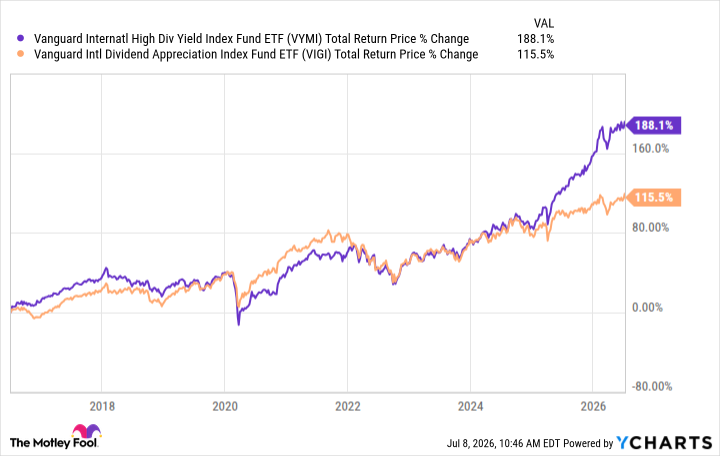
VYMI Total Return Price data by YCharts
Let's look at these two Vanguard international ETFs and see which could be a better choice for your investment dollars.
Vanguard International High Dividend Yield ETF (VYMI): 1,578 stocks, 10 years of 11.2% annualized returns
The Vanguard International High Dividend Yield ETF has had a strong recent run of performance. At recent prices, it has delivered a total return of 24% in the past year, which has outperformed the S&P 500 index.
VYMI Vanguard International High Dividend Yield ETF
NASDAQ · As of 4:00 PM ET 10/15/26
Over a longer-term time horizon, the fund's past performance is less strong, but still solid. This international ETF has delivered annualized total returns (by net asset value) of 22% for the past three years, 12.9% for the past five years, and 11.2% for the past 10 years. It charges a low expense ratio of 0.07%.
Could this fund be a good choice for the future? It holds a diversified portfolio of 1,578 global stocks. If you want developed market stocks, this fund can provide that exposure. Its portfolio consists of 43.7% European stocks, 23.8% Pacific region stocks, and only 22.8% emerging markets.
This ETF's top five countries included in the portfolio are Japan (11.5% of the fund), the United Kingdom (11%), Canada (8.9%), Switzerland (7.5%), and Australia (7.3%). The fund's top 10 stock holdings include international banks such as HSBC Holdings (HSBC +0.67%), pharmaceutical giants such as Roche Holding (RHHBY +1.96%), energy major Shell (SHEL -0.03%), and Australian mining company BHP Group (BHP -0.43%).
If you're concerned that U.S. tech stocks have gotten overheated, this fund can put your money to work in different parts of the global economy. Companies like these tend to be well-established and financially strong, which enables them to return lots of cash to shareholders. This dividend ETF has delivered a trailing-12-month dividend yield of 3.68%, which is higher than many of the best dividend index funds. And this fund has a price-to-earnings (P/E) ratio of 14.02, which makes it look much cheaper than the S&P 500 index earnings multiple of 25.37.

Image source: Getty Images.
Vanguard International Dividend Appreciation ETF (VIGI): 343 stocks, 10 years of 7.98% annualized returns
Another way to invest in international dividend stocks is to use the Vanguard International Dividend Appreciation ETF. This fund uses a different approach. Instead of more than 1,500 stocks, its portfolio holds only 343 stocks. This fund is even more focused on developed markets, with only 5.1% of its assets invested in emerging-market stocks. It charges the same low 0.07% expense ratio as the other Vanguard fund.
The Vanguard International Dividend Appreciation ETF has some of the same names as VYMI in its top 10 stock holdings. It owns international banks such as Royal Bank of Canada (RY +1.48%) and Mitsubishi UFJ Financial Group (MUFG -0.09%), pharma stocks such as Roche Holding and Novartis (NVS +2.38%), and German tech and industrial companies SAP (SAP +2.04%) and Schneider Electric (SBGSY -1.49%).
However, this fund has not performed as well as the other Vanguard international ETF. The Vanguard International Dividend Appreciation ETF has delivered average annual returns of 8% in the past year, 10.8% in the past three years, 4.6% in the past five years, and 7.98% in the past 10 years. It has underperformed the S&P 500 in all those time frames.
VIGI Vanguard Whitehall Funds - Vanguard International Dividend Appreciation ETF
NASDAQ · As of 4:00 PM ET 10/15/26
This dividend ETF is also lagging the other fund's dividend yield, with a trailing-12-month yield of 2.13%. And the Vanguard International Dividend Appreciation ETF has a more expensive P/E ratio at 19.33.
One possible risk of this fund is that its portfolio is less diversified than the other Vanguard ETF. The Vanguard International Dividend Appreciation ETF has almost 80% of its portfolio invested in its top five markets:
- Japan: 30.9% of the fund
- Canada: 23%
- Switzerland: 14.4%
- Germany: 5.5%
- United Kingdom: 5.6%
That's a rather highly concentrated bet on just a few countries. If any of those countries experiences an economic downturn or a weakening of its currency against the U.S. dollar, that could be bad news for American investors in this fund.
Why buy VYMI vs. VIGI
Recent Vanguard research says developed markets outside the U.S. could outperform in the next few years; both funds fit that strategy. And in case you're concerned about high valuations of tech companies, these international dividend stock ETFs tend to hold value stocks, not growth stocks. The companies represented in these funds are involved in different parts of the global economy that are less directly involved with the AI boom.
But the Vanguard International High Dividend Yield ETF is more diversified, its P/E ratio is lower, and it has a track record of paying a higher dividend yield in the past 12 months. I believe this fund is a better choice for most long-term investors who want exposure to high-yield dividend stocks outside the U.S. market.