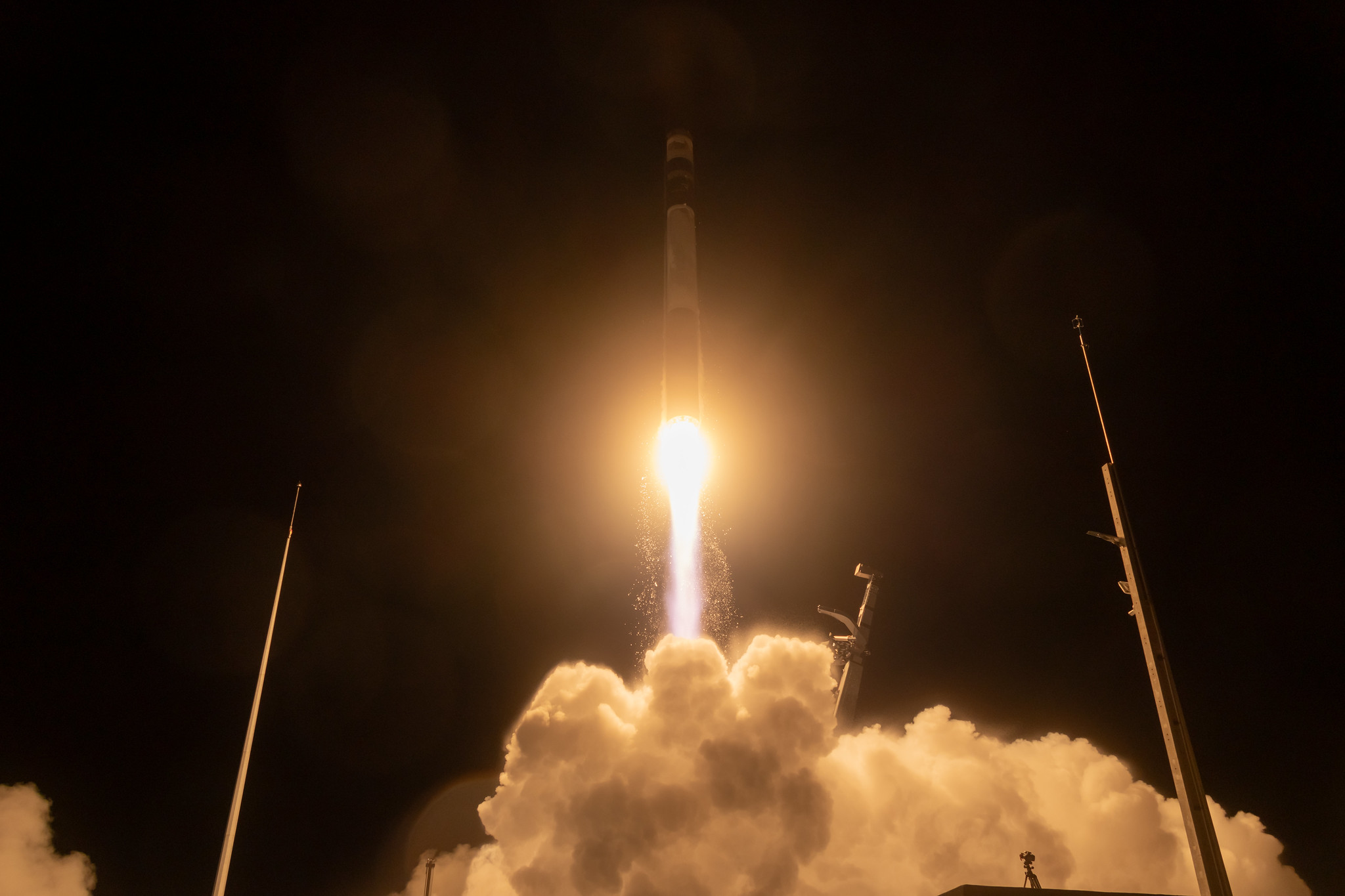
Reusable rockets are no longer a novelty, but there is still one piece of almost every launch that gets thrown away: the payload fairing, or the protective nose cone that shields the cargo on the way up. Rocket Lab (RKLB +2.32%) thinks it has solved that problem, and the solution has an unforgettable name.

Image source: Getty Images.
How the "Hungry Hippo" fairing works
On most rockets, the fairing splits into two halves and falls away during ascent, tumbling toward the ocean. Even the companies that recover fairings have to fish them out of the water and refurbish them.
Rocket Lab's approach, built for its upcoming medium-lift Neutron rocket, is different. The two fairing halves are hinged to the top of the first stage and never detach. Once the rocket climbs high enough, the halves swing open like a set of jaws -- the reason engineers nicknamed it the Hungry Hippo -- release the second stage and payload, then snap shut again in about 1.5 seconds.
Because the fairing stays attached, it rides back down to Earth with the first stage instead of being discarded. Rocket Lab qualified the design in testing and has been conducting final checks ahead of Neutron's debut.
RKLB Rocket Lab
NASDAQ · As of 4:00 PM ET 10/26/26

Why this technology matters
The appeal is economic. The fairing and the top of the rocket are among the most expensive structures on the vehicle, so recovering them in one piece with the booster removes a cost that rivals either eating or working hard to reclaim. It also simplifies the whole recovery process, which is the key to launching often and at low cost.
There is a second, subtler benefit. Because the second stage is tucked inside the fairing and shielded from wind and heat during ascent, it can be built lighter. A lighter upper stage can carry more payload to orbit, so the captive fairing improves both performance and reuse. Neutron is designed to lift 13,000 kilograms into low Earth orbit, powered by nine of Rocket Lab's own methane-fueled Archimedes engines.
The catch is that none of this has flown yet. Neutron's first launch has slipped several times and is now targeted for late 2026. A first-stage tank ruptured during a pressure test earlier this year, prompting a manufacturing change. A clever fairing means little until the rocket reaches orbit and the stage returns intact. Rocket Lab also remains unprofitable while funding this work.
The Hungry Hippo is a genuinely original idea, and if it works, it could make Neutron cheaper to reuse than partially reusable rivals like Space Exploration Technologies. But "if it works" is doing the heavy lifting here. The technology is worth watching, and the moment to watch for is Neutron's first flight and recovery, the real test of whether this design changes the game or just the vocabulary.