Warren Buffett last year prepared to vacate his spot in the driver's seat at Berkshire Hathaway and hand over the steering wheel to Greg Abel. But before he did so, he bought a few new stocks -- and one of them was UnitedHealth Group (UNH -1.62%), a down-but-not-out health insurance leader. As CEO of Berkshire Hathaway, Buffett added the stock to his portfolio in the second quarter of the year.
At the time, UnitedHealth was struggling with a number of challenges, but Buffett likely viewed it as a strong recovery story, particularly considering the company's market leadership: UnitedHealth is the country's biggest health insurer.
Earlier this year, though, Abel, in his first quarter as Berkshire Hathaway CEO, decided to cash out on this healthcare giant. He sold the entire position, or 5,039,564 shares. UnitedHealth previously represented 0.6% of Berkshire Hathaway's portfolio.
Now you may be wondering whether this stock, among one of Buffett's last stock picks as CEO, has reached its potential -- or if the stock is a steal at its current valuation. Let's find out.

Image source: Getty Images.
Buffett buys, Abel sells
First, let's consider why Buffett may have bought and why Abel may have sold. We don't know the exact reasons, as these investors only declare their trades publicly but aren't required to offer further details. Considering Buffett's investing focus on buying quality companies at reasonable or even bargain prices, we might deduce that he applied this idea when picking up the shares.
Buffett bought UnitedHealth in the second quarter, a time when valuation dropped sharply.
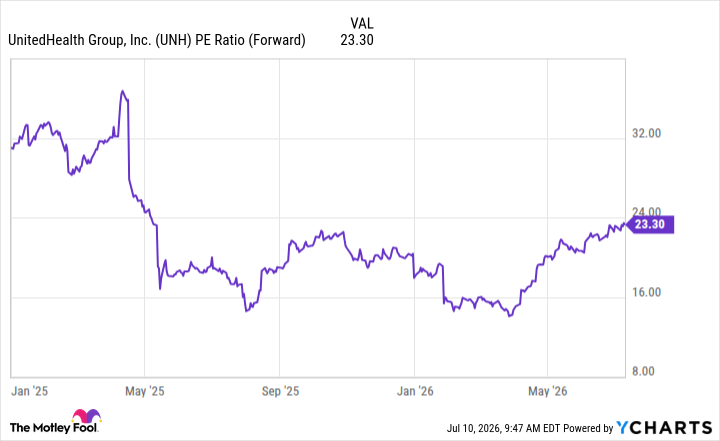
UNH PE Ratio (Forward) data by YCharts
The billionaire probably liked this price tag, along with UnitedHealth's strong moat or competitive advantage. The company dominates the U.S. health insurance market and has two enormous pillars -- the UnitedHealthcare insurance unit and the Optum healthcare services business. It would be very difficult for a rival to copy this model and unseat the market leader.
UNH UnitedHealth Group
NYSE · As of 4:00 PM ET 10/23/26

Meanwhile, UnitedHealth was making clear moves to spur recovery. The company, which struggled with increased patient use of healthcare and higher healthcare costs, cut certain plans and adjusted pricing, for example. UnitedHealth also invested in artificial intelligence (AI) to streamline certain processes and gain efficiency. And all of this has been progressively bearing fruit, as we've seen in recent earnings reports.
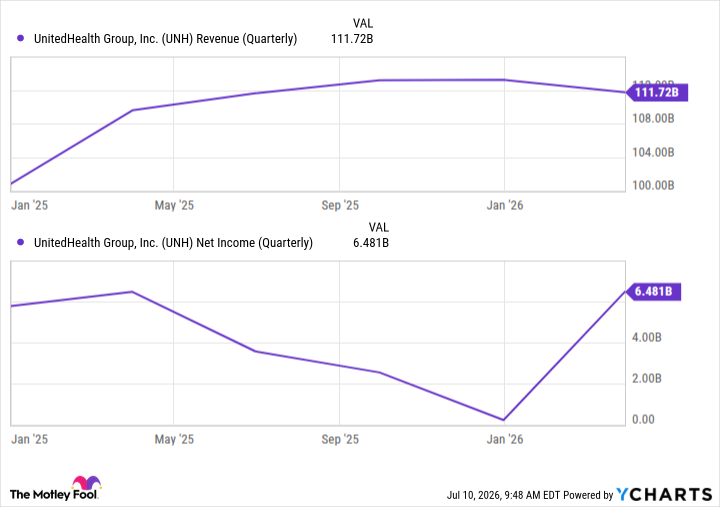
UNH Revenue (Quarterly) data by YCharts
Potential reasons for Abel's move
But at the start of this year, Abel decided to part ways with UnitedHealth. Again, we don't know the reasons behind his move. It may have simply been to free up more cash for other stocks that Abel aimed to include in the portfolio. Depending on the exact timing of Buffett's buy and Abel's sell, UnitedHealth could have delivered a gain of more than 20% to Berkshire Hathaway. (This is just an example of what might have happened -- we don't know the exact dates of the buys and sells, so we can't be sure of the return.)
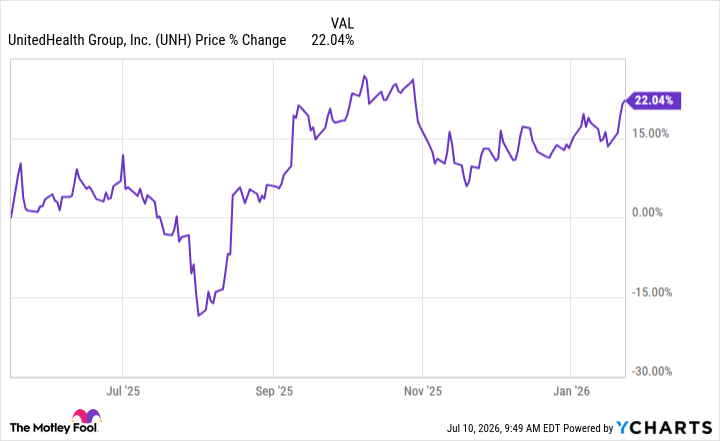
In any case, the move doesn't necessarily mean Abel doesn't like the stock or that it isn't right for your portfolio. It's important to keep in mind that professional investors often make moves to support a broader strategy -- so a "sell" doesn't always suggest the fund manager no longer believes in the stock's potential.
With this in mind, has UnitedHealth reached its maximum today? Or is the stock a steal?
At 23x forward earnings estimates, the stock is more expensive than when Buffett added it to the portfolio.
But, it's still cheaper than it was in the past -- and right now we might consider that revenue growth prospects are improving. This is considering the recent aggressive moves UnitedHealth has made to recover and favor growth moving forward.
All of this means that UnitedHealth may not be an absolute steal, but it remains reasonably priced. And that makes it a great healthcare stock to buy today and hold onto for the long term as this recovery story continues to unfold.