The old adage that you need money to make money is true, as the benefits of compounding are greater when an investment balance is large. Consider that the S&P 500 (^GSPC +0.73%) has averaged an annual return of 10% for decades. That means an investment might, on average, double after just over seven years. But if someone were to invest $1,000, the gain would be much more modest than if they invested $10,000 or $50,000.
That's why there's a strong incentive to invest a large lump sum for those who can afford to do so. Below, I'll look at whether a $50,000 investment in S&P 500 index funds today could grow to $1 million or more by retirement.

Image source: Getty Images.
The S&P 500 has generated strong returns, but they may be a bit more modest in the future
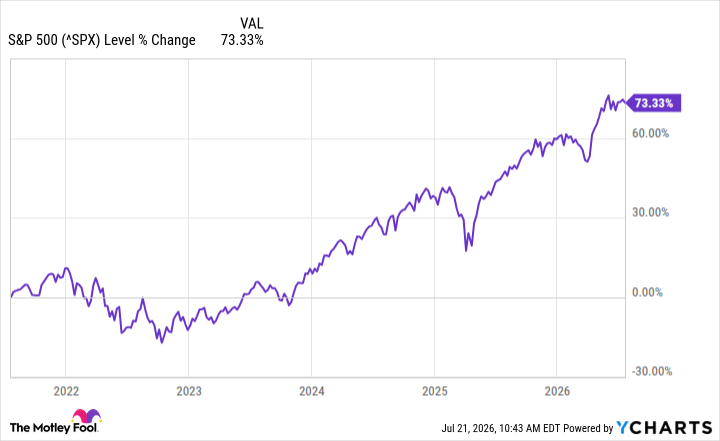
Estimating how large an investment in the S&P 500 might grow to be in the long run is no easy task, since it depends on assumptions about its future growth rate. What complicates matters is that the S&P 500 index has been performing well above average in recent years, and thus, it may be overdue for a slowdown. That means investing today could result in below-average returns in the future.
While the index has averaged returns of around 10% for decades, there have been periods when it's been far below that. Investing in an index fund that tracks the S&P 500 today might still be a good move, but investors may need to brace for lighter annual returns of around 9% or perhaps even 8%.
Here's how large a $50,000 investment might grow to be over the long run
Rather than picking a specific growth rate, I've created a table below showing what a $50,000 investment would grow to at varying rates over a very long time frame. It also demonstrates just how significant even a 1% change in the annual return can be for an investment in the long run.
| Year | 8% Return | 9% Return | 10% Return |
|---|---|---|---|
| 5 | $73,466 | $76,931 | $80,526 |
| 10 | $107,946 | $118,368 | $129,687 |
| 15 | $158,608 | $182,124 | $208,862 |
| 20 | $233,048 | $280,221 | $336,375 |
| 25 | $342,424 | $431,154 | $541,735 |
| 30 | $503,133 | $663,384 | $872,470 |
| 35 | $739,267 | $1,020,698 | $1,405,122 |
| 40 | $1,086,226 | $1,570,471 | $2,262,963 |
Table and calculations by author.
A $50,000 investment in an index fund tracking the S&P 500 can indeed grow to $1 million, but whether it gets there by retirement will depend on what the average annual return will end up being and how many years a person still has until retirement.
However, even for investors who may be worried about a slowdown ahead, it can still make a lot of sense to invest in a top index fund, as it remains a relatively low-risk way to invest in the stock market.