Caterpillar (CAT -6.91%) stock is up nearly 50% in 2026 and trading near record highs, driven by infrastructure build-outs associated with artificial intelligence (AI). Now that the stock is above $800 per share, the question arises: Will this Dow Jones Industrial Average (^DJI -2.19%) stock split?

NYSE: CAT
Key Data Points
The case for a split relies on the index's mechanics. The Dow is price-weighted, not market capitalization-weighted, like the S&P 500 (^GSPC -1.52%). This means higher-priced stocks exert outsize influence on the index.
As Caterpillar's price continues to increase, it skews the average. This is partially what pushed companies such as Apple and Nvidia to split in recent years.
The other reason is the "approachability" of the stocks for retail investors. If the price is lower, retail investors won't be scared off by the high per-share price.
While a split doesn't change the company's fundamental value, it's generally a bullish sign and a logical tool to keep enthusiasm high. This is why I think a split by Caterpillar is inevitable. Caterpillar also has a history of stock splits, the last of which was in July 2005.
Image source: The Motley Fool.
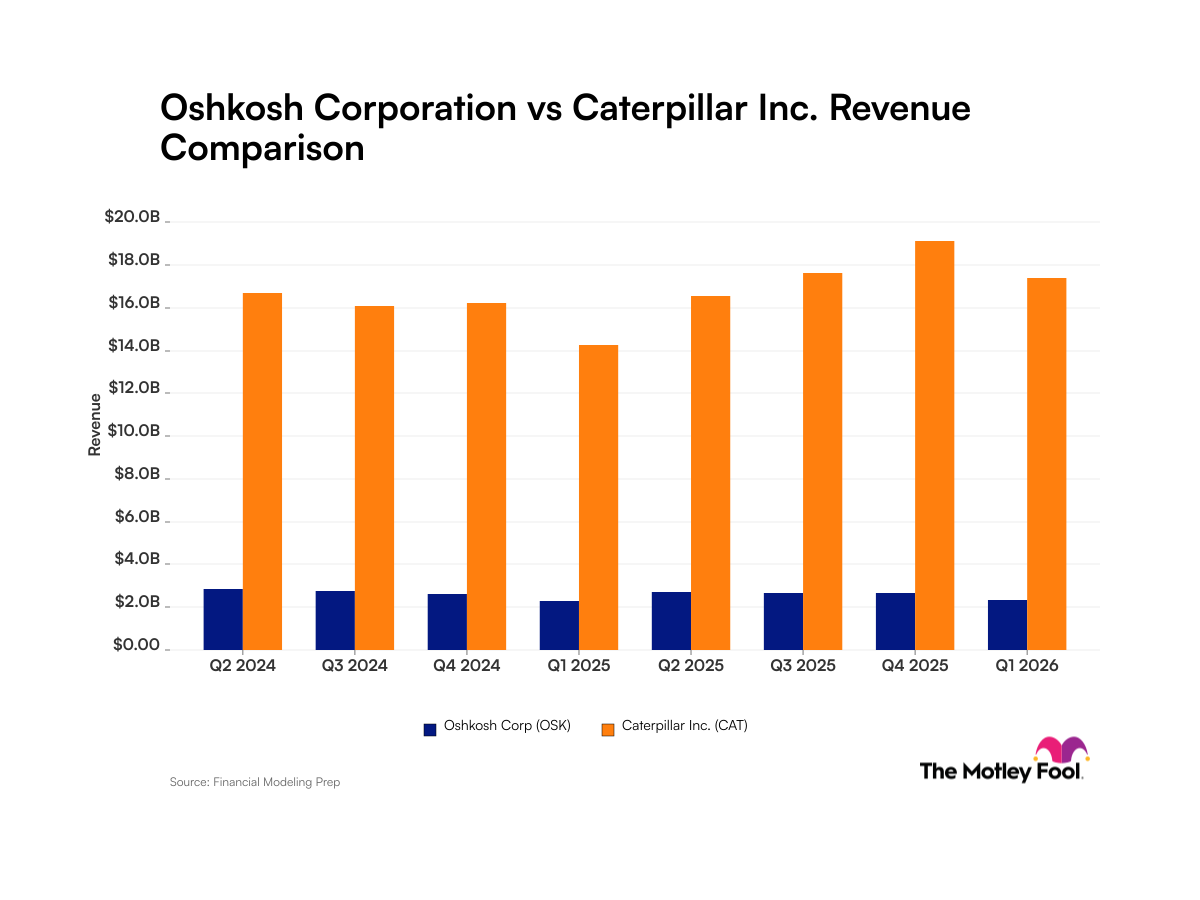
Caterpillar has a lot going for it right now. The construction equipment and heavy machinery company saw first-quarter revenue grow 22% year over year. The company also boasts a record backlog of almost $63 billion. This number has grown an astounding 79% since last year.
Investors will need to pay a premium for Caterpillar, as its forward P/E ratio has jumped to 36, well above the industry average. Still, Caterpillar is in incredible demand and has increased its dividend for 32 consecutive years. This isn't a cheap stock, but it's still a very reasonable long-term buy.
Caterpillar will likely split sometime in the near future. The company is riding a wave of highs, and a split makes complete sense at this point.