The Federal Open Market Committee's (FOMC) July meeting was divided. Three members dissented in favor of a rate hike, and Fed Chair Kevin Warsh made some conflicting statements during his post-meeting press conference. The FOMC's September meeting is now considered a toss-up.
According to CME Group's FedWatch tool, there's a nearly 55% likelihood the FOMC raises interest rates by a quarter point and roughly a 45% chance the Fed holds rates steady (as of Aug. 6).
This means that employment and inflation data over the next month and a half will be vital. The Fed recently released its August inflation forecast, and it could put the FOMC on a collision course ahead of the September meeting.

Image source: Getty Images.
Inflation is expected to reaccelerate after a soft June
The Federal Reserve Bank of Cleveland regularly maintains estimates of various inflation gauges for the upcoming month and, eventually, the month after. These estimates are known as Inflation Nowcasting, a useful resource for investors seeking to monitor inflation.
Inflation has really proven to be a mystery since the end of the COVID-19 pandemic. Prices soared in 2022 until the FOMC realized it was behind the eight ball, forcing the committee to impose multiple jumbo rate hikes.
Since then, inflation has slowed considerably but has not returned to the Fed's preferred 2% target. Some economists believe we might be there now, had it not been for President Donald Trump's high tariff rates and the Iran war, although there is strong debate regarding how much tariffs contributed to inflation.
The Fed began lowering interest rates last year due to concerns about a deteriorating labor market, but it has held rates steady since then. Now, the market seems to be more in the camp that rate hikes could be coming. At the last FOMC meeting, three of the 12 voting members preferred a rate hike.
Chair Warsh has consistently said that prices are too high, although he's been more vague about how he wants to measure inflation, which has confused the market. All of this makes inflation data between now and the Fed's September meeting incredibly important.
Here are Nowcasting's annual and monthly estimates for July inflation (as of Aug. 6), which will be reported this month, and August inflation, which will be reported next month. Keep in mind that estimates are updated each business day, so these could change.
| Monthly Estimate | July | August |
|---|---|---|
| Consumer Price Index (CPI) | 0.09% | 0.38% |
| Core CPI (ex. food and energy) | 0.21% | 0.20% |
| Personal Consumption Expenditures (PCE) | 0.19% | 0.36% |
| Core PCE (ex. food and energy) | 0.27% | 0.27% |
Data source: Federal Reserve Bank of Cleveland.
| Annual Estimates | July | August |
|---|---|---|
| Consumer Price Index (CPI) | 3.42% | 3.45% |
| Core CPI (ex. food and energy) | 2.52% | 2.43% |
| Personal Consumption Expenditures (PCE) | 3.69% | 3.79% |
| Core PCE (ex. food and energy) | 3.31% | 3.36% |
Data source: Federal Reserve Bank of Cleveland.
There's a lot to unpack here.
The Bureau of Labor Statistics (BLS) will release the July CPI data on Aug. 12, at which time CPI is expected to rise roughly 0.09% for the month and be up 3.42% year over year. Core CPI, which strips out more volatile food and gas prices, is expected to have risen 0.21% in July and up 2.52% year over year.
Now, I believe investors should discount the headline numbers, which are being heavily influenced by energy prices. If the core number comes in as estimated, that shows some monthly growth in prices and a year-over-year decline. Monthly core CPI growth was flat in June and up 2.6% annually.
Core PCE, the Fed's preferred gauge of inflation, is projected to come in a little hotter, up nearly 0.3% in July after rising 0.1% in June. The annual number is expected to be roughly the same as in June.
The looming collision course
The FOMC's September meeting is Sept. 15-16, meaning the committee will receive all of the July data and the August CPI, which is expected to be published on Sept. 11. However, the August PCE report will not be published until after the Fed's meeting.
Currently, though, Nowcasting estimates potentially put the FOMC on a collision course. Projected monthly core CPI growth of roughly 0.2% represents a reacceleration, although it is slightly below the average monthly core CPI growth over the past year.
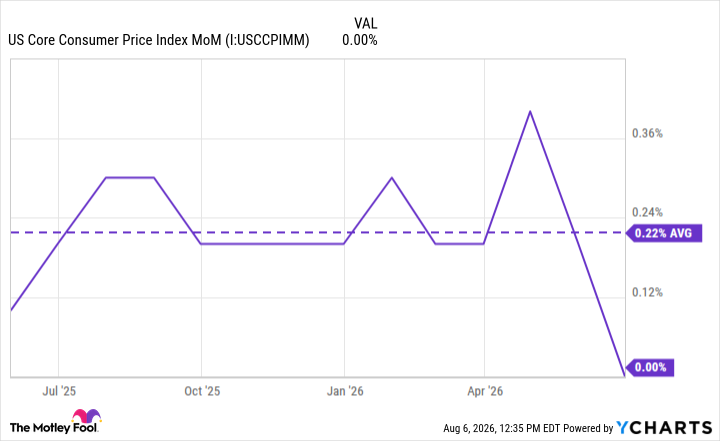
US Core Consumer Price Index MoM data by YCharts
I get the sense that this data point could add fuel to both the hawks and the doves. There were already three FOMC members in favor of a rate hike at the Fed's last meeting, and now inflation may be reaccelerating somewhat, which could push some FOMC members into the hawkish camp.
The doves could also argue that core CPI growth of 0.2% is softer than previously seen and does not necessarily signal an acceleration in inflation. The best thing to do is to continue to wait and see, they might argue.
Remember, these are just estimates, so we don't know how things will play out. Data above estimates would favor the hawks, while slower-than-expected inflation growth would favor the doves.
Either way, the FOMC is already divided, given the odd situation the economy finds itself in. Any further divide could lead to a split FOMC, setting up a rather interesting September meeting.