When I was a younger investor, I focused on buying stocks with yields of 10% or higher. I no longer invest that way; instead, I focus on the company before the dividend yield. If you are a dividend investor looking to create a reliable long-term income stream, you should tread carefully when considering ultra-high-yield stocks like AGNC Investment (AGNC +0.00%) and Ares Capital Corporation (ARCC +0.37%).
They aren't bad companies, but they come with an important risk you shouldn't ignore. Here's how you should think about stocks with yields that may seem too good to be true.

Image source: Getty Images.
My original logic and what changed my thinking
Investors generally expect the market to return around 10% a year over the long term. Early in my investing life, I decided that if I could get a 10% yield on a stock, I would be way ahead of the game. I ventured into some pretty obscure investments, took on risks I didn't realize I was taking on, and even took on some huge risks I recognized but took anyway. A number of my ultra-high-yield stocks blew up on me. Think bankruptcies that left me with nothing but worthless shares, drastic dividend cuts, and lots of tax loss harvesting opportunities.
To be fair, there were some success stories in the mix, too. But there were too many bad outcomes to justify the approach. I finally learned that while I may use yield to identify investment opportunities, the real work starts at the company level. For example, Realty Income (O +0.23%) with a 10% yield was a gem. But buying a mortgage REIT at the start of the Great Recession was an error in judgment.

NYSE: O
Key Data Points
Today, I focus on having a core of great businesses. Typically, I like to see stocks with decades of annual dividend increases (think Dividend Kings, with 50+ annual hikes). I still make mistakes, but I've dramatically cut down the error rate.
What about ultra-high-yield stocks
The big story here is that I have tried building a portfolio of ultra-high-yield stocks, and it didn't work as well as I would have liked. I don't recommend trying it. But that doesn't mean you can't own some ultra-high-yield stocks. They just shouldn't be the core of your portfolio because, too often, the dividend isn't sustainable.

NASDAQ: AGNC
Key Data Points
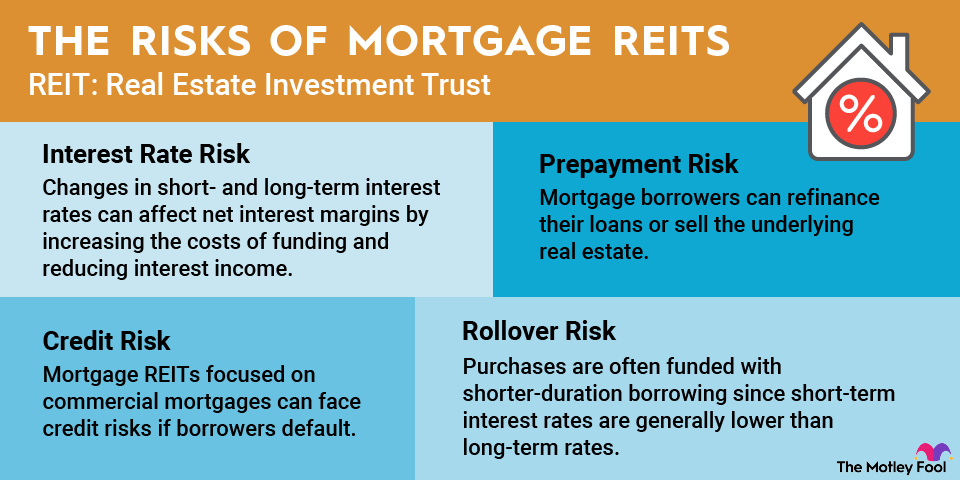
Some good examples are Ares Capital Corporation and AGNC Investment. One is a business development company (BDC), and the other is a mortgage real estate investment trust (REIT). They are both well-respected companies, and there's nothing particularly troubling about either business. And both have dividend yields of roughly 10% or higher.
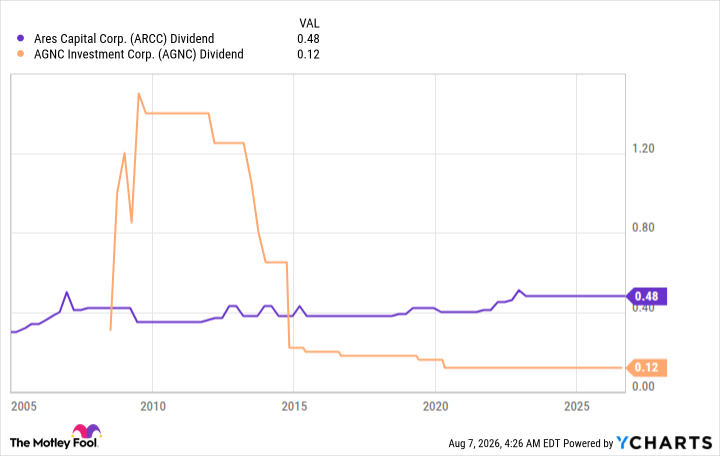
ARCC Dividend data by YCharts
However, if you examine their dividend histories, you see considerable variability. They are both designed to pass income on to investors, but their dividends fluctuate. You simply can't look at the dividend yield at any given time and extrapolate the income stream into the indefinite future, as you might with high-performing Dividend King consumer staples companies like Procter & Gamble (PG +0.38%) or Coca-Cola (KO -0.33%).

NASDAQ: ARCC
Key Data Points
However, if you have a strong foundation of reliable dividend stocks, there's no reason why you can't buy an ultra-high-yield stock like Ares Capital Corporation or AGNC Investment. But you should look at the dividends as "extra", something to pay for eating out and trips, not something you rely on to buy groceries every week.

NYSE: CAG
Key Data Points
The same sentiment would apply to a struggling business, leading investors to dump the stock and push the yield higher. Think of a company like food maker Conagra (CAG -2.39%). The dividend yield may spike to lofty levels, but if the business can't sustain the dividend, the dividend will be cut. Which is what happened with Conagra. Conagra will likely turn its business around and resume dividend growth in time, but you shouldn't fill your dividend portfolio with struggling companies if you need your dividends to live on.
How many ultra-high-yield stocks should you own?
There's no real answer to how many ultra-high-yield stocks is the right number. It is probably better to think of it as a percentage. For most, 10% of a portfolio in more speculative investments is probably a reasonable amount. That could be one investment or a dozen, but remember that maintaining a portfolio requires effort. So, perhaps, two or three stocks wouldn't be too much extra effort. But much more than that may end up being a material distraction from the hard work of monitoring your core portfolio of lower-yielding, more reliable dividend stocks.