Legendary hedge fund investor and billionaire Bill Ackman went all in on Uber Technologies (UBER +0.58%) at the start of 2025, but more than a year and a half later, his $2 billion investment in the rideshare operator hasn't gone very far. He's still probably up on his investment, having reportedly bought most of his shares in early January 2025, but after a surge to over $100 per share, the stock is off 25% from its highs and up only about 15% from early January 2025.
When Ackman revealed his stake in Uber in February 2025, he called it "one of the best-managed and highest quality businesses in the world." He said the long-term risk from autonomous driving looked limited, believing these companies are more likely to partner with Uber given its scaled network.
He also noted that delivery, which makes up half its bookings, is unlikely to be affected given the need for a person to pick up and deliver the food. Ackman also believed the company was well positioned to see rapid earnings growth in the medium term coming from a combination of strong revenue growth and expense control.

NYSE: UBER
Key Data Points
Bullish thesis remains on track
Ackman's thesis that Uber would see strong operating leverage and brisk earnings growth has largely been playing out, even if the stock hasn't always followed suit. The stock immediately fell in the aftermath of its Q2 results, reported before the bell on Aug. 5, although it has since rebounded.

Bill Ackman. Image source: Getty Images.
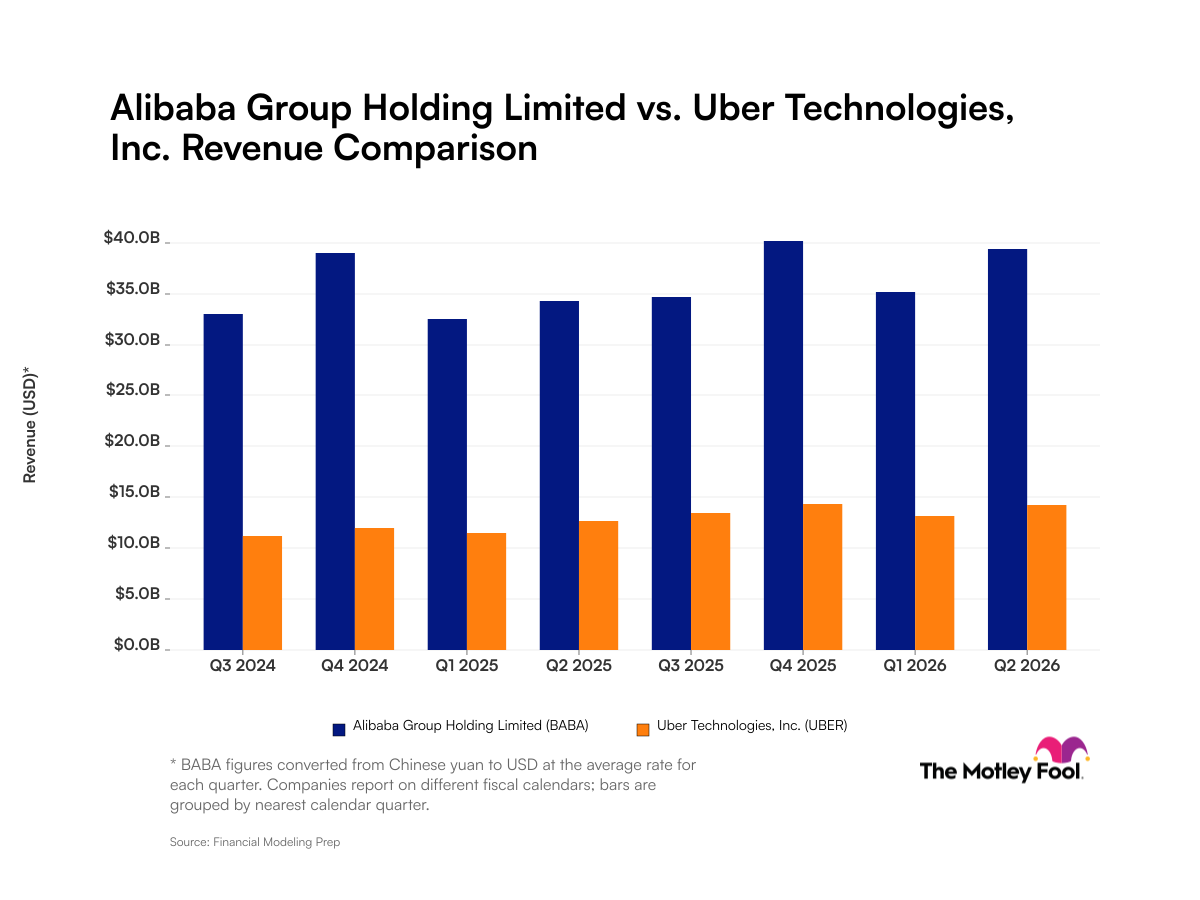
For the quarter, Uber's revenue climbed 12% year over year, or 11% on a constant currency basis, to $14.19 billion. However, it saw an 8-percentage-point headwind because of a business model change in some international markets that affected its accounting.
The change stems from laws in the U.K. and some other European countries that require the company to classify drivers as workers rather than independent contractors, shifting how things such as fares and drivers' earnings affect revenue in these markets. However, the reclassification doesn't affect other metrics such as operating income, adjusted EBITDA, or free cash flow.
Nonetheless, the revenue number came up just short of the analyst consensus for revenue of $14.24 billion, as compiled by LSEG, and its guidance was below expectations.
Both the company's main segments -- mobility (rideshare) and delivery (home to UberEats) -- saw strong gross bookings (the total dollar amount billed to customers) in Q2. Mobility gross bookings climbed 22% to $29 billion, although its revenue rose by just 1% to $7.4 billion because of the business model change. Segment adjusted EBITDA, however, climbed 28% to $2.2 billion. Its U.S. mobility operations benefited from the World Cup, as well as newer offerings like U4B, or Uber for business.
Delivery gross bookings climbed 26% to $27.5 billion, while revenue grew 28% to $5.2 billion and segment EBITDA increased 38% to nearly $1.1 billion. The company also announced earlier that it will acquire Germany's Delivery Hero to help expand its international presence.
Uber's overall gross bookings rose 24% year over year in the quarter, while trips in the quarter climbed 18% to 3.9 billion. Showing strong operating leverage in the business, adjusted EBITDA surged 33% to $2.8 billion, while adjusted EPS soared 35% to $0.81. However, that just met analyst EPS estimates.
Looking ahead, the company forecast gross bookings to rise between 18% and 22% to a range of $58.25 billion to $60.25 billion. It projected that adjusted EPS would increase to a range of $0.84 to $0.88, representing growth of 28% to 35%. That was below the $0.89 analyst consensus, according to LSEG.
Is the stock a buy?
Trading at a forward P/E of 17 based on 2027 analyst estimates, Uber's stock is attractively valued given the strong bookings growth and operating leverage its business is seeing. The company isn't sitting still, with new offerings, such as U4B, and expansion into lower-density markets representing solid growth opportunities. Meanwhile, the acquisition of Delivery Hero should help it scale its delivery network in international markets via its various brands.
The ultimate impact of robotaxis on its business remains a question, but the company is investing in the space with various partners and targeting being in 15 cities or more by the end of 2027. It looks as if the company should continue to play an important role in the rideshare and delivery markets in the future. Given its current valuation, I think the stock looks attractive at current levels.