The timing can certainly be debated, but I think the artificial intelligence (AI) boom began in November 2022, when OpenAI released ChatGPT, which amassed 100 million users in just two months. However, many companies were developing and even successfully monetizing AI long before that moment.
Upstart (UPST +8.84%) has developed AI models to assess the creditworthiness of potential borrowers for its lending partners since 2014. In many cases, those models are more reliable than the best human-led assessment methods, which still rely on Fair Isaac's FICO credit scoring system.
Upstart's revenue soared during the first half of 2026, and yet its stock is down almost 35% for the year (as of Aug. 12). I think the market is too pessimistic. Here's why I predict the stock will double by the time we enter 2027.

Image source: Getty Images.
Upstart's AI assessment methods are transformational
Upstart's AI algorithm considers more than 2,500 data points to determine a potential borrower's creditworthiness, and it can do so almost in real time to deliver rapid decisions. It would take a human assessor days or even weeks to process an equivalent amount of data. Moreover, the FICO credit scoring system that most banks rely upon only considers five key metrics, including a person's existing debts and repayment history.
Upstart's AI-powered approach is proving superior in practice because its underwriting model is now 2.74 times as accurate as a traditional credit model, and it's constantly improving as it ingests more data. The result is a better overview of the risk posed by each loan to the bank that originates the loan, potentially leading to higher approval rates and more suitable interest rates for each borrower. That is why a growing number of banks turn to the company to assess loan applicants.
Upstart approved a record 558,014 loans worth $4.2 billion during the second quarter, and both numbers grew by 50% year over year. Unsecured personal loans continued to be the company's bread and butter, accounting for $3.6 billion of that total. But originations in the secured category -- which includes car loans and home equity lines of credit (HELOCs) -- soared by 218% to a record $589 million.
Those numbers are a drop in the bucket compared to Upstart's long-term opportunity. Chairman Dave Girouard believes AI will replace human-driven loan assessment methods during the next decade, leaving $25 trillion in global originations and $1 trillion in fee revenue on the table for the companies that are leading the transition.
UPST Upstart
NASDAQ · As of 4:00 PM ET 10/15/26

Rapid revenue and earnings growth
Upstart doesn't lend its own money to consumers, except in some cases where it's conducting research and development. It gets paid a fee by banks and other funding partners to use its AI technology to originate loans on their behalf, so it has a relatively low-risk business model.
The company generated $364.7 million in revenue during the second quarter, a robust 42% increase from the year-ago period. It also delivered $16.5 million in generally accepted accounting principles (GAAP) net income, nearly triple its year-ago result of $5.6 million.
Upstart also generated $76.9 million in adjusted (non-GAAP) earnings before interest, tax, depreciation, and amortization (EBITDA) in the second quarter, up 45%. This is the company's preferred measure of profitability because it excludes one-off and noncash expenses such as stock-based compensation.
Simply put, Upstart is growing quickly and profitably, which isn't always easy.
Why Upstart stock could double by 2027
Aside from Upstart's consistently strong operating performance, its valuation is the other big reason I think its stock could double during the next few months. It's trading at a price-to-sales (P/S) ratio of just 2.6 as I write this, far below its three-year average of 5.5.
Further, management forecasts $1.4 billion in total annual revenue for 2026, placing Upstart stock at a forward P/S ratio of 2.1.
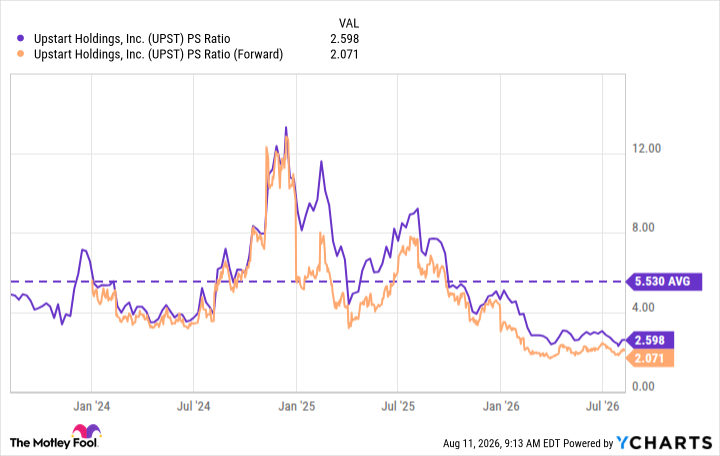
UPST PS Ratio data by YCharts
That suggests Upstart stock would have to soar by 162% by the end of this year just to match its three-year average P/S ratio of 5.5. In my opinion, the stock is trading at a discount right now because interest rates may rise during over the next few months, which could slow the economy and reduce consumer demand for credit. However, Upstart proved its ability to navigate high interest rates in 2022 and 2023, and its business emerged stronger than ever.
If rates don't rise, I think investor sentiment will improve, and the stock will have an easier path to double from here. In any case, I currently own the stock myself, and I don't plan to sell before the end of 2026.