Oracle (ORCL +0.49%) stock has plummeted by 56% from last year's record high, but I'm not convinced this is a good buying opportunity. Although the company operates some of the world's best data centers for processing artificial intelligence (AI) workloads, investors are concerned about its substantial debts, especially because some of its top customers could struggle to fulfill their financial obligations over the next few years.
Oracle will have an opportunity to ease some of those jitters in early September when it releases its financial results for its fiscal 2027 first quarter (ending Aug. 31), but here's why the report -- expected on Sept. 8 -- probably won't turn sentiment around.
Image source: The Motley Fool.
There is a problem with Oracle's $638 billion order backlog
Oracle has a diverse business spanning enterprise software, database systems, AI infrastructure, and more. All eyes are on the cloud infrastructure segment right now, which is where the company logs the revenue it earns from renting data center computing capacity to AI customers.
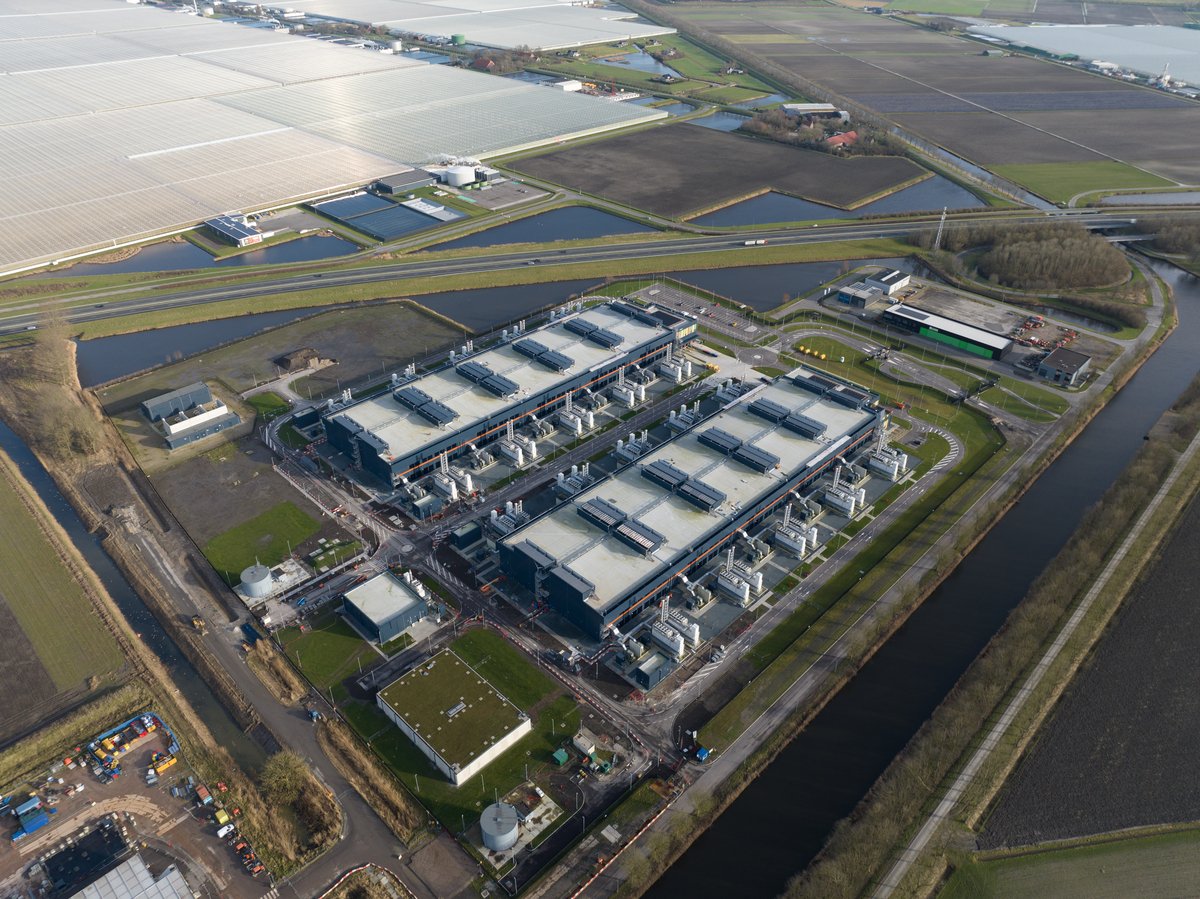
Oracle's data centers are filled with thousands of advanced chips from suppliers like Nvidia and Advanced Micro Devices, connected by proprietary random direct memory access networking (RDMA) technology that moves information between components faster than traditional Ethernet networks. Moreover, Oracle's infrastructure is highly automated by software, so the company can bring new locations online faster than competitors that rely on human-led processes.
Those features combine to provide AI developers with fast processing speeds at an affordable price, which is why companies like OpenAI, Elon Musk's xAI, and Meta Platforms are lining up to use Oracle's infrastructure.
ORCL Oracle
NYSE · As of 4:00 PM ET 10/23/26

The company generated $19.2 billion in total revenue during its fiscal 2026 fourth quarter (ended May 31), a 21% increase from the year-ago period. Cloud infrastructure accounted for $5.8 billion of that revenue, and it grew at a significantly faster pace of 93%. But Oracle's remaining performance obligations (RPO) were the headline number in the fourth-quarter report, soaring by 363% to a record $638 billion.
RPO reflects the value of signed contracts for services that haven't been delivered yet, so it's like an order backlog, and it's often used as an indicator of future revenue. Most of the $638 billion is from AI customers waiting for more data center infrastructure to come online -- but therein lies a big problem. According to a report by The Wall Street Journal from last September, around $300 billion of Oracle's RPO was from OpenAI alone.
However, OpenAI currently has just $40 billion in annualized revenue and is losing truckloads of money, so there is a serious question mark over the start-up's ability to fulfill its financial commitment to Oracle over the next few years. To make matters worse, OpenAI has made similar commitments to other cloud providers like Microsoft, making it even more unlikely that Oracle will see the entire $300 billion.
A cheap stock isn't always a good stock
The main reason Oracle's RPO conundrum is so concerning is because the company is taking on a mountain of debt to build more data centers, so if it can't convert its backlog into revenue, it could find itself in a dire financial position in the future. As of May 31, it was sitting on $122 billion in long-term debt, and it has since announced plans to raise a further $40 billion through a mix of debt and equity.
That risk is now being reflected in Oracle's valuation. Its stock was trading at a price-to-earnings (P/E) ratio of 24.7 as of the market close on Wednesday, Aug. 19, making it cheaper than both the S&P 500 and Nasdaq-100 indexes, which had P/E ratios of 26.5 and 35, respectively. Simply put, investors seem unwilling to pay a market multiple for the stock, despite the incredible growth in the AI infrastructure business.
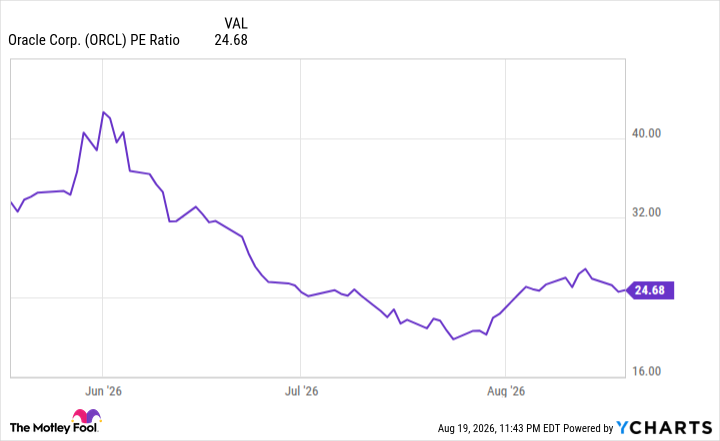
ORCL PE Ratio data by YCharts
When Oracle releases its fiscal 2027 first-quarter financial results in early September, management might be able to ease Wall Street's concerns by providing an update on the composition of its RPO. If the backlog is less concentrated than before, investors might feel better about the company's ability to convert most of it into revenue. Management might also commit to avoiding additional debt.
Despite Oracle's seemingly attractive valuation, I personally don't feel comfortable buying its stock ahead of its upcoming report, because the severe risks facing the business can't be fully resolved in a single quarter.