For those investors old enough to remember it, the dot-com mania of the late-1990s was an amazingly bullish time for the stock market. You'll also remember that the crash that began in March of 2000 was nothing less than miserable.
All told, the S&P 500 (^GSPC -0.06%) fell 50% from its then-peak to its October 2002 trough, and it wouldn't revisit that peak again until the middle of 2007 ... right before the subprime mortgage meltdown wrecked the market once again with an even bigger sell-off.
And yet, for investors with enough patience to ride out these very rough patches, stocks still offer tremendous long-term upside. Here's the math.

Image source: Getty Images.
Patience clearly pays off
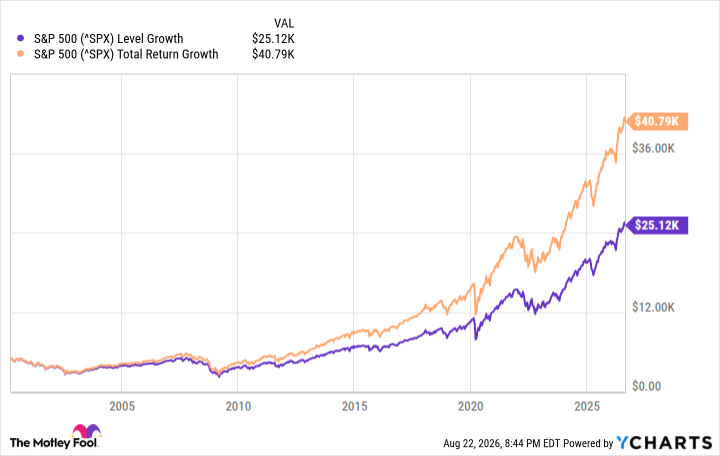
It's true: Even if your timing was incredibly unlucky, and you made a major investment in the market -- perhaps in the form of an investment in an S&P 500 index fund -- at its peak of 1,552.92 in March of 2000, you'd still be well up. The S&P 500 is trading at above 7,670 today, or nearly 400% above that high. In more relatable terms, a $5,000 investment in the S&P 500 then would be worth roughly $25,120 today.
And that's without reinvesting any dividends paid in the meantime, by the way. If you had put those cash payments back to work in the S&P 500 as they were issued, you'd now have roughly $40,790.
Time heals all wounds
Past performance is never a guarantee of future results, of course. However, the numbers paint a pretty clear picture of what's possible, even if you're unlucky enough to buy in at the worst possible time. In the long run, just being in -- and staying in -- the market can undo a great deal of bad luck.