AGNC Investment (AGNC -0.11%) has an eye-popping dividend yield of more than 13%. A yield that high is almost always a trap. However, I think AGNC is a bargain, at least in the current market environment.
I'm going to lay out the case for why the real estate investment trust (REIT) could be a classic dividend yield trap and why I think it's actually a bargain right now. Unraveling that tension should aid you in deciding whether a big-time yield belongs in your portfolio.

Image source: Getty Images.
The case for a trap
A yield trap is a stock with a currently high dividend yield that its underlying financials can't support indefinitely. AGNC Investment has been such a trap in the past, evidenced by the series of dividend cuts it has made over the years:
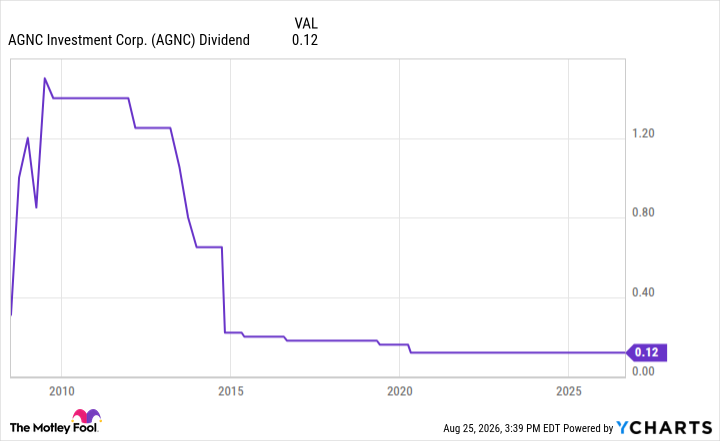
AGNC Dividend data by YCharts
There's a real risk that it might need to cut its dividend again. The mortgage REIT invests solely in Agency MBS (pools of residential mortgages guaranteed against credit losses by government-sponsored enterprises such as Freddie Mac). That leaves it highly exposed to changes in interest rates and other market risks. It also invests on a leveraged basis, which can work both ways, boosting its returns during favorable market conditions and negatively impacting them when they deteriorate. If there's another major credit market upheaval, AGNC might need to cut its dividend again.
The case for a bargain
AGNC Investment isn't like other REITs. It doesn't own a portfolio of rental properties that generate stable income. It actively invests in Agency MBS to earn a leveraged return above its cost of capital (including operating costs and dividend payments). It routinely raises new capital by selling additional shares to grow its MBS portfolio.

NASDAQ: AGNC
Key Data Points
The REIT's CEO, Peter Federico, highlighted on the second-quarter earnings conference call that it can currently earn returns in the 15% to 17% range when it leverages its capital within its 7.0-7.5 times target range. It can currently raise equity capital at a yield slightly above 13%, allowing it to make accretive new investments. It raised $167 million of equity capital during the second quarter. That enabled it to grow its portfolio (from $94.7 billion at the end of the first quarter to $97.2 billion at the end of the second) and its book value per share (up 2.4% to $8.58).
Federico noted on the call that the current return on equity range "aligns really well with the economics of our dividend." That alignment is why it has been able to maintain its payment for 75 straight months.
Today's bargain could be tomorrow's trap
I think AGNC is a bargain, not a trap, because its dividend aligns with its current returns. However, that's because the market environment is favorable these days. Federico commented in the earnings press release that "favorable dynamics should be supportive of Agency MBS performance over the near to intermediate term and position AGNC to continue to deliver strong risk-adjusted returns for our stockholders."
The rub here is that the currently positive market environment, which includes elevated mortgage rates, strong MBS demand, and historically wide mortgage spreads, won't last forever. If the Federal Reserve makes an abrupt, unexpected policy shift, market dynamics could move in the opposite direction. That makes AGNC Investment a riskier income stock. Investors need to keep an eye out for any signs that it's turning from a bargain to a trap.