According to prediction platform Polymarket, the chances of the U.S. experiencing a recession before the end of this year or the end of 2027 are 8% and 34%, respectively (as of Aug. 25). Only time will tell how it plays out, but one thing remains true: It's always better to be overprepared than underprepared.
Recessions are a natural part of the economic cycle, so it's never too early for investors to position their portfolios accordingly. One of the best investments to own while approaching or during a recession is the Vanguard Morningstar Total Stock Market ETF (VTI +0.63%). It lets you invest in the entire U.S. stock market with a single investment, covering a lot of ground.

NYSEMKT: VTI
Key Data Points
There's value in keeping it broad
VTI holds 3,515 stocks covering small-cap, mid-cap, and large-cap, so it's as close to a one-stop shop as you'll find (minus international stocks). Being broad works in VTI's favor during recessions because it reduces reliance on a single industry or market-cap segment.
It first began trading on May 24, 2001, and since then, it has experienced three recessions: the dot-com bubble, the financial crisis, and the COVID-19 pandemic. Still, it has weathered each storm and produced decent gains. VTI's 7.8% average annual returns since its inception aren't eye-popping by any means, but it has still outperformed the S&P 500.
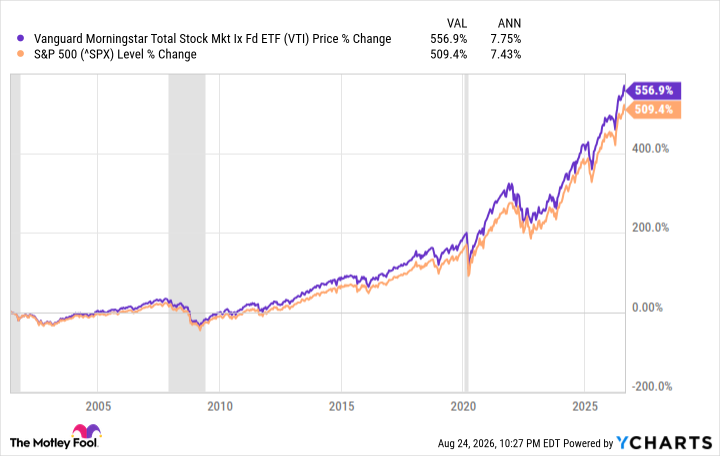
VTI data by YCharts. Vertical grey bars represent U.S. recessions.
Past performance doesn't guarantee future performance, but it's encouraging to see how resilient the U.S. market has been, even through some of the country's worst economic periods.
Why VTI over the S&P 500?
The S&P 500 is an investment I'll always endorse and invest in, but when it comes to recessions, VTI has a slight advantage because it has less concentration risk. Every S&P 500 company is in VTI, but the small-cap and mid-cap companies VTI holds provide exposure to the economy's full recovery potential.
Smaller companies typically experience sharper drops during recessions, but they also tend to rebound faster in the early phases of economic recovery. There are, of course, exceptions to every rule, but that's the general trend that has historically happened.
That doesn't mean it'll continue to happen, but in either case, you can't go wrong with being invested in the U.S. stock market as a whole. The one thing to keep in mind is the importance of staying the course and being consistent.
It can be tempting to try to time the market (like holding off on investing, anticipating a market drop), but that generally doesn't work in an investor's favor because doing so consistently is nearly impossible. Stick with VTI and trust its long-term return potential, recession or not.