Artificial intelligence is changing the landscape in the technology sector. So, as Tim Cook gets set to retire from the CEO spot at Apple (AAPL +1.07%) on Sept. 1, investors should probably anticipate some change. But will the stock's performance follow the trend set by Amazon (AMZN -1.25%), which has underperformed since Jeff Bezos stepped down as CEO?
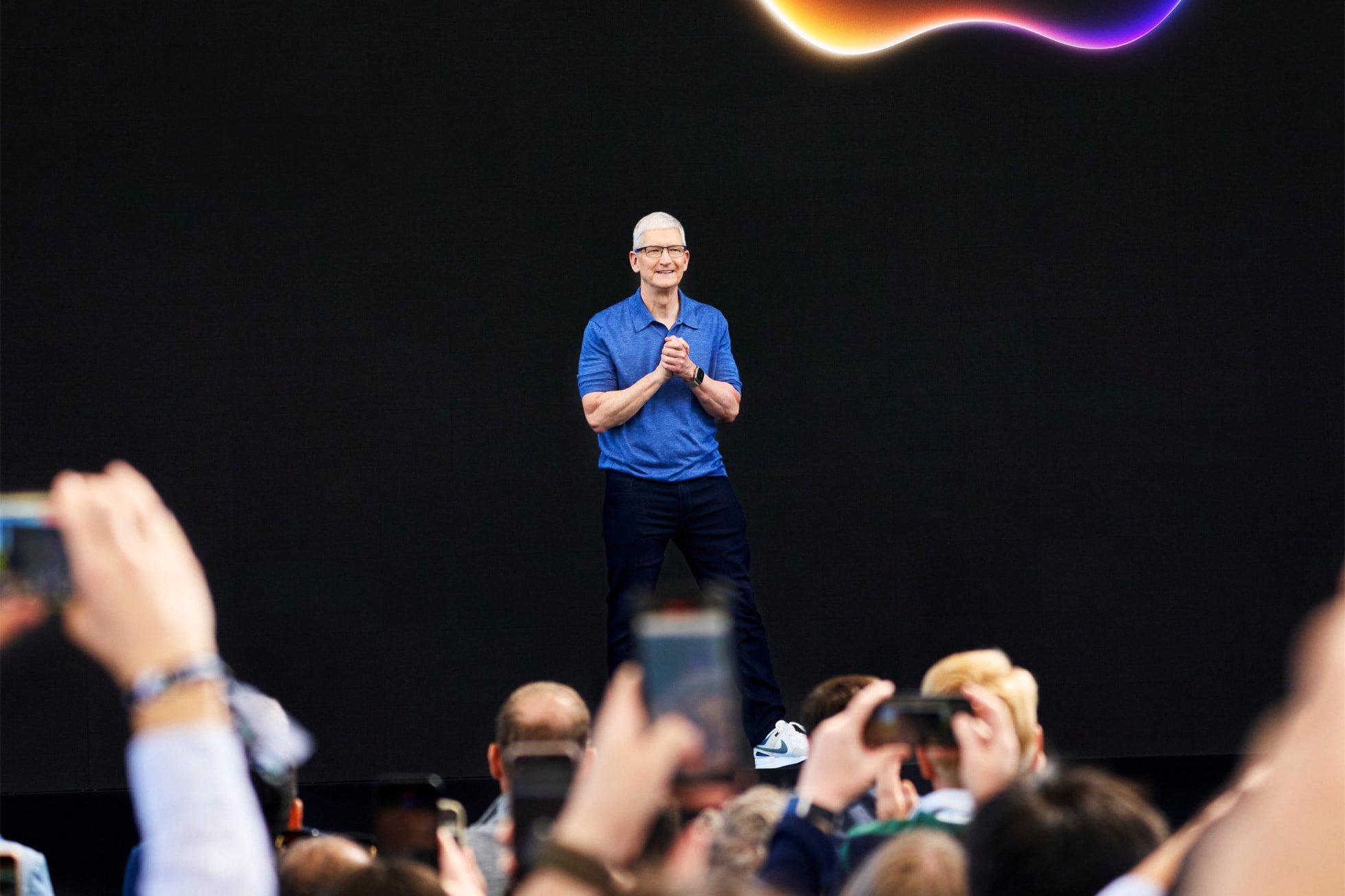
Image source: Apple.
What happened to Amazon?
Jeff Bezos helped turn Amazon into an industry-leading technology company, taking it from an e-commerce disruptor selling books to a diversified technology services company. There's no question that he was an important figure at the company. However, he stepped down as CEO in mid-2021. Since that point, Amazon's stock has been a laggard.
As the chart below highlights, Amazon's roughly 50% price advance is well behind the over 100% gain of the Nasdaq-100 and the roughly 90% rise in the S&P 500 index (^GSPC -0.76%), as of this writing. To be fair, Bezos was at the helm while the company was still a relatively small business, so growth was much easier to achieve. Today, Amazon is a $2.8 trillion market cap technology giant. It is much harder to grow a large business, as it often requires massive capital investments.
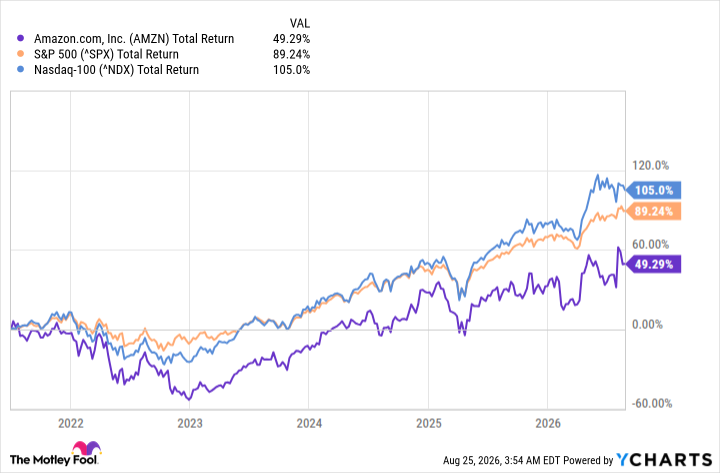
AMZN Total Return Level data by YCharts
That, of course, is showing up in the artificial intelligence (AI) spending underway today. AI really only started to take off after Bezos stepped aside. Although there is massive spending across the industry, Amazon alone is expected to invest $220 billion in 2026. While the now-giant Amazon hasn't kept up with the broader market, it has continued to cement its position as an industry leader. This dynamic is important to keep in mind as you consider Tim Cook's departure from Apple.
Tim Cook is stepping aside as the AI race heats up
Could Apple underperform after Tim Cook leaves? Yes, and the timing of his exit is important because it coincides with the world's big AI technology transition. Under Cook, Apple hasn't taken as aggressive a stance in the AI race, focusing on using AI to enhance its products rather than trying to be a hyperscaler like Amazon, which is building massive AI data centers. That's the path he's laid out for his successor, but it is too early to know if it is a good or bad direction.
The benefit for Apple is that it isn't spending as heavily on AI infrastructure as its technology competitors. The risk is that Apple ends up left behind in a fast-developing market. Right now, given that Apple's stock is trading within 10% of its all-time high, it seems like investors like the plan. Indeed, there is increasing concern about the amount of money being spent on AI infrastructure by companies like Amazon. But investor enthusiasm for Apple's approach could quickly shift in a highly competitive industry as the AI space continues to evolve.

NASDAQ: AAPL
Key Data Points
There is always uncertainty, and each company charts the course it thinks best. But even the best-laid plans sometimes fall short. It is almost a certainty that Apple will eventually go from industry leader to industry laggard at some point in the future. It has happened before. Whether that occurs after Cook leaves is hard to say, but it is possible. And it will likely depend heavily on the AI decisions currently being made.
Focus on the big picture, not the CEO
Good companies adjust to market conditions, as Apple has many times in the past. So, too, has Amazon. Moreover, a CEO doesn't operate in a vacuum; they have a team behind them. So Apple's differentiated approach to AI isn't of Cook's sole design. In other words, don't expect a dramatic change in the company's business direction until it is clearly out of step with AI's trajectory or with shifts in consumer demand. That's the real takeaway.
The company has made a strategic bet. Whether or not Apple leads or lags the market will likely depend on how well that bet plays out. Cook stepping down as CEO isn't really going to be the biggest deciding factor in the outcome, even though he was at the head of the company when the path was laid out. But even if the company does fall behind, it is likely to adjust, as it has before.