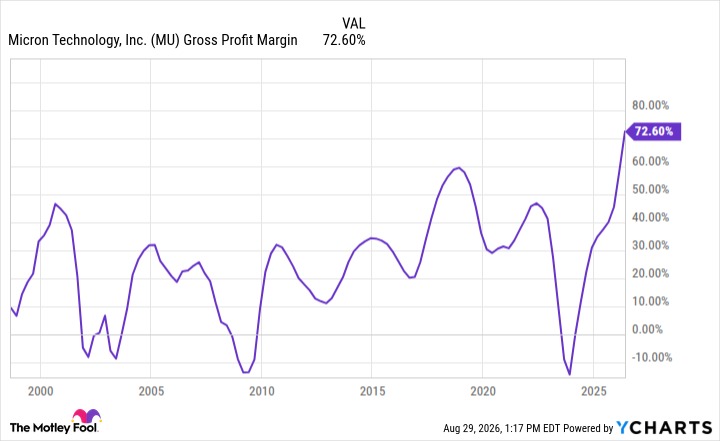
Just a few years ago, Micron Technology's (MU -5.63%) business was in so much pain that it had negative gross margins. This was the down cycle coming out of the pandemic-era semiconductor shortage. In fact, in Q4 of fiscal year 2023, which ended in August of that year, Micron's gross margin was negative 11%, and its stock price was in the gutter.
A few years later, everything has changed. The growing demand for artificial intelligence (AI) chips has boosted demand for Micron's memory products, with limited supply across the industry, leading to soaring profits and a surging Micron stock price. Its shares are now up almost 700% in the last year.
However, as enthusiasm in the AI trade has faded, Micron's stock price has fallen 23% from its highs. Now, Nvidia (NVDA -1.43%) may be back to help keep the party going, with comments from the latest earnings call indicating the memory chip shortages will continue. Could this be the turnaround Micron's share price was looking for?
Image source: Getty Images.
Massive growth and pricing power
Micron's latest quarter covered the three months ending in May 2026. Revenue was $41.4 billion in the quarter, up from $9.30 billion in the same period a year ago. Most of this growth is not coming from shipping more memory chip units, but from price hikes, selling to AI companies like Nvidia, or other chipmakers.
MU Micron Technology
NASDAQ · As of 4:00 PM ET 10/16/26

This is why gross margin was up to 85% last quarter and 73% over the last 12 months. Operating income was $33.3 billion, for an astonishing operating margin of 80%, making Micron one of the most profitable companies in the world at the moment. It is taking full advantage of the shortages and has decided to significantly hike prices for captive buyers.
For the most recent quarter, which ended in August, Micron guided for $50 billion in revenue. Apply that over a full year, keep operating margins the same, and that is $160 billion in annual operating earnings for Micron. That is more than Amazon and many other big tech companies.
Growth through the next calendar year
AI company executives, including Elon Musk, have said that the biggest bottleneck in AI infrastructure is memory chips. This was further emphasized on the recent Nvidia earnings call, when executives said that the scarcity of memory chips is only increasing. This should benefit Micron.
Nvidia CFO Colette Kress also discussed the company's projections of 70% revenue growth for the next calendar year. Memory chipmakers like Micron are spending heavily to increase capacity, but they won't catch up if Nvidia is growing this quickly, let alone the rest of the AI chipmaking supply chain.
This should keep shortages in place through the rest of 2027, meaning Micron will likely see stellar revenue growth and profits for at least the next few quarters. Don't be surprised if it reaches $200 billion in operating earnings sometime next year. It already generated $33 billion in earnings last quarter, and the shortages are only getting worse.
Data by YCharts.
Should you buy Micron stock?
Right now, Micron has a market cap of approximately $1 trillion. This looks cheap if the stock ends up generating $200 billion in operating income during the next calendar year.
The problem is determining what happens over the next decade. Memory chip cycles are steep, and can lead to huge demand collapses if supply overstretches what customers need. You can see this in the gross margin chart for Micron, which has dipped into negative territory many times in its history.
Yes, $200 billion in earnings on a $1 trillion market cap looks very cheap. But what will Micron's average earnings be over the next decade if the supply shortage becomes a glut? This should have investors thinking twice before piling into Micron stock, even if earnings are set to soar in the quarters ahead.