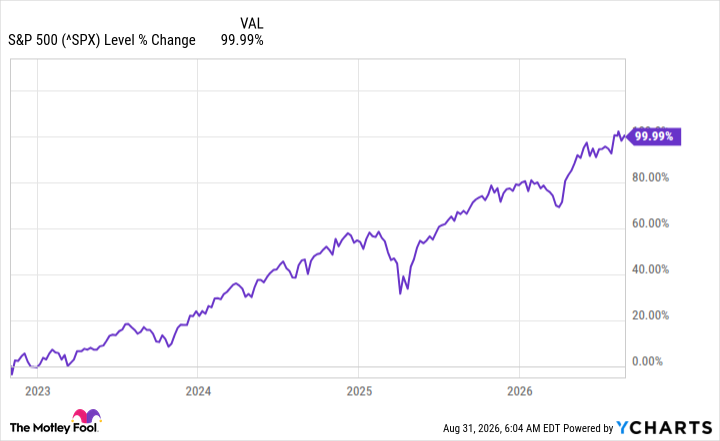
The S&P 500 (^GSPC -0.06%) is up nearly 13% this year, and while the end of the year is still four months away, 2026 could end up being the fourth year in a row with double-digit returns.
The market has been in spectacular bull form over the past few years, driven by the rise of artificial intelligence (AI). In fact, the S&P 500 has doubled since ChatGPT was launched in late 2022, nearly four years ago.
These are the kinds of gains that make investing in the S&P 500 a no-brainer. Even though it has its dips and crashes, it has many more good times than bad. However, you can supercharge that theory with an investment in a growth-oriented exchange-traded fund (ETF) that follows an index, like the Vanguard Morningstar Growth ETF (VUG -0.36%).

Image source: Getty Images.
The index fund, supercharged
The growth ETF was one of Vanguard's earliest index ETFs, launched in 2004. That was even before the Vanguard S&P 500 ETF, which opened in 2010. That's an important distinction because the annualized gains since inception for the Growth ETF include the 2008 mortgage crisis and the ensuing years of market losses, whereas the S&P 500 ETF gains don't.

NYSEMKT: VUG
Key Data Points
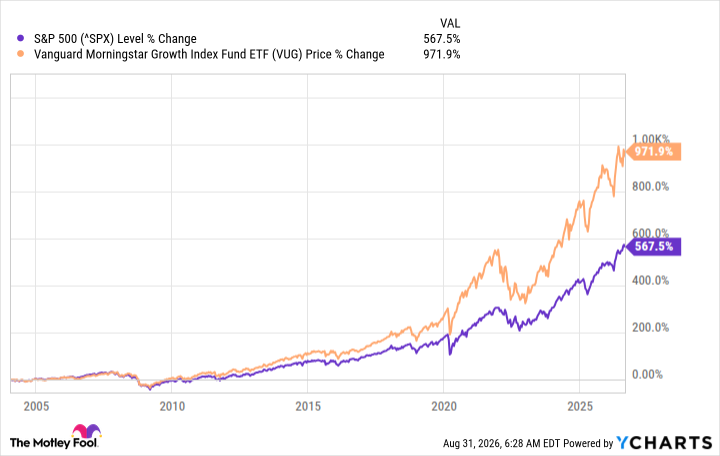
However, if you compare the performance of the S&P 500 itself and the Growth ETF since their respective inception, the gap is clear.
The growth ETF has a strategy similar to that of the S&P 500 ETF, which invests in a broad index. The growth ETF tracks the Morningstar US Large Cap Growth Index, which comprises 147 growth stocks. Nearly 70% are in tech, and Nvidia, Apple, and Microsoft alone account for more than 30% of the total weight.
On the one hand, that has helped the ETF rack up its impressive gains. On the other hand, that's a lot of the portfolio in just a few stocks. However, the remainder of the portfolio is well-diversified across categories and presents an instant, growth-oriented profile.
The path to $733,998
The growth ETF has averaged 13.3% annually over the past 20 years, compared with 11.4% for the S&P 500. There's no guarantee that will continue, but assume a 12% annualized gain over 30 years for this exercise. If you start with $10,000 and add $150 monthly, you end up with $733,998.

Image source: Investor.gov.
Whether it happens exactly this way or not, you're likely to see substantial value creation from buying a growth-oriented index ETF and waiting for many years.