Most companies want to do more business. Not all business is necessarily worth doing though.
That's the dilemma that logistics outfit United Parcel Service (UPS -0.45%) had been facing for some time before deciding early last year to scale back the amount of delivery work it was doing for e-commerce giant Amazon (AMZN -0.95%). While this relationship generated plenty of revenue, the company felt the revenue it generated was no longer profitable enough.
That's why, all told, it ultimately cut its Amazon volume by more than half. Here's what this could mean for the stock.

Image source: Getty Images.
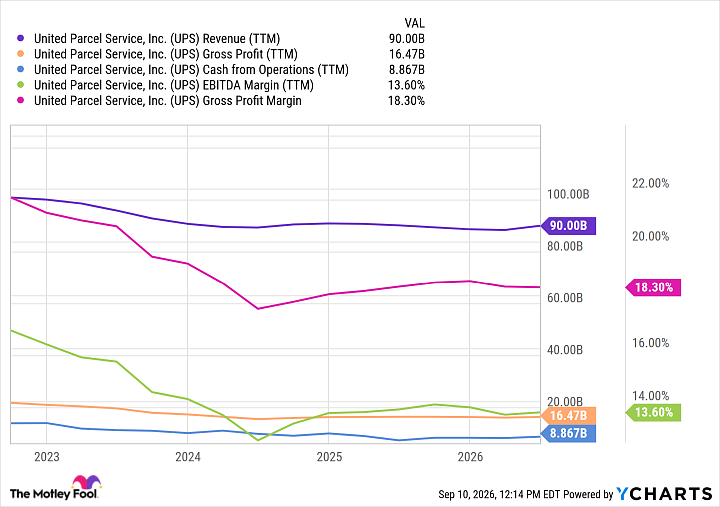
The plan appears to have worked as hoped. While sales are down slightly (albeit, not nearly as much as one might expect) since then, gross profits and operating cash flow appear to be stabilizing and even teasing the possibility of recovering at a faster rate than revenue is expected to in 2027.
Arguably, most encouraging is the fact that, despite soaring fuel costs in the meantime, UPS's earnings before interest, taxes, depreciation, and amortization (EBITDA) margins and gross margins are both holding up at levels well above 2024's when the cost of continuing to do so much business with Amazon became untenable.
UPS Revenue (TTM) data by YCharts.
The likelihood of returning to 2022's amazing profitability anytime soon is very low, for the record. That was the proverbial perfect storm for its business. Despite the prices of diesel fuel, jet fuel, and gasoline soaring in 2022 before easing back to more palatable levels in 2023 and 2024, the lingering COVID-19 pandemic continued to spur consumers to do a great deal of their shopping online. UPS just wasn't able to navigate that price volatility as well as Amazon did.
In UPS's CEO Carol Tomé's own words on the matter, however, by "taking control of our destiny," the company's future now looks measurably brighter than it did just a couple of years ago.