Even after a post-IPO lull, SpaceX (SPCX +2.04%) remains one of the market's most exciting stories. Despite its $2 trillion market cap, SpaceX shares trade at nearly 100 times sales. Sales growth did hit 92% year over year last quarter. But the space company clearly has a long way to go before it can fully justify its rich valuation.
Wall Street remains unfazed. The consensus price target for SpaceX stock is $227.66, implying more than 50% in upside over the next 12 months. Around 26 analysts have a buy rating on the stock, with six issuing a hold recommendation. Only three analysts believe SpaceX shares are a sell.
SpaceX investors are likely pleased that Wall Street is so bullish. But here's the thing: SpaceX's valuation won't be justified over a matter of months or even years. It could take a decade or more for SpaceX to fully execute on its long-term growth vision.
So much of the stock's value is tied up in these long-term opportunities that short-term prognostications should mean very little to investors. In fact, SpaceX's valuation likely hinges on a single catalyst, even if other successes will be necessary to reach that point.

NASDAQ: SPCX
Key Data Points
Here's the only catalyst SpaceX investors should care about
While SpaceX has since reported quarterly earnings, the best way to understand the company is likely through its IPO prospectus. This document reveals SpaceX's exact growth roadmap, with values attached to each opportunity.
For example, SpaceX values the total growth opportunity for its "space-based" solutions at $370 billion. These solutions mostly comprise the firm's traditional commercial aerospace and core space segment, namely its launch capabilities. Even if SpaceX captured its entire estimate for the long-term global launch industry, that wouldn't be enough to justify a $1 trillion market cap.
Where else will SpaceX be able to grow? The company values its connectivity segment at $1.6 trillion. This segment is mostly comprised of its Starlink satellite network. That business segment is profitable and growing quickly. But still, the total opportunity set for both space-based solutions and connectivity is less than $2 trillion.
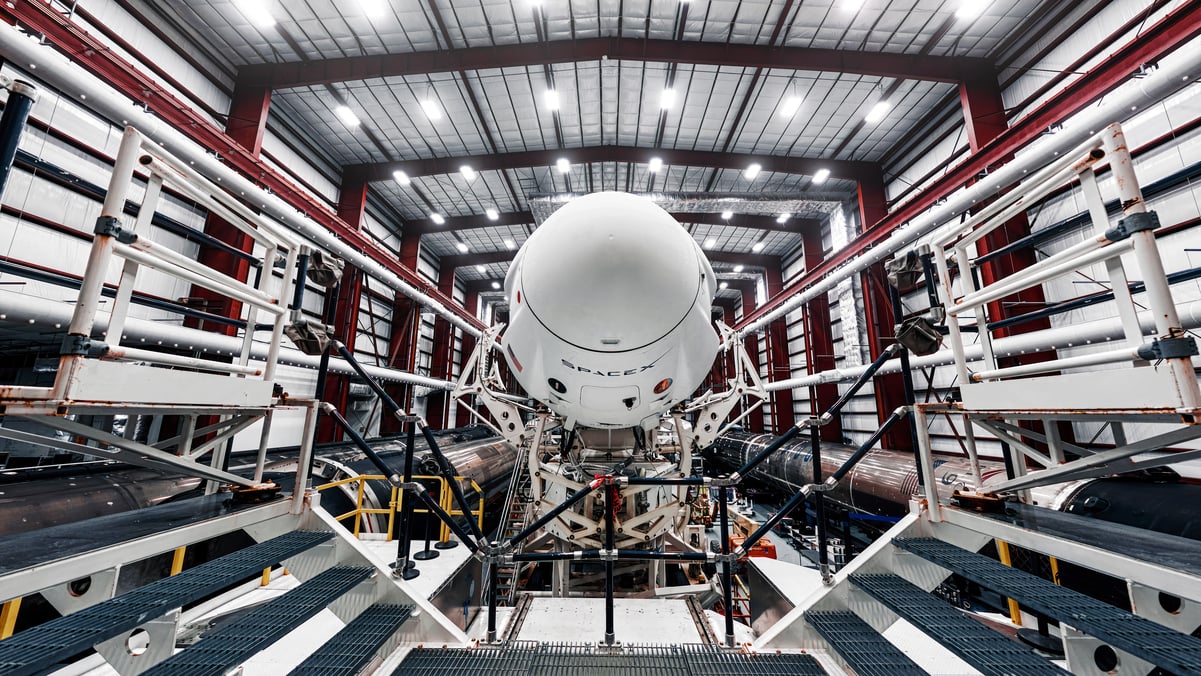
Image source: Getty Images.
For SpaceX to thrive in the long term, it is essential for the company to execute on its artificial intelligence ambitions, an opportunity set it values at an astounding $26.5 trillion. This division is highly capital-intensive, reliant on building data centers on Earth, in space, and possibly on the moon. In short, it could take a decade or more for SpaceX to prove its ability (or inability) to capture this massive market.
The need to factor in success on this front has certain analysts concerned. "Only the most optimistic Moonshot scenario, which requires a rapidly reusable Starship and commercially competitive orbital data centers, approaches the IPO price," warns Morningstar. "The IPO price implies the Moonshot scenario is highly likely, but we think the outlook is very uncertain."
Wall Street is split on whether SpaceX stock is a buy or a sell over the long term. But what isn't up for debate is that it will take some time for SpaceX to prove those predictions right or wrong. While many analysts are focused on quarterly earnings, SpaceX investors should maintain a longer time horizon. The company will need a lot more patience from investors than Wall Street commentary would lead one to believe.