The question hanging over Marvell Technology (MRVL +0.25%) is not whether its artificial intelligence (AI) story is real. Its share price has already answered that. Marvell stock opened 2026 at around $87, ripped to a high above $300 in June, got clobbered throughout July and August, and recently bounced back toward the $240 range.
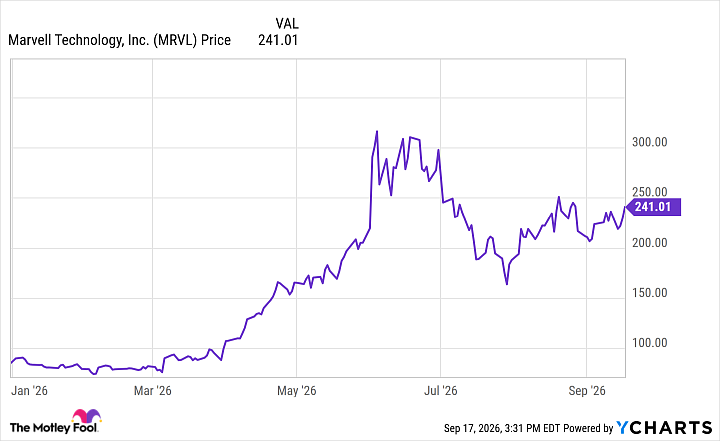
This is the kind of action that growth investors live for. It is also the kind of volatility that forces investors to take a hard look at the business, its partners, and the math that supports whether Marvell can realistically produce a 10x gain from here.
What is Marvell's position in the AI chip stack?
Marvell is not a GPU designer nor a specialty manufacturer. Rather, it is a fabless designer that used to be primarily known for networking silicon but has spent the AI revolution transitioning into a data center infrastructure business. Marvell's stack within AI factories covers optical DSPs, Ethernet and switching, silicon photonics, and custom chips.
However, its custom silicon designs are why Marvell has become such a hot semiconductor stock. Hyperscalers like Amazon, Microsoft, Alphabet (GOOGL +0.97%) (GOOG +0.87%), and Meta Platforms do not want to rent every watt of compute from the duopoly GPU suppliers, Nvidia (NVDA -0.52%) and Advanced Micro Devices. Instead, they are allocating meaningful capital expenditures toward application-specific integrated circuits (ASICs) and XPUs (specialized AI accelerators) that are fine-tuned to their own models.
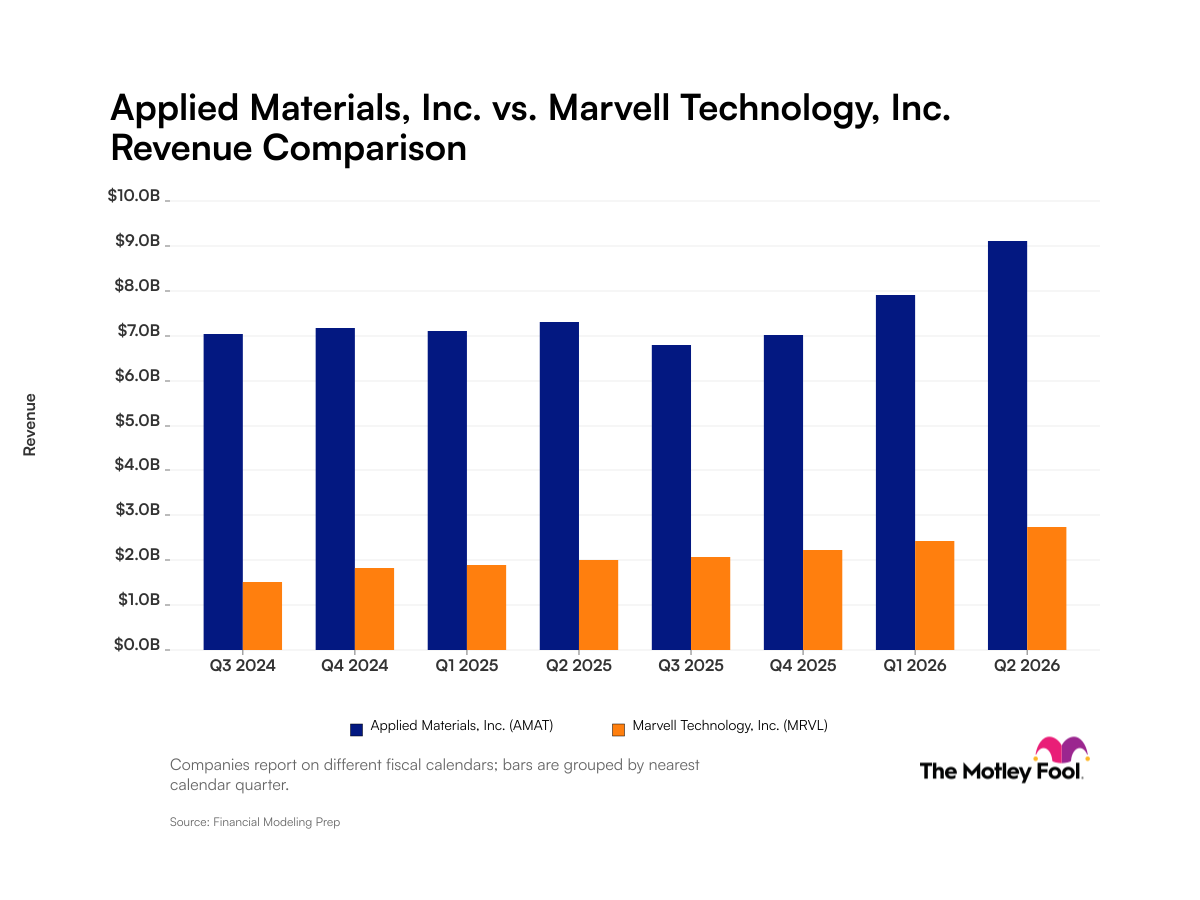
Marvell's financial performance is beginning to match the growth story. In its fiscal 2026 (which ended Jan. 31), the company reported record revenue of $8.2 billion, up 41% year over year. The data center business grew 46% to $6.1 billion, fueled by demand for optical interconnects, custom silicon, switching, and storage. During its most recent fiscal quarter, which ended Aug. 1, Marvell generated revenue of $2.7 billion, up 37% year over year. The data center segment comprised 79% of sales and grew 46% year over year.

Image source: Getty Images.
Nvidia's stamp of approval, plus a high-five from Google
In March, Nvidia invested $2 billion into Marvell as part of a broader strategic collaboration. Marvell's ecosystem is now folded into Nvidia's NVLink Fusion. By partnering with Marvell, Nvidia can integrate the smaller company's custom XPUs and networking equipment within its own racks. While Marvell supplies the custom silicon and compatible interconnects, Nvidia supplies the rest of the server. A few months later, in June, Nvidia CEO Jensen Huang called Marvell "the next trillion-dollar company" during a public event in Taipei, Taiwan.
About a month ago, Alphabet announced its own interesting deal with Marvell. Marvell has been tapped to help develop products around Google's custom Tensor Processing Units (TPUs). The ecosystem includes inference accelerators, storage and network controllers, memory interfaces, and near-memory compute.
Attached to that deal was a warrant for nearly 59 million shares at a fixed price of $206.58, worth about $12.2 billion if fully exercised. The majority of the warrant vests in 240 equal tranches for every $500 million Marvell generates in custom products revenue from Google. The structure of this deal implies up to $120 billion of qualified purchases through fiscal 2033.
Both the Nvidia and Alphabet deals matter because Broadcom dominates the custom ASIC space right now, holding an estimated 80% to 85% of the market. But a check and partnership from Nvidia implies that the much smaller Marvell is still useful inside its GPU empire. Meanwhile, Alphabet's warrant is a mechanism to show that one of Broadcom's flagship TPU customers is still willing to dual-source the surrounding silicon under the right conditions instead of leaving the whole project scope with one incumbent.

NASDAQ: MRVL
Key Data Points
Can Marvell stock 10x from here?
If Marvell's share price were to 10x from its current level, that would make it a $2.1 trillion company -- twice as ambitious as Huang's trillion-dollar line from a few months ago. To assess what its growth trajectory could realistically look like, let's start by considering Marvell's total addressable market.
On the custom silicon side, Bank of America analyst Vivek Arya forecasts that the market for custom AI processors and the chips wired to them will be worth around $300 billion by 2030. On the other side of the business, Goldman Sachs estimates that the global optical-module market is worth $68 billion currently and expects it to grow to $148 billion by 2028. Adjacent analyses from Dell'Oro Group see AI back-end data center switch spending crossing $100 billion by 2030.
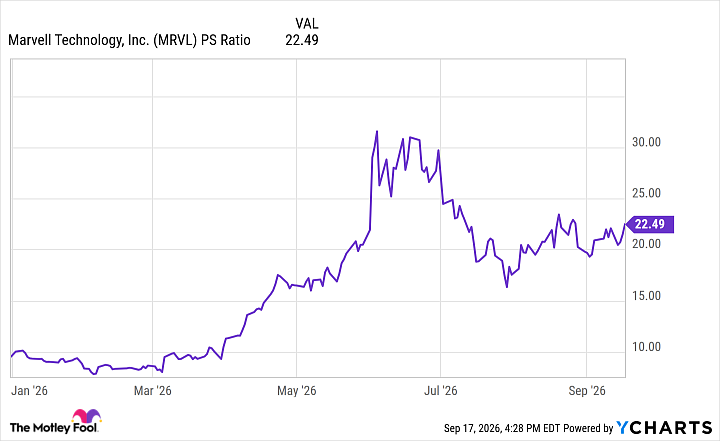
If I blend these market sizes with Marvell's own fiscal 2028 sales guide of $18 billion, I think a setup where it brings in annual revenues in the range of $60 billion to $90 billion by the early 2030s is reasonable. Of course, the top of that range could wind up stretching toward $100 billion or more if Google's warrant converts into higher volumes. Assuming Marvell can maintain a healthy price-to-sales (P/S) ratio around 20 through its hypergrowth phase, a $2 trillion market cap outcome becomes less of a fantasy.
MRVL PS Ratio data by YCharts.
While a $2 trillion market cap is not the base case, I think there is an achievable path for the company to get there. Although a 10x gain won't be easy, I'm confident Marvell stock will be a multibagger by the time 2033 comes around.