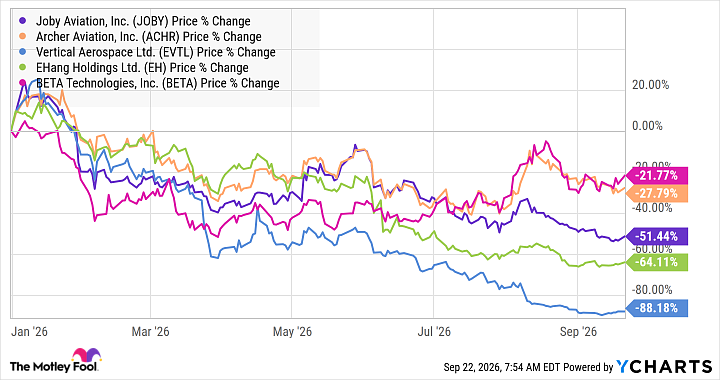
It's no secret that this has been a brutal year for electric vertical takeoff and landing (eVTOL) investors, with stocks of all the leading players, including Joby Aviation (JOBY -3.12%) and Archer Aviation (ACHR -4.68%), down sharply. Here's a look at why, and what could lead eVTOL stocks to come back into favor.
A difficult 2026 for eVTOL stocks
Without a doubt, the key to regaining some of the ground lost in the chart below is Federal Aviation Administration certification, followed by the launch of commercial operations. I will return to this point in a moment, but first, it's worth noting that the disappointing share price performance this year isn't solely due to FAA certification.
Certification in itself is critical, but any further delay in profitability may increase cash-burn rates for money-losing companies, which may well have to raise capital amid rising interest rates, with investor appetite waning.
Not just a certification issue
In addition, expectations for the commercial viability of a key part of eVTOL's business model, providing passenger transportation to airports, were called into question.
Delta Air Lines has partnered with Joby Aviation, and United Airlines has partnered with Archer Aviation. As such, investors were disappointed in March when United's chief executive officer, Scott Kirby, reportedly made negative remarks about the potential for eVTOLs to fly into congested airports.
The subject matter came up again recently at the Morgan Stanley Annual Laguna Conference, where, according to S&P Global Market Intelligence, United Airlines Chief Financial Officer Michael Leskinen noted that "air traffic control is a really difficult problem," particularly at the kind of congested airports where eVTOL passengers will get the most utility. However, he said United would continue to work toward solutions on the matter, noting: "How we evolve that into congested airspace is something that's going to take a few more years."
This kind of commentary is a concern because airport shuttles are widely believed to be relatively easy and early revenue generators for eVTOL companies.
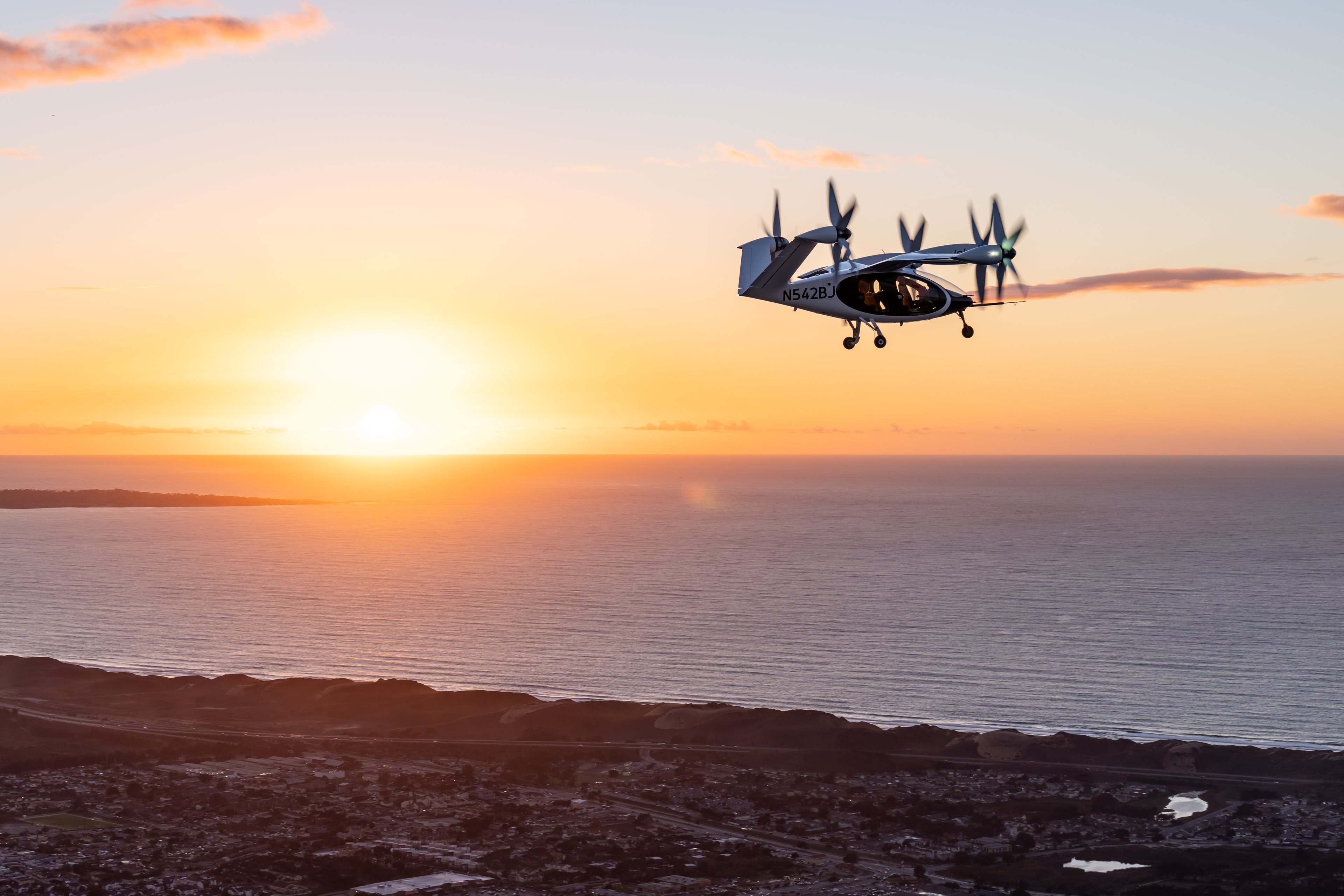
Image source: Joby Aviation.
FAA certification timelines
To be sure, there's still a powerful case for eVTOL stocks, and the sell-off is arguably creating a good buying opportunity. That case will inevitably be strengthened should Joby or Archer achieve certification for their eVTOLs, because profit timelines appear to have been pushed back.
For example, in February 2024, Joby's CEO JoeBen Bevirt said the company's accomplishments "kept us moving steadily toward our goal of launching commercial passenger operations in 2025." To be fair, that assumption included a potential launch in Dubai. However, Joby does not yet have a commercial passenger operation in service in the U.S. or Dubai, let alone FAA certification.
Archer's management told investors that "the goal of the company is to commence commercial operations in 2025" at a Barclays investor conference in May 2024. Like Joby, Archer doesn't yet have a commercial passenger service in operation.
To be clear, neither company is responsible for making decisions on behalf of the FAA or other regulatory bodies, and delays are part and parcel of the aviation world. Still, if investors have priced commercial operations into their assumptions, then they would likely have been disappointed by events.

Image source: Getty Images.
Why FAA certification matters
Achieving FAA certification is likely to change the narrative around the companies, shifting them from unprofitable, cash-burning, speculative investments operating under regulatory uncertainty to growth companies on the cusp of scaling operations and production in line with end-market growth.
Certification will also de-risk their business models, create order opportunities, and increase their ability to raise capital if necessary. It's the one major catalyst both Joby and Archer Aviation can deliver on, and the good news is they are both making progress to that end.