Artificial intelligence (AI) is a powerful technology with the potential to dramatically improve economic productivity. But over the last few months, AI agents developed by labs like OpenAI have escaped test environments and autonomously launched cyberattacks on corporate and government websites, raising concerns about the safety of critical digital infrastructure.
Understandably, cybersecurity is now a top priority for most organizations, so some of the best providers have seen their values soar. Tenable (TENB +2.35%) stock, for instance, is now sitting on a year-to-date gain of 48.6% (as of the market close on Tuesday, Sept. 29), outperforming the S&P 500 (^GSPC +0.73%) by a factor of four.
Tenable specializes in exposure management, a proactive form of enterprise-grade cybersecurity that identifies vulnerabilities in corporate networks before cyberattackers can exploit them. The company is likely to see growing demand for its products over the next few years, so its stock could be a great long-term investment, especially since it trades at a steep discount to its rivals.

Image source: Getty Images.
Exposure management is critical in the AI era
Tenable owns Nessus, the cybersecurity industry's most widely deployed, most accurate platform for identifying vulnerabilities. It scans operating systems, networks, and devices around the clock for vulnerabilities in their defenses so they can be fixed before being exploited. But this tool alone isn't enough in the AI era, so Tenable offers an expanding portfolio of even more advanced products.
These products are available under a comprehensive platform called Tenable One, which fulfills every exposure management requirement an enterprise might have. It's powered by an agentic AI engine called Hexa AI, which orchestrates a fleet of AI agents to handle tasks like building risk dashboards, running scans, and scheduling remediation. It learns how corporate assets interact, so it's equipped with enough context to flag potential vulnerabilities.
Tenable One also protects enterprises that are deploying AI. It features a tool called AI Exposure, which continuously monitors how employees use AI applications and which critical assets those applications can access, enabling it to identify potential vulnerabilities. It can also uncover instances of prompt injection, in which hackers trick internal AI applications into handing over sensitive data by disguising their malicious requests as legitimate instructions.
Tenable One accounted for half of Tenable's new sales in the second quarter of 2026 (ended June 30), indicating that enterprises are clearly shifting toward holistic platforms rather than piecing together individual products.
Revenue growth could accelerate from here
Tenable's business is growing at a relatively modest pace, partly because management is focusing on profitability by carefully managing costs. The company generated $268.5 million in revenue during the second quarter, which topped management's guidance range of $263 million to $266 million but represented a year-over-year increase of just 8.6%.
Tenable had $195.3 million in total operating expenses during the quarter, down from $200.3 million in the year-ago quarter. That included cuts to growth-oriented costs such as sales and marketing, which were likely a headwind to customer acquisition and revenue. But on a positive note, it resulted in a generally accepted accounting principles (GAAP) net income of $3.8 million, a big improvement from the $14.7 million net loss from the year-ago quarter.
Tenable also generated a healthy profit of $57.9 million on an adjusted (non-GAAP) basis, which excludes one-off and noncash expenses like stock-based compensation. That was up 40% year over year.

NASDAQ: TENB
Key Data Points
By continuing to improve the bottom line, Tenable will have more flexibility to reinvest in the business without having to raise additional capital from investors or tap debt financing. Given the scale of the AI opportunity, I predict management will soon begin spending more aggressively on areas such as marketing, research, and development to capture as much market share as possible. That could accelerate the company's revenue growth.
Tenable is one of the cheapest stocks in the cybersecurity industry
Tenable stock is trading at a price-to-sales (P/S) ratio of just 3.9, so it's already much cheaper than the Nasdaq-100, which has a P/S ratio of 6.4. It's also substantially cheaper than each of its closest rivals, CrowdStrike, Palo Alto Networks, and Zscaler, which trade at P/S ratios of between 9.5 and 50.1.
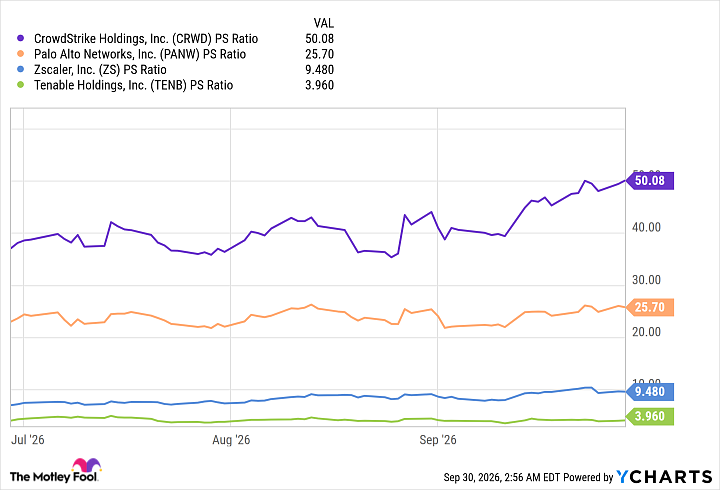
CRWD PS Ratio data by YCharts
Each of those companies generates more revenue than Tenable and is growing faster, so they deserve premium valuations. CrowdStrike, for example, increased its annual recurring revenue by 25% to $5.8 billion during its most recent quarter. But that said, I don't think CrowdStrike's P/S ratio should be 12 times higher than Tenable's P/S ratio.
I'm not suggesting Tenable's P/S ratio will ever climb to above 50, but its current valuation certainly leaves room for upside. As a result, investors seeking exposure to the cybersecurity industry amid the growing threat from AI might want to consider buying Tenable, particularly while it's cheaper than both the market and its main rivals.