Bear markets tend to come around every seven or eight years, on average, as there have been 13 of them in the past 100 years. But sometimes they are 13 years apart, like the gap between Black Monday in 1987 and the dot-com bubble in 2000, or two years apart, like the span between the COVID-19 crash of 2020 and the inflation crash of 2022.
While there are warning signs, such as the historically high Shiller P/E ratio, you don't actually know when a bear market is coming, even if you are already in its early stages. So, that makes it critical to heed the warning signs and be prepared for when it does come. That means you should be preparing now, and this one move will help you do that.

Image source: Getty Images.
Fend off the bear
The best way to keep a bear market from sinking your portfolio is to ensure it is diversified across stocks and exchange-traded funds (ETFs) that have performed well during downturns. When the market tanks 20% or more, it's typically measured against the S&P 500 or the Nasdaq Composite, which are large-cap stock or technology indexes.
There are typically other areas of the market that aren't hit as hard. The chart below shows the returns of different investment styles in 2022, the last bear market. You see that value ETFs have vastly outperformed growth, technology, and broad market-cap funds.
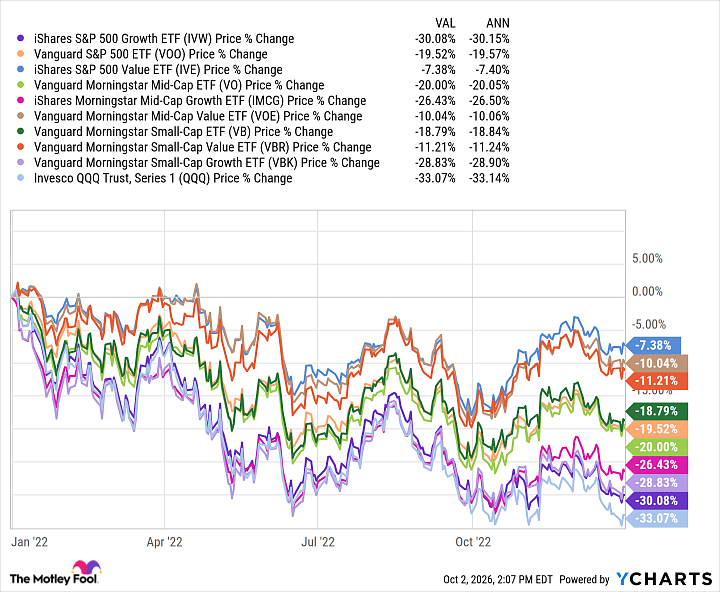
So, you definitely want to make sure you have a healthy dose of value ETFs and stocks in your portfolio because, in this cycle, it is the large-cap growth stocks that look extremely overvalued, based on the Shiller P/E. So when the market corrects, they will likely feel it the most. If you have stocks in your portfolio with valuations that are not only super-high but well out of their historical ranges, those are red flags, and you may want to pare back on them.
But diversification goes beyond value. You should also have a substantial portion of your portfolio in international and emerging-market stocks, which have outperformed U.S. large caps over the past 12 months.
Don't forget dividend stocks
In general, you want stocks or ETFs of quality companies, perhaps blue chip stocks or those built to navigate downturns. You can tell by how much cash they generate, because these firms have the operating cash flow to continue investing and growing when most others don't.
They also have the ability to fund their dividends, providing investors with income that can be reinvested to boost total return. Over time, dividends have accounted for 40% of the S&P 500's total returns, according to an analysis by Fidelity. But in bear markets or downturns, dividends account for a much larger share of total returns.
In the 1970s, for example, about three-quarters of the total return that decade came from dividends. In the 2000s, stock values were negative, so dividends accounted for all of the positive returns that decade.
So, the takeaway is to start preparing now and create an all-weather, diversified portfolio with stocks and ETFs that tend to perform well when the broader market does not.