Conventional computers process information using bits, often represented as lines of binary code (0 or 1). Quantum computers use qubits to perform certain calculations in fundamentally different ways. Through a property known as superposition, qubits can exist in multiple states at the same time.
Quantum computing technology is promising to transform drug discovery, materials science, financial modeling, cybersecurity, and more. Given its various use cases, McKinsey estimates the quantum computing market could reach between $43 billion and $71 billion by 2035.
That opportunity has attracted enormous attention to pure-play quantum developers such as Rigetti Computing (RGTI -0.78%). Smart investors understand the difference between a revolutionary technology and buying a stock at an attractive valuation.
As of this writing (Oct. 8), Rigetti commands a market capitalization of roughly $4.7 billion despite generating relatively little revenue and no profits. Let's consider what Rigetti could look like in five years to assess if now is a good opportunity to buy the stock.

Image source: Getty Images.
Rigetti has promising technology, but lots of competition
Rigetti specializes in superconducting quantum computers, an approach also being explored by technology giants such as Alphabet and IBM. This strategy centers on building quantum processors with modular chiplets, enabling multiple components to work together as systems scale.
Rigetti also operates its own fabrication facility and provides access to quantum computing through cloud-based services. This vertical integration gives the company considerable control over its technology stack.
Rigetti has also garnered the attention of major artificial intelligence (AI) infrastructure suppliers such as Hewlett Packard Enterprise, with which it is developing hybrid quantum-classical computing workflows. While these developments are encouraging, Rigetti faces stiff competition from IonQ, D-Wave Quantum, IBM, Google, and other quantum developers pursuing different technological approaches. Given the nascent state of quantum computing, no one knows which architecture will ultimately dominate.

NASDAQ: RGTI
Key Data Points
Rigetti's financials reveal a glaring problem
Rigetti generated just $5.1 million in revenue during the second quarter while reporting an operating loss of $28.1 million. The company's net loss reached $52.6 million, although most of it was attributable to noncash accounting adjustments.
The company finished June with approximately $541 million in cash and investments and no debt besides some minor operating leases. That's reassuring, given that quantum computing requires substantial spending on research and development (R&D) and engineering.
Nevertheless, the company trades at a price-to-sales (P/S) ratio of 394. That's an unsustainable valuation for any business, let alone one without consistent profitability.
That leads me to my next concern: liquidity. Rigetti has been issuing stock over the past year to help fund the operation. If the company's outstanding share count continues to balloon to fund research, existing investors will own progressively smaller percentages of the business. This means the technology could succeed without shareholders necessarily enjoying equally spectacular returns.
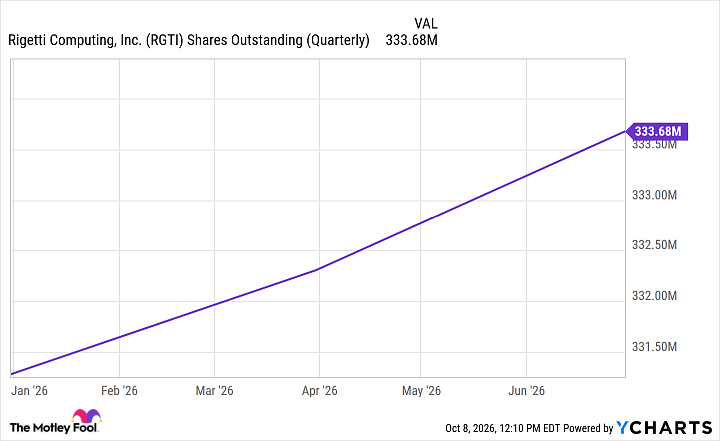
RGTI Shares Outstanding (Quarterly) data by YCharts
Where could Rigetti stock be in 2031?
Let's consider two scenarios. Suppose Rigetti generates $500 million in annual revenue by 2031 and commands a more mature valuation of 10 times sales. That produces a $5 billion market capitalization. In other words, Rigetti could increase annual revenue by nearly 7x compared to its trailing-12-month sales and still trade around today's valuation.
Now, imagine quantum computing becomes a major commercial opportunity by the next decade, and Rigetti evolves into a key supplier. If the company reaches $1 billion in revenue and still trades at 10 times sales, the company's market capitalization would reach $10 billion. This implies roughly 113% upside from today's level. With shares currently trading around $14, that bullish scenario implies a future stock price around $30.
While the math shows Rigetti's stock could double, both scenarios require exceptional execution and broader adoption of quantum computing within a relatively tight time frame. This is precisely why I wouldn't chase Rigetti simply because quantum computing sounds like an exciting opportunity.
This analysis is meant to show how Rigetti's valuation already prices in significant commercial success. For investors willing to tolerate volatility and uncertainty, Rigetti stock could be a speculative hold rather than a compelling long-term buy at today's price. For investors seeking broader exposure to artificial intelligence (AI) and who want to participate in the potential upside of quantum computing, blue chip stocks like Alphabet or IBM are a better bet.