Over the next couple of months, most publicly listed American companies will report their operating results for the quarter ended Sept. 30. Investors are trying to navigate several headwinds right now, including a higher inflation rate, interest rate hikes, and even a potential slowdown in artificial intelligence (AI) development from labs like Anthropic and OpenAI, so this earnings season comes at a critical moment.
Moreover, the S&P 500 (^GSPC +0.59%) is trading at a Shiller cyclically adjusted price-to-earnings (CAPE) ratio of 41.8, its second-highest valuation ever, behind the dot-com bubble peak in 2000, so strong corporate results might be necessary to sustain the current bull market.
Netflix (NFLX -1.77%) stock is currently trading 48% below its all-time high, and it's one of the few major technology companies heading into this earnings season at a very attractive valuation. The streaming giant will report its third-quarter results on Oct. 20. Here's why I predict they will spark a recovery in its stock.

Image source: Netflix.
Wall Street is souring on Netflix stock, but analysts are still collectively bullish
Netflix has over 325 million paying subscribers, making it the largest streaming platform in the world for movies and television shows. The company enjoys economies of scale, so it's highly profitable while most of its competitors continue to lose money. This has a few advantages: Netflix can spend more on creating and licensing content and on advertising, and can afford to offer multiple subscription tiers at different price points.
But over the last few months, Wall Street analysts at major firms like Goldman Sachs, Barclays, and Wells Fargo have slashed their price targets for Netflix stock, citing concerns about declining engagement and a potentially weak content slate that could hurt revenue growth. Some of that is baked into management's most recent forecast, which suggests the company's revenue is on track to grow by just 13% to $51.2 billion in 2026 (at the midpoint of the guidance range).
However, Netflix's most promising growth engine is still in its infancy. In late 2022, the company introduced an affordable subscription tier priced at $8.99 per month, well below its Standard ($19.99 per month) and Premium ($26.99 per month) tiers. Despite the lower price point, these members become more valuable over time because they must watch ads during programming, and Netflix can charge more per ad slot as the viewer base grows.

NASDAQ: NFLX
Key Data Points
The ad-tier subscription regularly accounts for over half of new signups in countries where it's available, so it's resonating with customers. And in 2025, revenue from selling ad slots to businesses alone more than doubled to $1.5 billion. Management says it's on track to double again in 2026 to $3 billion. That number could grow significantly in the future, especially because Netflix is now showing ads to users across all tiers during live events, where it's currently making large investments.
Therefore, some of Wall Street's concerns could be resolved over the long term as Netflix focuses more on advertising, which might explain why 32 of the 54 analysts tracked by The Wall Street Journal still rate Netflix stock a buy. Four other analysts are in the overweight (bullish) camp, while 17 recommend holding, and just one recommends selling. Plus, their average price target of $92.21 suggests the stock could rise by 31% over the next 12 months.
Netflix stock is attractively valued heading into Oct. 20
Considering Netflix stock has declined by 48% from its all-time high and is currently trading near a 52-week low, expectations are already subdued heading into its third-quarter report on Oct. 20. An upward revision to management's 2026 revenue outlook or a positive update on the advertising business could be enough to spark a rally, especially given the stock's attractive valuation.
Based on Netflix's trailing-12-month earnings of $3.18 per share, its stock is trading at a price-to-earnings (P/E) ratio of just 21.9, a steep discount to its five-year average of 39.1. It's also cheaper than the S&P 500 and Nasdaq-100, which have P/E ratios of 23.3 and 34.6, respectively.
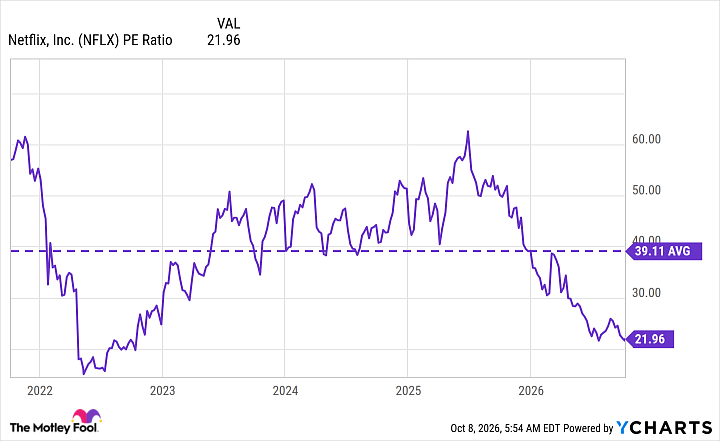
NFLX PE Ratio data by YCharts
Netflix believes it has captured only 7% of its $670 billion global opportunity across streaming subscriptions, advertising, gaming, and more, suggesting its long-term growth potential is promising. Therefore, while the upcoming third-quarter report could turn the stock around, investors who focus on the next five years (or more) could reap the greatest rewards.