Breakfast News: INTC Drops as CEO Flags Demand Gap
January 23, 2026
| Thursday's Markets |
|---|
| S&P 500 6,913 (+0.55%) |
| Nasdaq 23,436 (+0.91%) |
| Dow 49,384 (+0.63%) |
| Bitcoin $89,536 (-0.75%) |
Source: Image created by Jester AI.
1. Intel Plunges 10% on Supply Shortage
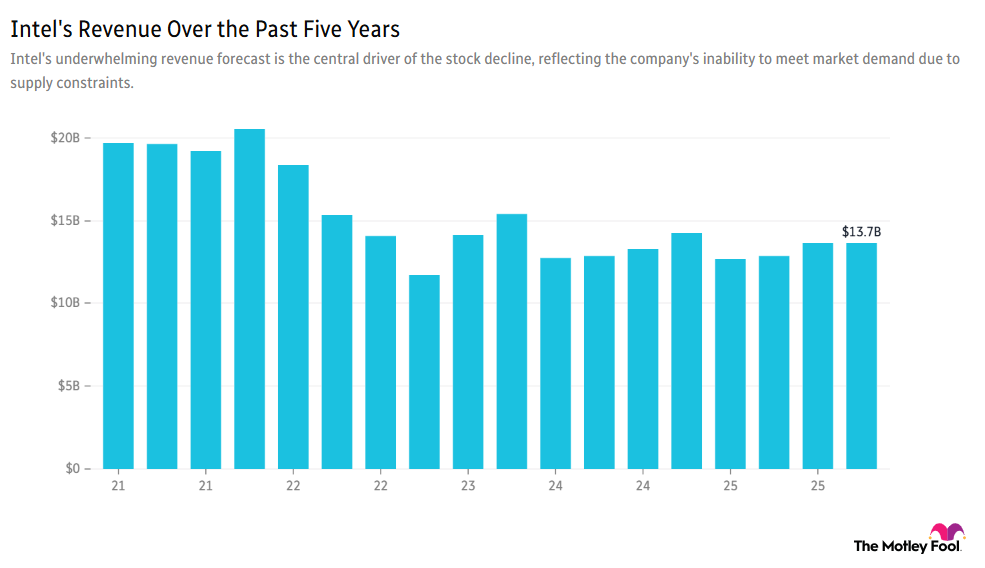
Intel (INTC +0.13%) was down more than 10% in pre-market trading, after results detailed an underwhelming revenue forecast, with CEO Lip-Bu Tan expressing disappointment "that we are not able to fully meet the demand in our markets."
- "Our conviction in the essential role of CPUs in the AI era continues to grow": Tan tried to strike an upbeat tone, as the company ramps up production of key chips despite dealing with an inventory shortage. CFO David Zinsner said they hadn't anticipated such a surge in demand.
- Concerns of industrywide shortage pulls rivals lower: Zinsner's comments on supply issues caused Advanced Micro Devices (NASDAQ:AMD) to fall close to 1% in pre-market trading. The stock is beating the S&P 500 by 6% since the January 2024 Stock Advisor recommendation by Team Rule Breakers.
2. ISRG Rises on Q4 Beat and Outlook
Rule Breakers rec Intuitive Surgical (ISRG +0.41%) rose over 2.5% ahead of the market open thanks to quarterly results highlighting growing adoption of medical systems, with a further procedure growth of 13-15% expected for 2026.
- Procedures outside the U.S. increased 23%, contributing 35% of total global procedures: International markets helped to drive quarterly revenue performance, with the newest da Vinci 5 surgical system continuing to be rolled out globally.
- "Government budget challenges in Japan and the UK, and robotic competition in China intensified in Q4": CFO Jamie E. Samath noted some risks, including how China was favoring local suppliers, with sharper pricing another negative impact in the region.
3. Why a Company's Workforce Might Matter More Than Its Earnings
Fool senior advisor Robert Brokamp, CFP, recently sat down for a conversation with Dr. Ben Zweig, CEO of Rovelio Labs and author of Job Architecture: Building a Language for Workforce Intelligence. Here are the key takeaways.
- Labor data offers a hidden edge for investors: Traditional financial statements are outdated because they ignore human capital, which is now the primary driver of value for modern tech giants. By using AI to analyze millions of job postings and online profiles, investors can spot massive strategy shifts – like Meta's (META +5.63%) quiet retreat from the metaverse – months before they are officially announced. Tracking employee "flows," such as a sudden exodus of top salespeople, provides a real-time health check that standard accounting simply cannot capture.
- AI automates tasks rather than entire occupations: A common fear is that AI will destroy jobs, but history shows that technology usually automates specific tasks while requiring workers to "reconfigure" their roles. The workers most at risk are those in rigid roles with strict licensing, while those in fluid, adaptable careers will likely see their productivity and value increase.
- Coordination is the most valuable skill for the future: As AI takes over technical execution like coding or data analysis, the ability to act as an "orchestrator" who manages complex, end-to-end projects becomes the ultimate competitive advantage. In an automated world, the highest economic returns will go to those who can effectively conduct the "symphony" of AI-driven tasks.
4. Food for Thought
Fun fact: small-cap stocks tend to rise more in January than in any other month, due to 'new year' money hitting the market and their low liquidity. And what led the broad market rally Thursday? Tech and small-cap stocks!