Related investing topics
FAQ
Tony Dong has no position in any of the stocks mentioned. The Motley Fool has positions in and recommends Vanguard FTSE Emerging Markets ETF. The Motley Fool has a disclosure policy.
Invest better with The Motley Fool. Get stock recommendations, portfolio guidance, and more from The Motley Fool's premium services.
An emerging markets ETF (exchange-traded fund) is a listed investment vehicle that invests in stocks from developing nations. They can offer investors exposure to economies experiencing rapid growth and industrialization, but that are still facing higher volatility and structural challenges than developed nations.
Many of the world's largest non-NATO economies are BRICS countries -- Brazil, Russia, India, China, and South Africa -- all of which are classified as emerging market countries. Beyond this, emerging markets include many South American and Middle Eastern countries such as Mexico, Argentina, the UAE, and Qatar.
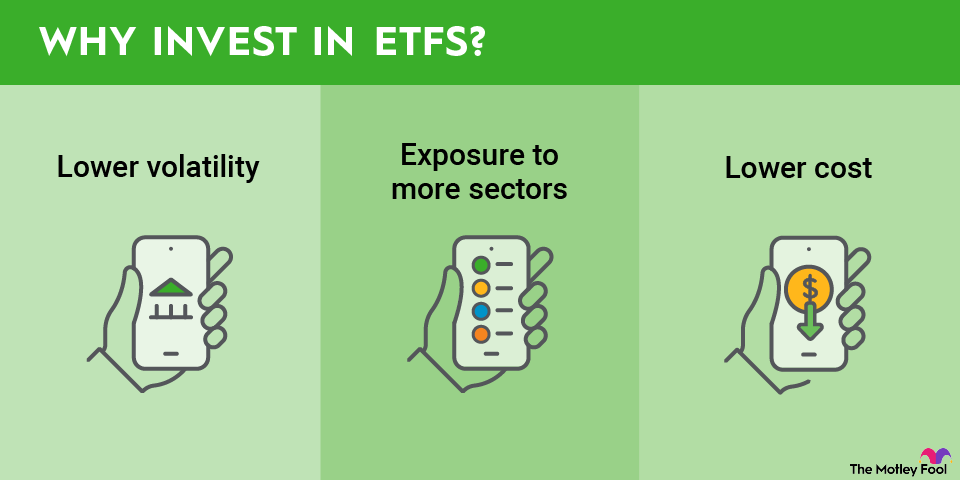
Investing in emerging markets through an ETF helps avoid the complexities of currency conversion, provides diversified exposure across multiple sectors and regions, and reduces the risks of picking individual stocks in unpredictable economies. However, they can come with higher fees and greater principal risk.
Here's a look at some of the best overall emerging markets ETFs, offering broad diversification, exposure to high-growth economies, and suitability for many investors. Some are index funds, while others are actively managed.
The iShares Core MSCI Emerging Markets ETF (IEMG -2.84%) is one of the most comprehensive emerging markets ETFs. It holds more than 2,800 stocks across large-, mid-, and small-cap companies within the MSCI Emerging Markets Investable Market Index.
The fund is market-cap weighted, meaning larger economies dominate its holdings. In July 2026, China, India, Taiwan, and South Korea made up the bulk of the portfolio. Fees are relatively low thanks to a 0.09% expense ratio.
This ETF is widely popular, with $160.7 billion in assets under management (AUM), making it one of the most liquid emerging markets ETFs. It features a tight 0.01% 30-day median bid-ask spread. While it has lagged U.S. ETFs over the last decade, this reflects the relative strength of the U.S. dollar, which has weighed on foreign equity returns.


The Schwab Emerging Markets Equity ETF (SCHE -2.37%) tracks the FTSE Emerging Index while maintaining a low 0.06% expense ratio. The fund holds around 2,200 stocks, offering a well-diversified mix of small-, mid-, and large-cap companies. Investors currently get paid a decent 2.02% 30-day SEC yield.
Despite including smaller stocks, the Schwab Emerging Markets Equity ETF is market-cap weighted, meaning larger companies dominate its portfolio. This has resulted in a weighted average market capitalization of $406.1 billion as of May 31, 2026, giving the fund a tilt toward large-cap stocks, similar to other major emerging markets ETFs.

Emerging markets ETFs can offer investors a variety of benefits.
Investors should also keep in mind the risks associated with emerging markets ETFs.
When creating this list, we prioritized low expense ratios, substantial assets under management, strong trading liquidity, and long operating histories. Lower fees help preserve long-term returns, while larger, established ETFs generally offer tighter bid-ask spreads and a lower risk of fund closure.
We also favored broad, market-cap-weighted index funds over more specialized strategies. Market-cap weighting keeps portfolio turnover low, improving tax efficiency while naturally allowing the largest and most successful companies to become a greater part of the portfolio over time, rather than requiring frequent trading.
Finally, we generally preferred unhedged emerging markets ETFs to currency-hedged alternatives. While exchange rates can create short-term volatility, currency movements have historically tended to wash out over long investment horizons, whereas hedging introduces additional costs and can create a persistent performance drag.
Emerging markets ETFs can be a valuable addition to a diversified portfolio, offering exposure to faster-growing economies and markets that may outperform developed countries over certain periods. At the same time, they require more due diligence than a typical U.S. index fund because seemingly small differences in methodology can lead to portfolios that differ meaningfully.
Before investing, read the ETF's index methodology carefully. Index providers such as MSCI and FTSE classify countries differently, meaning two emerging markets ETFs may have very different exposures despite similar names.
Finally, pay attention to liquidity. Emerging markets ETFs often trade with wider bid-ask spreads than comparable U.S. equity funds, making it worthwhile to review trading costs before placing an order.
Ultimately, the best emerging markets ETF is the one that aligns with your investment objectives, risk tolerance, and time horizon. Understanding what the ETF owns and how it achieves that exposure is often more important than chasing the strongest recent performance.

The State Street SPDR Portfolio Emerging Markets ETF (SPEM -2.27%) follows the S&P Emerging BMI Index (Broad Market Index), which covers small-, mid-, and large-cap stocks across emerging markets.
While the underlying index includes over 7,200 stocks, the SPDR Portfolio Emerging Markets ETF holds slightly fewer than 3,000 due to its sampling methodology rather than full replication. The fund avoids illiquid or extremely small companies, improving efficiency while maintaining broad exposure.
The ETF is market-cap weighted, with its largest country allocations in China, India, Taiwan, and Brazil. It remains competitive with a 0.07% expense ratio, making it a solid choice for investors seeking broad emerging-market exposure with minimal fees.
| Company name | Company ticker | Current price |
|---|---|---|
| iShares - iShares Core Msci Emerging Markets ETF | NYSEMKT:IEMG | $75.89 |
| Vanguard FTSE Emerging Markets ETF | NYSEMKT:VWO | $57.71 |
| State Street SPDR Portfolio Emerging Markets ETF | NYSEMKT:SPEM | $49.84 |
| Schwab Strategic Trust - Schwab Emerging Markets Equity ETF | NYSEMKT:SCHE | $35.06 |
| American Century ETF Trust - Avantis Emerging Markets Equity ETF | NYSEMKT:AVEM | $88.18 |

The Vanguard FTSE Emerging Markets ETF (VWO -2.30%) is one of the largest and most diversified emerging markets ETFs. It tracks the FTSE Emerging Markets All Cap China A Inclusion Index for a low 0.06% expense ratio.
One key difference between this fund and the iShares Core MSCI Emerging Markets ETF is that it excludes South Korea. This is because FTSE classifies it as a developed market, whereas MSCI classifies it as an emerging market.
Another unique feature is the China A Inclusion designation. This designation means the fund holds Chinese stocks listed on the Shanghai and Shenzhen exchanges, rather than just H-shares traded in Hong Kong.
With more than 6,300 holdings, the Vanguard FTSE Emerging Markets ETF is even more diversified than the iShares Core MSCI Emerging Markets ETF, making it a broad-based, cost-effective way to access emerging markets. It is also available as a mutual fund.
Unlike traditional index-tracking ETFs, the Avantis Emerging Markets Equity ETF (AVEM -2.44%) takes an active approach with its stock selection and weighting.
The Avantis Emerging Markets Equity ETF systematically screens stocks based on multiple factors, prioritizing smaller companies, undervalued stocks, and highly profitable businesses. This factor-based strategy aims to outperform traditional market-cap-weighted emerging-market ETFs, and historically, it has.
Despite its active approach, this fund remains broadly diversified, holding more than 3,900 stocks across various emerging markets. It also maintains an expense ratio of 0.33%, which is reasonable for active management and makes it an affordable choice for investors seeking enhanced exposure to emerging markets.