But what if it's a stock you still like, and you don't really want to sell? Can't you just sell it, harvest the loss, and then buy it back immediately? In a word, no. This is precisely what the wash-sale rule exists to prevent: harvesting tax-loss benefits on an investment you don't intend to exit.
What is a wash sale?
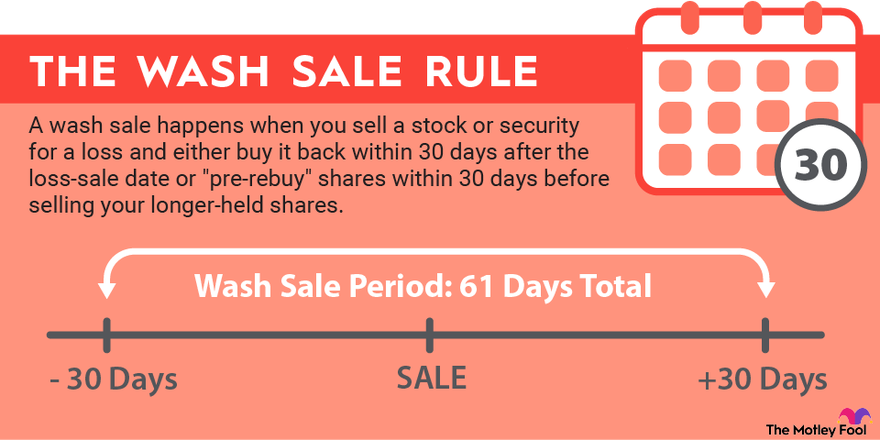
Under the wash-sale rules, a wash sale happens when you sell a stock or security for a loss and either buy it back within 30 days after the loss-sale date or "pre-rebuy" shares within 30 days before selling your longer-held shares.
In either case, the loss is not considered realized for tax purposes, with the sale and subsequent (or prior) purchase "washing" one another out. This rule is designed to prevent people from selling stock to just to claim the tax benefit, without intending to exit the investment.
Again, the rule applies to a 30-day period before and after the sale date to prevent your buying the stock "back" before it's even sold.
Wash-sale rule examples
Let's say you own 100 shares of XYZ Corp with a cost basis (what you paid for them) of $10,000, and you sell them on June 1 for $3,000. That works out to a $7,000 loss, and if you own the shares in a taxable brokerage account, you can claim that loss when you file your taxes.
However, if you were to rebuy shares anytime between June 2 and July 1, then the sale is considered a wash sale, and the loss doesn't qualify as a taxable loss. It works the same way if you buy shares within 30 days before your sale as well; in this case, if you bought shares equal to what you sold on June 1 anytime on or after May 2, then it would "wash out" your taxable loss.