Types of general obligation bonds
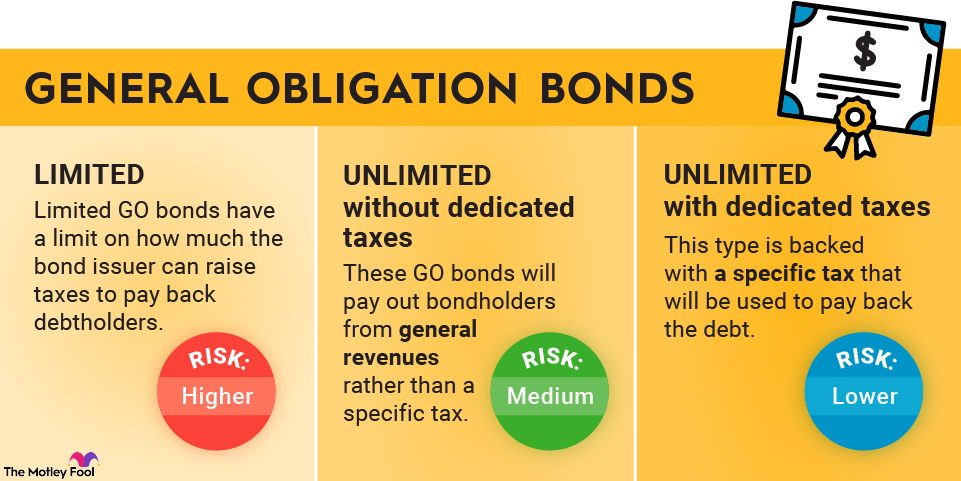
There are two primary classifications of general obligation bonds: limited GO bonds and unlimited GO bonds. Limited and unlimited general obligation bonds are both backed by the general revenues of the issuing municipality, but they differ in their ability to levy taxes in order to pay bondholders.
Limited GO bonds
Limited GO bonds have a limit on how much the bond issuer can raise taxes to pay back debtholders. Those limits vary and are generally detailed in the bond offering statement. As you would expect, the limit on the ability to raise taxes makes limited GO bonds riskier than unlimited ones.
Unlimited GO bonds
Unlimited GO bonds come in two varieties. One comes with dedicated taxes, while the other does not.
An unlimited GO bond with dedicated taxes means that it’s backed with a specific tax, usually a property tax, that will be used to pay back the debt. With these kinds of GO bonds, the municipality also typically pledges to use other available funds or to raise taxes if they are unable to pay back the bond with the taxes earmarked for it. Because this bond comes with taxes specifically set aside for it, it’s considered the strongest, most secure GO bond.
An unlimited GO bond without dedicated taxes will pay out bondholders from general revenues rather than a specific tax connected to the project. In this case, if the local or state government does not have sufficient funds to pay back the bond, they must raise taxes to cover the difference. Unlimited GO bonds without dedicated taxes are less secure than ones with dedicated taxes, but they are still safer than limited GO bonds.
Related investing topics