These beverage competitors show noticeably different revenue profiles. Coca-Cola (KO +0.32%) has historically been the more consistent performer in terms of revenue. Its stock has also significantly outperformed PepsiCo (PEP -1.85%) over the past two years.
Coca-Cola: Steady Revenue Consistency
Coca-Cola primarily manufactures, markets, and sells a wide variety of nonalcoholic beverages, concentrates, and syrups to distributors and retailers worldwide. It generated $49 billion in trailing-12-month revenue.
It recently appointed Henrique Braun as its new chief executive officer and expanded its global marketing agreements in spring 2026. The company reported a net income margin of approximately 32% for the quarter ended April 3, 2026.

NYSE: KO
Key Data Points
PepsiCo: Higher Volume and Volatility
PepsiCo manufactures and distributes a diverse portfolio of beverages and convenient foods through wholesale networks, direct-store-delivery systems, and e-commerce channels globally. It generated $95 billion in trailing-12-month revenue.
It recently implemented a workforce restructuring plan that involved hundreds of layoffs. In the recent quarter, the company reported a 12% net income margin.

NASDAQ: PEP
Key Data Points
Why Revenue Matters for Retail Investors
Revenue is the most fundamental measure of a company’s performance. Changes over time can tell investors about the strength of its competitive positioning relative to competitors, as well as its ability to expand its operations and gain market share.
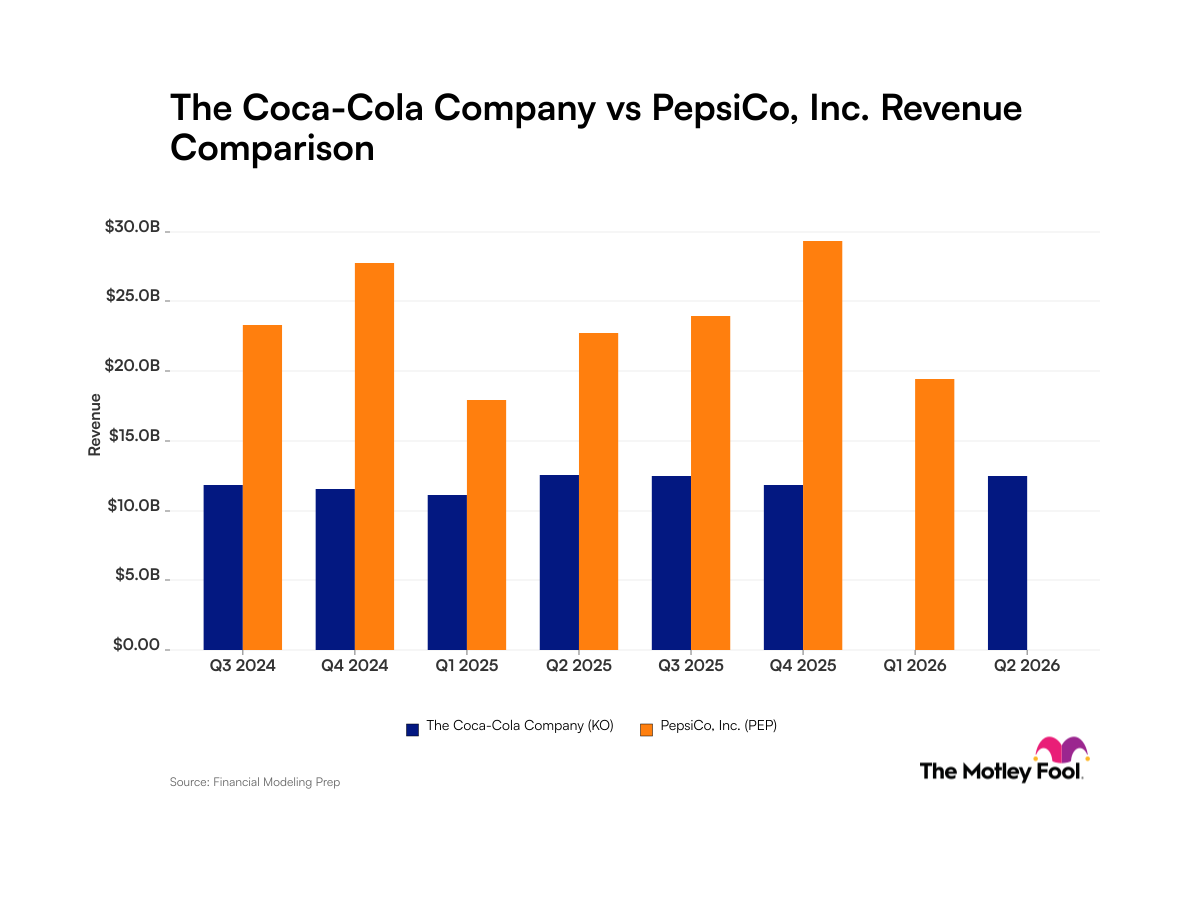
Image source: The Motley Fool.
Quarterly Revenue for Coca-Cola and PepsiCo
| Quarter (Period End) | Coca-Cola Revenue | PepsiCo Revenue |
|---|---|---|
| Q2 2024 | $12.4 billion (period ended June 2024) | $22.5 billion (period ended June 2024) |
| Q3 2024 | $11.9 billion (period ended Sept. 2024) | $23.3 billion (period ended Sept. 2024) |
| Q4 2024 | $11.5 billion (period ended Dec. 2024) | $27.8 billion (period ended Dec. 2024) |
| Q1 2025 | $11.1 billion (period ended March 2025) | $17.9 billion (period ended March 2025) |
| Q2 2025 | $12.5 billion (period ended June 2025) | $22.7 billion (period ended June 2025) |
| Q3 2025 | $12.5 billion (period ended Sept. 2025) | $23.9 billion (period ended Sept. 2025) |
| Q4 2025 | $11.8 billion (period ended Dec. 2025) | $29.3 billion (period ended Dec. 2025) |
| Q1 2026 | $12.5 billion (period ended April 2026) | $19.4 billion (period ended March 2026) |
Data source: Company filings. Data as of May 18, 2026.
Foolish Take
These consumer goods giants show contrasting revenue patterns. PepsiCo’s quarterly revenue shows sharp swings, while Coca-Cola’s is much more consistent. This doesn’t necessarily signal anything negative about the quality or competitive position of either company. It’s merely a reflection of the difference in how they generate revenue.
PepsiCo’s revenue is roughly split between beverages and snack foods. By comparison, Coca-Cola is focused on beverages, with a substantial portion of its revenue from high-margin syrup sales. This shows a key difference in the business models of these companies and why Coca-Cola generates a much higher profit margin than its rival.
That said, Coca-Cola stock has been the better investment over the past two years. Its shares are up 36% (including dividend reinvestment), outpacing PepsiCo’s 12% decline.
Going forward, investors should watch whether PepsiCo’s investments in product development, artificial intelligence (AI) capabilities, and improving its cost efficiency can boost its earnings growth. Higher margins could be a catalyst that lifts the stock higher.
PepsiCo generates nearly double the annual revenue of Coca-Cola, so the revenue gap is not going to narrow much anytime soon. But for Coca-Cola to continue delivering returns to investors, it’s all about continued investment in marketing and adapting its packaging and product development to suit changing consumer preferences.