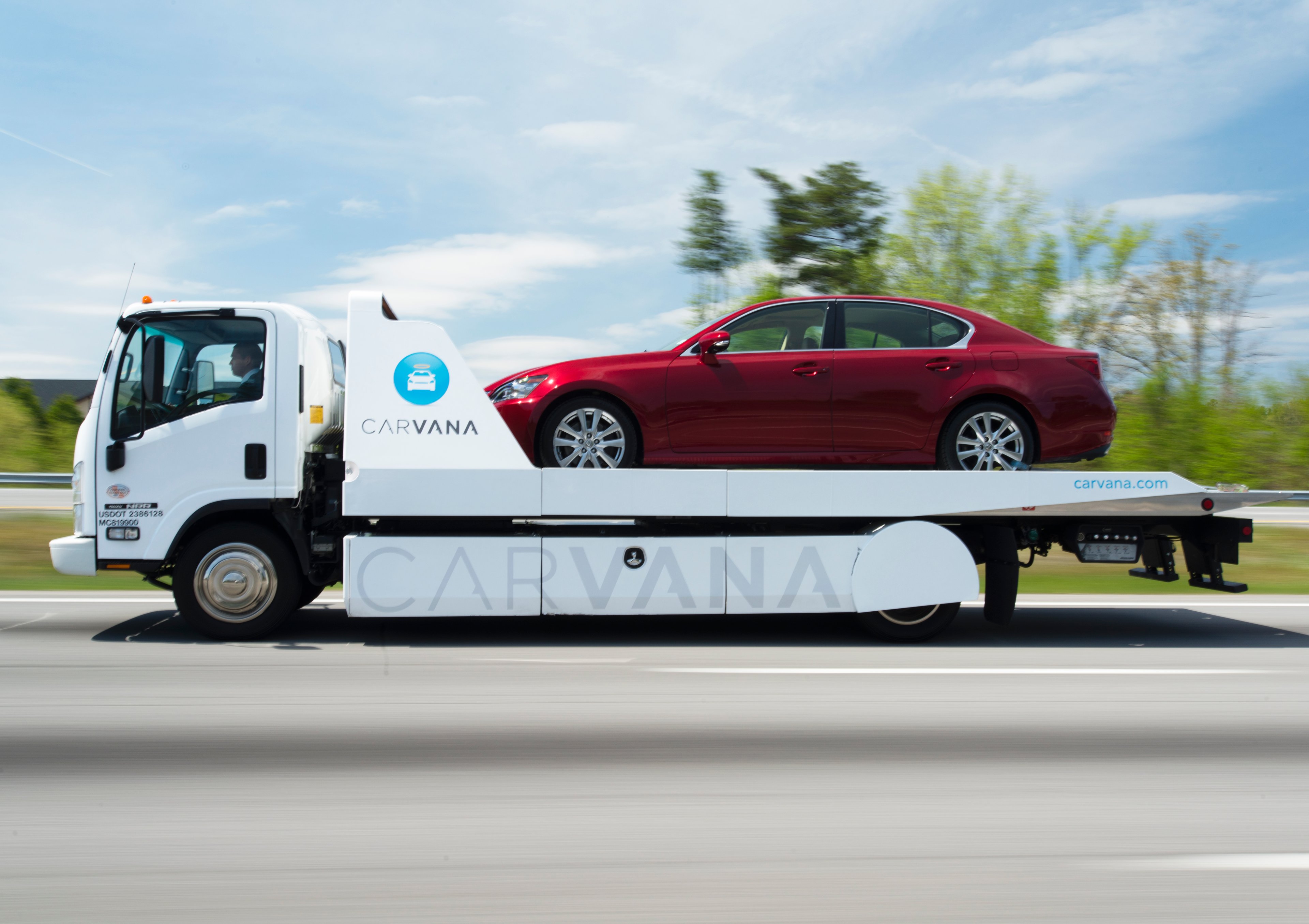
Image source: The Motley Fool.
DATE
Feb. 18, 2026 at 5:30 p.m. ET
CALL PARTICIPANTS
- Chief Executive Officer — Ernest Garcia
- Chief Financial Officer — Mark Jenkins
- Head of Investor Relations — Meg Kehan
Need a quote from a Motley Fool analyst? Email [email protected]
TAKEAWAYS
- Retail Units Sold -- 596,006 for the full year, representing 43% growth; fourth-quarter figure was 163,522, also up 43%.
- Revenue -- $5.60 billion for the fourth quarter, reflecting 58% year-over-year growth; growth exceeded unit volume due to gross revenue treatment of specific vehicles from a large retail marketplace partner.
- Adjusted EBITDA (non-GAAP) -- $511 million in the fourth quarter, representing a $152 million increase and a new company Q4 record.
- Adjusted EBITDA Margin (non-GAAP) -- 9.1% in the fourth quarter, a decrease from 10.1%, attributed to increased retail revenue per unit from accounting changes described by management.
- Net Income -- $951 million, a $792 million increase, driven by a non-cash benefit of $618 million (including a net non-cash tax benefit of $685 million and a $67 million warrant revaluation loss).
- Net Income Margin -- 17%, up from 4.5%.
- Non-GAAP Retail GPU -- Decreased by $255 in the quarter due to higher non-vehicle costs, lower shipping distances (passed as lower shipping fees), and higher retail depreciation rates.
- Non-GAAP Wholesale GPU -- Dropped by $148, due to faster retail growth versus wholesale marketplace volumes.
- Non-GAAP Other GPU -- Increased by $49, reflecting improved cost of funds and higher finance and VSC attach rates, offset by lower customer interest rates.
- SG&A Leverage -- Non-GAAP SG&A expense per retail unit dropped by $340, including $57 in operations and $344 in overhead, while advertising per unit increased by $83.
- Cash & Equivalents -- $2.3 billion at period end, along with $7.9 billion in retired corporate notes, and a net debt/trailing twelve-month adjusted EBITDA ratio of 1.3x.
- Loan Sale Platform Expansion -- New agreements with a longstanding partner for up to $4 billion in loan purchases through December 2027, bringing total new partner commitments to $12 billion over two years, and $6 billion more via Ally Financial through October 2026.
- Customer Experience Metrics -- Net promoter scores at multi-year highs; 30% of retail customers and 60% of selling customers completed transactions without human interaction due to advanced AI systems.
- Reconditioning Capacity -- 34 locations operational, providing infrastructure to support growth to 3 million retail units annually; 1.5 million annual car reconditioning facilities already in place.
- Market Share -- Approximately 1.6% of the U.S. used vehicle retail market, contrasted with about 20% e-commerce adoption in non-auto retail sectors.
- Operational Efficiencies -- Improved logistics positioned more cars closer to customers, saving about $60 per car in both logistics expense and shipping fees, with all savings passed to customers.
SUMMARY
Carvana (CVNA 1.92%) management indicated a clear path toward its stated goals of reaching 3 million annual retail units and a 13.5% adjusted EBITDA margin, citing fixed cost leverage and ongoing operational efficiencies as primary contributors. Reconditioning costs were higher in the quarter, attributed to rapid facility expansion and less experienced management, but leadership outlined initiatives to improve consistency and scalability. Customer-facing digital automation advanced, with substantial shares of transactions now completed without human contact, helping margin and differentiation. New loan purchase agreements increased funding capacity for originated loans by $4 billion through 2027, ensuring continued access to capital and competitive customer financing. Release of a deferred tax asset valuation allowance created a significant one-time gain in net income, reflecting sustained company profitability.
- Management addressed investor concerns about related party transactions, stating, "we do not sell loans to related parties. And have not done so for all of the years from 2017 through 2025," and called short reports alleging otherwise "100% inaccurate."
- The company increased advertising expense per retail unit by $83, explaining the intent to further build awareness, understanding, and trust during rapid scaling.
- Sequential increases in both retail units sold and adjusted EBITDA are forecasted for the first quarter of 2026, with management signaling focus remains on significant top and bottom-line growth for the full year.
- Reconditioning cost elevation was presented as temporary, linked to ongoing site openings and leadership transitions, with explicit plans to automate and standardize management processes to achieve a potential $220 per car benefit if all locations reach top-quartile efficiency.
- Market share is viewed as early-stage, supporting management’s view of significant headroom in a fragmented industry.
- Deferred tax benefits stemming from the Up C corporate structure will now flow to common shareholders, representing over $600 million in additional net income this quarter.
- Customer survey results highlighted by management showed 70% factored in peer recommendations, and three-fourths recommended Carvana to multiple people, underscoring word-of-mouth as a growth lever.
INDUSTRY GLOSSARY
- GPU (Gross Profit per Unit): A Carvana-specific metric indicating total gross profit per retail or wholesale vehicle transaction, excluding certain non-recurring or non-operating costs as defined by management.
- VSC (Vehicle Service Contract): An extended warranty product sold alongside a vehicle, generating additional per-unit profit and recurring revenue for the company.
- Up C Corporate Structure: A tax-advantaged holding company structure allowing LLC units to be exchanged for publicly traded shares, generating deferred tax benefits for both pre-IPO unitholders and common shareholders.
Full Conference Call Transcript
Meg Kehan: And thank you for joining us on Carvana's fourth quarter and full year 2025 earnings conference call. Please note that this call will be simultaneously webcast on the Investor Relations section of the company's corporate website at investors.carvana.com. The fourth quarter shareholder letter is also posted on the IR website. Additionally, we posted a set of supplemental financial tables for Q4, which can be found on the events and presentations page of our IR website. Joining me on the call today are Ernie Garcia, Chief Executive Officer and Mark Jenkins, Chief Financial Officer.
Before we start, I would like to remind you that the following discussion contains forward-looking statements within the meanings of federal securities laws, including but not limited to, Carvana's market opportunities and future financial results that involve risks and uncertainties that may cause actual results to differ materially from those discussed here. A detailed discussion of the material factors that cause actual results differ materially from forward-looking statements can be found in the Risk Factors section of Carvana's most recent Form 10-Ks. The forward-looking statements and risks in this conference call are based on current expectations as of today. And Carvana assumes no obligation to update or revise them whether as a result of new developments or otherwise.
Our commentary today will include non-GAAP financial metrics. Unless otherwise specified, all references to GPU and SG&A will be to the non-GAAP metric and all references to EBITDA will be to adjusted EBITDA. Reconciliations between GAAP and non-GAAP metrics our reported results can be found in our shareholder letter issued today. And with that said, I'd like to turn the call over to Ernie Garcia. Ernie? Thanks, Meg, and thanks, everyone, for joining the call.
Ernest Garcia: 2025 is another incredible year for Carvana. There are many useful ways to describe the progress that we've made, but one approach I return to each year starting with the graph at the beginning of our shareholder I find that useful because they provide a simple visual view of the big picture. And the big picture story is clear and meaningful. The first observation from the graph is that both volume and financial performance are moving up and to the right rapidly. This is only possible if you offer customers something that is sufficiently different and desirable, that it caused them to break habit and if the business model itself is sufficiently different and efficient that enables qualitatively different results.
We went public, we wrote that our mission was to change the way people buy and sell cars. And the graphs show that we have built a customer value proposition and a business model with the power to do it. Having a great customer offering is the single most important thing. We have it, and we are making it better every year. Looking at the year in our current position, there are three key takeaways in our minds. One, we are getting better and more differentiated as we get bigger. In the last twelve months, we increased customer selection by 20,000 cars. 20,000. We're delivering cars to our customers a full day faster.
We have put more cars closer to our customers leading to $60 average savings on shipping fees for our customers. We have reduced the interest rates our customers pay on their loans by about 1% relative to benchmark on average. We have made the transaction simple and straightforward enough that many of our customers can confidently make it all the way to the vehicle handoff without ever speaking to a person at Carvana. And customers are telling us they love it with MBS at multiyear highs. That's a lot of progress we made in a year, We also improved our EBITDA margin by a 100 basis points.
Lots of good things have to be through to make all that possible, and those things are hard to replicate. Two, we're making rapid progress toward our goals. With every step, our path to our current goal is 3,000,000 retail units a year, and 13.5% adjusted EBITDA margin becomes clear, and this year was a big step. We estimate that fixed cost leverage alone will be worth about two points of adjusted EBITDA margin over time. We're making rapid progress in fundamental gains that is lowering variable cost and increasing the efficiency of variable monetization, which gives us more fuel to hit our financial goals and to keep providing additional value to our customers over time.
On units, we grew by 43% in 2025, meaning that the compounding annual growth rates necessary to hit our twenty thirty to twenty thirty five retail unit goal are now 3818%, respectively. With the quality of our customer offering and the positive feedback in our business, we believe there is plenty of fuel to get us to our 3,000,003 million unit goal and beyond. But we have a lot of work to do and to keep scaling our operational machine to handle all that volume. And that brings us to point number three. We have the infrastructure to scale, and we just need to execute. The most operationally intensive part of our business is vehicle reconditioning.
Continuing to scale reconditioning quickly, cost efficiently, and at high quality has been, currently is, and for the foreseeable future will be a central focus. We have a better foundation to scale reconditioning effectively than we have ever had in the past. We already own the real estate for 3,000,000 units per year. We've already made the investments in the facilities to produce 1,500,000 cars per year.
Our systems that manage the entire process flow through our reconditioning centers are more and robust than they have ever been, and we have more locations that are capable of reconditioning cars 34 as of today, than we have ever had meaning we can scale hiring and production faster because of access to more people in more geographies. But it's still hard work, we still have significant room to continue to push more of the complexity of managing cars through these locations into systems with the goals of continually improving consistency across locations and of making scaling easier. The team is up to the challenge. The Carvana future is bright.
The experience we deliver to our customers are exceptional and getting better all the time. The scale of our opportunity is enormous, and the financial opportunity is clear to see. And we have a team that has proven that we can tackle the difficult technology and operational challenges that are in front of and turn them into modes that are behind us. The march continues far. Thank you, Ernie, and thank you all for joining us today. Unless otherwise noted, all comparisons
Operator: Will be on a year over year basis.
Ernest Garcia: 2025 is an exceptional year for Carvana.
Operator: We entered the year focused on three key objectives.
Mark Jenkins: One, delivering significant growth in retail units sold and adjusted EBITDA. Two, driving fundamental gains in unit economics and customer experience. And three, developing foundational capabilities. By these measures, 2025 was a resounding success. In full year 2025, we grew retail units sold by 43% to a record $596,006.41. We integrated 10 additional ADESA locations We expanded our digital auction capabilities nationwide. We reached multiyear highs on customer net promoter score. And we increased adjusted EBITDA margin to a record 11%. Again, making us the fastest growing and most profitable company in our industry. We Moving to the fourth quarter, retail units sold totaled 163,522 in Q4, an increase of 43% and a new company record.
Revenue was $5,603,000,000, an increase of 58%. Revenue growth exceeded retail units sold growth, primarily due to traditional gross revenue treatment for certain vehicles acquired from a large retail marketplace partner. Consistent with past quarters, our growth in the fourth quarter was driven by our three long term drivers of growth. A continuously improving customer offering, increasing awareness, understanding, and trust, and increasing inventory selection and other benefits of scale. The fourth quarter marked our eighth consecutive quarter of industry leading retail unit growth and unit economics. Non-GAAP retail GPU decreased by $255, primarily driven by higher non-vehicle costs, lower shipping distances flowing through to customers in the form of lower shipping fees, and higher retail depreciation rates.
Non-GAAP wholesale GPU decreased by $148 primarily driven by faster growth in retail units sold than wholesale marketplace units. Non-GAAP other GPU increased by $49, primarily driven by improvements in cost of funds and higher finance and VSC attach rates partially offset by our decision to give back to customers in the form of lower interest rates. Since our last reporting, we again expanded our loan sale platform by entering into a fourth loan purchase agreement with a long standing loan for up to $4,000,000,000 of loan purchases through December 2027. This brings the total of our new partner loan purchase agreements to $12,000,000 over the next two years, in addition to $6,000,000,000 with Ally through October 2026.
Q4 was another strong quarter for levering SG&A expenses. Our 43% growth in retail units sold led to a three forty reduction in non-GAAP SG&A expense for retail units sold, including a $57 reduction in operations expenses, and a $344 reduction in overhead expenses. Advertising expense increased by $83 per retail unit sold as we continue to invest in building awareness, understanding, and trust of our customer offering. With approximately 1.6% market share, of the used vehicle retail market compared to approximately 20% e-commerce adoption in non-automotive retail verticals. We believe we are in the early days of customer awareness and adoption of our model.
We see continue to see opportunities for significant SG&A expense leverage over time and as we scale, driven by both continued improvements in operational expenses as well as leverage in the fixed components of our cost structure. Net income was $951,000,000 an increase of $792,000,000 Net income was positively impacted by a non-cash benefit of $618,000,000 including a net non-cash tax benefit of $685,000,000 partially offset by a $67,000,000 reduction in the fair value of warrants. Net income margin was 17% an increase from 4.5%. Adjusted EBITDA was $511,000,000 an increase of 152,000,000 and a new Q4 record.
Adjusted EBITDA margin was 9.1%, a decrease from 10.1% primarily driven by increased retail revenue per unit resulting from the traditional gross revenue treatment mentioned previously. GAAP operating income was $424,000,000 or 83% of adjusted EBITDA. An increase of $164,000,000 and a new Q4 record. 2025 was a strong year for our balance sheet. We ended 2025 with $2,300,000,000 of cash and equivalents, retired $7.00 $9,000,000 of corporate notes, and reduced our net debt to trailing twelve month adjusted EBITDA ratio to 1.3 times. Our strongest financial position ever. As discussed in prior quarters, we remain committed to driving toward investment grade quality credit ratios over time. In 2026, we plan to maintain our three key objectives from 2025.
While placing additional weight on driving significant profitable growth at scale. Looking forward, assuming the environment remains stable, we expect significant growth in both retail units sold and adjusted EBITDA in full year 2026. Including a sequential increase in both retail units sold and adjusted EBITDA in Q1 2026. In conclusion, Q4 represented another strong quarter closing out our best year in company history. We remain excited about progressing toward our goals of becoming the largest and most profitable auto retailer and buying and selling millions of cars. Thanks for your attention. We'll now take questions.
Operator: Thank you. We will now begin the question and answer session. And the first question will come from Sharon Zackfia with William Blair. Please go ahead.
Sharon Zackfia: Hi, thanks for taking the question. Guess I wanted to, kind of double clip click on the reconditioning dynamics. So if you could
Ernest Garcia: Maybe talk about kind of the challenges you're facing as you're growing at this rapid pace, which is certainly hard to keep up with. And I think in the shareholder letter, you mentioned something like, know, if you got all of the locations to the top quartile, you'd you'd get a $220 benefit per car. You know, what is a reasonable timeline to kinda move that bell curve to the right? And do you see the opportunity for GPU to be flatter up for the full year? Thanks.
Operator: Yeah.
Ernest Garcia: So first I would say, I think that has done an incredible job for a long time and we've been obviously working hard scale that part of the business. I think as we've said before, as a general matter I think for any operational business, oftentimes, the most difficult parts are the parts where you're moving the most people and things. And for us, reconditioning centers. And so that tends to be, the most difficult area to scale. I think in addition to growing at 43% supporting unit growth of 43% and also growing our inventory last year, That team also has been hard at work opening these additional integration sites.
Operator: Which is great because it lays the foundation for additional growth in the future.
Ernest Garcia: And then I think in Q4, I think there's no question that our expenses were a little higher than we would have liked there. And I think that is partially the result of these additional sites kind of having a single line instead of multiple lines and there being some extra cost that flow through there as a result. I think it's also partially result of we kind of spread out, we had some newer managers. And I think, a trend that we've seen is locations that have managers that have around for longer. Tend to perform a bit better. And think those are addressable issues.
I think you've many of you have been to, many tours inside of our inspection centers and seen all the work that we've done in Carly to make that process as automated as possible. I think we've got some opportunities to also make the management, of those processes more automated. And I think that those capabilities are kind of focused more on lifting the floor, of performance instead of raising the ceiling. I think a lot of what we've done so far has been about raising the ceiling. So I think we've got opportunities. I think we've got a very clear plan.
I think, this is one of those things where I sometimes if you take a little step backwards, it kinda fires you up. And my strong guess is we'll be in a better spot, in three to six months than we would have been otherwise. I think team is fired up and ready to go. And, you know, no one's excited about taking a little backwards step there. So, we're focused on it. I do not think it'll have long term implications. I think I think we'll react to it very positively as we have to many other similar things in the past. And I think we'll get right back at it.
Sharon Zackfia: Thanks for that. I guess as a follow-up, I know you have your AI brain, I think, as well in the shareholder letter, and it seems to me you would be maybe the most uniquely poised to benefit from what's happening in AI. Can you talk about what the early kind of nascent uses are that you're implementing AI to do. And then if you're seeing anything in the competitive side or if it's just, you know, business as usual, there? Thanks.
Ernest Garcia: Sure. Well, I think if we start with things that are visible, to investors, I think we put some stats there. We have 30% of our retail customers now go through the entire process without talking to a person until they get the car. We have 60% of our customers that are selling cars to us to go through the process out without talking to anyone until they drop off their car. That's only possible because of the systems that we've built and those systems being intuitive and automated and straightforward. And I think a major set of tools that contributes to that is Sebastian and other tools that emerge from that AI brain.
So I think that's a very clear place where we're getting more scalable, where we're reducing costs. And I think very importantly, where we're improving customer experience. Those customers that go through the experience in that way have a higher NPS, than customers that call us. And I think that also speaks to the power of those systems. So I think that's an area where it's it's very apparent, I think, even from the outside looking in. And we've been focused on that for several years, and I think, you'll continue to get better all the time.
I think if you look at other parts of business, including just the speed at which we're developing new products, that continues to get better all the time. I think there's been a couple material step changes up in the quality of these different tools. And we're seeing internally those step changes start to flow through the business and we're getting things done faster. I think that is still relatively early. I think the last I mean, the last year has been a massive step up in the quality of these tools. I think the three to six months has been another very large step up in the quality of these tools.
But we do believe that we're fundamentally extremely well positioned to benefit from these things because we have a big deterministic system that's vertically integrated that has access to all the information, and that brain has every system feeding it so we can give customers very simple answers to any questions they've got in really any software interface that we choose to put on top of it. So we think that's very powerful. And then I think, you know, importantly, to try to, you know, discuss a relative, negative as something that I think is a long term positive. I think even the a discussion today is what does AI mean for, different companies in the long term?
And I think we're sitting here talking about the realities of our business, including financing and logistics and reconditioning in these difficult operational things. I think that those are other areas of the business that are very important to deliver great customer experience, and those are areas that are not subject to AI disruption in the immediate term. So we think that we're positioned to in a major way. We think that competitively we're incredibly well positioned compared to the rest of our industry. And we think that our business itself is also positioned, to be an AI winner and not something that is disrupted by AI.
So our view is the sum of all that is very positive, and we remain excited.
Operator: The next question will come from Jeff Lick with Stephens. Please go ahead.
Ernest Garcia: Good afternoon. Thanks for taking my question and congrats on a nice quarter and a great year. Thank you. I was just wondering
Mark Jenkins: And Mark, can you talk about the environment though at least the depreciation environment is actually kind of
Ernest Garcia: Reversed a little bit. In
Operator: Q1 so far. Was wondering if you could just talk about
Mark Jenkins: You highlighted in the
Jeffrey Francis Lick: The letter that you expect a sequential improvement, but maybe if you could just talk about the puts and takes in the path of travel for GPU not only in Q1, but for 2026.
Mark Jenkins: Sure. Yeah. I could that one. So Ernie hit pretty well on some of the cost dynamics of Q4. We do expect those cost dynamics to play out in Q1 as well and do expect our non vehicle costs to be up on a year over year basis in Q1. Despite that, we expect a sequential increase in retail GPU in Q1. So we expect to overcome those cost headwinds and demonstrate a sequential increase. Beyond that, know, I don't have too much commentary to give. I think we'll, you know, we'll see how the year progresses. Obviously, you know, we've had a lot of success driving strong g p retail GPUs. For a long period of time.
And, you know, that's just one of the many places where we've demonstrated a lot of success over time, including obviously, the significant growth. But in addition to that, you know, very significant growth throughout the income statement, including adjusted EBITDA, operating income, and net income. So, you know, our goal in 2026 is to have another great year, to have another year. We drive very significant top and bottom line growth, and that's what we're gonna be focused on.
Jeffrey Francis Lick: Awesome. Let someone else ask a question. Thanks very much. Best of luck. '26.
Operator: Thank you. The next question will come from Daniela Haigian with Morgan Stanley. Please go ahead.
Daniela Marina Haigian: Great. Thanks for taking the question. First one, you might have addressed a bit with the retail GPU commentary, but overall on EBITDA, the variable adjusted EBITDA decelerated down to 7% this quarter. Is this a one off decline? How should investors be thinking about this metric longer term? And is the pace of growth needed to reach that longer term target, the 18% to 38% CAGR like you mentioned, Ernie? That supportive of incremental margin expansion?
Daniela Marina Haigian: Thanks.
Ernest Garcia: Sure. So I think, maybe the first thing I would say on the beginning point is, I think revenue changes play a very big role in that calculation. I think if you look year over year, we moved away from marketplace units and meant we moved to a more traditional kind of gross revenue accounting on a number of units. I believe they were down by about $14 year over year, which is, you know, first order flat. If you look at EBITDA dollars per unit instead in Q4, So I think, you know, calcs kind of on EBITDA dollars, I think, would look significantly different.
I think looking forward, you know, we feel like we gave you a little bit of a walk. I think you can see where our where our margins are today. We clearly have significant fixed cost to leverage. We clearly have significant fundamental gains throughout the business. You can see those showing up in our expense line items. I think, you know, we remain very excited by the progress that we're seeing in operational expense despite the fact that we're passing value back to customers and faster delivery times and other ways that they do have some costs. So I think we still got a lot of room for that.
So we feel like the path to 13 and a half is very straightforward. And not only is it straightforward, we think that there's clearly significant additional gains that can be made and handed back to customers along the way. I think our goal has been, remains, and always will be to try to make progress across all areas of the business rapidly and simultaneously. So we're going we're going to try to always push all those numbers up. Our EBITDA margin, our EBITDA dollars, our growth, our customer experience. And I think that where our priorities come in. We gotta then try to figure out what are our priorities.
We gotta pick projects that push us in the right directions. And so we try to communicate that clearly to investors as well as in the same way that we communicate it internally. But the opportunity is clearly there. I think, in terms of the opportunity, the way we're thinking about the business, nothing has changed, I mean, really, since we started the business. It's just a function of how well we execute at any point in time. The opportunity's there. And if we execute well, we'll go get it, and we'll we'll get it all simultaneously.
Daniela Marina Haigian: Thank you. That's that's helpful color. My follow-up is I guess, the question on everyone's minds here. I just want to give you an opportunity to clarify some concerns around the related party transactions. Does Carvana sell loans to related parties? Do the related parties originate loans for cars sold on Carvana? I think if you look at the 10 ks you might have some answers there, but just any messages for investors on the topic here.
Operator: Sure. The answer there is very simple. All of our related party transactions are disclosed. Our financial statements, As a specific matter, we do not sell loans to related parties. And have not done so for all of the years from 2017 through 2025. Recent short reports that suggest otherwise are inaccurate. We have checked every single detail. Of those short reports to ensure that all of our reporting is entirely accurate and definitively say that those reports are 100% inaccurate. So I think that we feel, you know, very strongly about that. We don't loans to related parties. We disclose our related party transactions. And there's no ambiguity about that.
And then maybe, maybe friendly request to investors out there.
Meg Kehan: If we have another short report during a quiet period at the end of the year just maybe think back to last couple of years and recognize the pattern. Thank you. Helpful. Thank you. The next question will come from Brian Nagel with Oppenheimer. Please go ahead.
Operator: My first question, I think this goes back to Sharon's question at the beginning of the Q and A session.
Ernest Garcia: If you're looking at the reconditioning cost dynamic here in the fourth quarter. So I guess what I want to ask, that was more of a challenge for Carvana in the fourth quarter. What changed? Why did that become a more challenging here in Q4 than it had been in Q3 or prior quarters? Sure. I mean, I would say is
Meg Kehan: I think that the most important answer honestly, there's no, unique dynamic that instantaneously changed. I think the execution of that team has been exceptional for a very long time and we haven't spoken about this much, but I think we've been continually over time discussing the fact that, if you look back over the last ten years, the areas where we've run into more issues over time tend to be in reconditioning because it is fundamentally a very hard operational problem. And so I think, you know, we try to set people up for that possibility because I think it you know, there's operational complexity, there's room for variation. I think that will remain true, forever.
Like I said, I think that team is gonna I really do believe that in six months, we're gonna be in a better spot than we would have been if we didn't have a fourth quarter miss. I think the dynamics are straightforward. I think, you know, they're they're as described. We've opened a lot of facilities. We've grown quickly. We were growing inventory quickly in the fourth quarter. We're hiring new managers and kind of moving around some management layers put us in a position to continue to quickly. And so I think they're removing pieces and sometimes that leads to a little backsliding. But they're fired up.
I mean, you know, just small anecdote one of the corporate, team members who runs that team, I'll phone with this morning at 06:00 when he was driving out to tell us Indigo to go work on it. They're aware that, you know, we had a little miss, and they don't like it. And my strong guess is we're gonna we're gonna end up in a good spot quickly.
Ernest Garcia: That's helpful. Thanks, Raven. My second question is also on the retail GV. You called out is your positioning inventory better. As you indicated that your shipping fees now are declining. So I mean, clearly, that's a positive for the business. It's very much a positive for know, the consumer dynamic. But as we look at the financials, how should we think about that? Because it's then, you know, that I guess that's you know, that, to some extent, undermines the one driver of GPU, but there should be benefits either in sales or your SG and A, correct?
Meg Kehan: Sure. Yes. So I think I think the simplest way to think about that is year over year by positioning cars closer to customers our logistics expenses were reduced by about $60 and our shipping fees were reduced by about $60 basically making it kind of a breakeven from our perspective. But making it $60 better for our customers. I think we talk about fundamental gains and I think that's a fundamental gain that emerges from basically scaling, where there's just kind of cost savings in the system.
And then I think the question is if we wanna keep the menu of options of equivalent economic quality, you know, as the previous year to our customers, then we would basically have the ability to raise shipping costs for any given distance We would keep shipping costs flat, you know, year over year on average, and we would see you know, lower cost and the same revenue. If we choose to leave the shipping cost menu the same, then we effectively pass through those cost savings straight to customers, and that's the election that we made.
You know, we think over time that there's a lot of value to sharing that value with our customers and just continuing to separate the offering that we have. I think, you know, today, can see in our performance and our growth and our NPS, we are dramatically separated from know, the outside industry offering. But we wanna to separate, and we think that the more that we separate, the louder you know, customer support becomes and the more quickly we can take over, you know, more of the market, which is absolutely our aim. So I think we try to be thoughtful about where that money goes.
But that's an area where we got better as a business and customers benefited.
Ernest Garcia: Appreciate it. Thank you.
Meg Kehan: Thank you.
Ernest Garcia: The next question will come from Rajat Gupta with JPMorgan. Please go ahead. Hi, thanks for taking the question. Just one clarification, when you're seeing profitable growth for 2026, is it fair to assume that EBITDA per unit should expand in '26 versus '25 Just wanna clarify if that is the message, then I have a
Meg Kehan: Sure. I mean, I think we're trying to communicate there is subtle and I think we're trying to communicate is kind of similar to the way that we're discussing internally. So in the letter we talked about doing full build outs of ADESA locations, for example. I think you know, in market ops, you know, we're making subtle choices to, to operate at slightly lower utilization, which happened in Q3 and in Q4. Of twenty five, but results in faster delivery times because we think the math of that is good.
And so those are some areas where we're making, you know, some subtle some subtle changes either in CapEx or in kind of transitioning away from fundamental gains and towards supporting growth at higher scales. Those are not big moves. So I think what we're trying to communicate is we have those three priorities from last year. This year, we're leading a touch into growth. The other two priorities remain the same. Our goal is always gonna be to make as much progress we simultaneously can, across all you know, parts of the transaction. We don't think there's these are necessarily trade off. The trade off is in our focus and where our priority is, more than anything else.
We think that there's room to get better in everything all the time, and we'll work hard to do it. And, of course, it'll be hard like everything that matters is.
Mark Jenkins: Understood. Maybe, like, a little more of a high level question. I mean, you've you've tried to be as worth it to integrated as possible. On everything that occurs presale. Is it is it when is it the right time to start getting more vertically integrated on the post sales? Side, you know, maybe around loan servicing. I mean, I'm sure at some point, you know, servicing cars, you know, with some of the franchise acquisitions you're doing, comes on board. You know, just curious around your thoughts on that and the timing. Thanks.
Meg Kehan: Sure. No. I think you can see from the sum of our choices over a long period of time that we're big believers in vertical both because of the economic benefits and because of the customer experience simplification. So I think as a general matter, we are believers in that. And I think that, that belief is deep. And so it probably show up in lots of choices over a long period of time. I think in the immediate moment, we're now at a place where our contribution margins are very, very high.
And I think we have we've also put, you know, some data in the in the shareholder letter that talks about just 70% of our customers reference recommendation from a friend or family member mattering when they when they buy a car from us and that, you know, the majority of our customers, three quarters are recommending us to multiple people after buying from us. I think those are the sorts of things that they tell us that there's a lot of value, not just kind of in the math from scaling. You know, the math is very clear because the contribution margins are very high. So that just shows up nearly.
But also in just kind of laying the foundations for long term secular growth in our market share because we're we're delivering great experiences to people that they're gonna tell their friends and family about for a long time. I think those survey results are very consistent with individual conversations. If you talk to a customer, you obviously get lots of stories, but the standard story that I feel like I hear is I kinda knew what Carvana was. I knew about your vending machines. I know you guys were innovative. I didn't really know what that meant. I went to your website, checked it out.
Before I knew it, had bought a car, and then I was almost nervous that I messed up. And it got delivered and, you know, the Admiral delivered. It was great. And then I so much better, and I was super excited, and I told my friends about And to me, that's that's like a very simple story, but that's just the way that actual growth happens. And so, you know, we're going to focus on trying to take the machine that we've got right now, growing it, delivering more experiences like that to cause people to talk.
And we think that's gonna pay us back, and we will always be looking at, you know, foundational capabilities would kinda be like the broad bucket that we use that we discuss additional vertical integration. I think the opportunities there are straightforward. I think you can see many of them, and you listed I'm sure you could think of more if you sat here and thought about them for a We see them too, but we're trying to be focused on what's most important. At any given point in time because we think prioritization matters a lot and right now it's the priorities we outlined for you.
Mark Jenkins: Understood. Thanks for all the color. Good luck. Thank you.
Ernest Garcia: The next question will come from Joe Spak with UBS. Please go ahead. Thanks so much. I'm curious if you could comment on your feelings about what your customers are saying about affordability. I know you invested a little bit into rates and financing to sort of help this quarter. Curious to sort of see what the reaction to that was. And, you know, if, you know, maybe more is needed or is anything else we could do, whether it's longer terms or whatnot,
Meg Kehan: And somewhat related, you know, there's, know, a lot of EVs coming back at some, you know,
Ernest Garcia: Think going to some attractive rates at auction. And I'm curious whether you think that as an opportunity you know, plug the hole, so to speak, at the lower end of the market.
Meg Kehan: Sure. I think that's a big question. I think there's no question affordability is always an issue and we would always love for cars to be less expensive. And I think it's always helpful when we can find pockets where we can give customers offering that's better. I think you know, we're in a market that I think, in aggregate is has relatively low elasticities. And what I mean by that is if you look at kind of aggregate used car sales across a long period of time, you tend to see used car sales that are relatively flat over very long periods of time across different economic environments and affordability environments. And everything else.
So we think the thing that we can most impact is the quality of our offering relative to the rest of the market. And to do that, you know, that's kind of that term fundamental gain that we throw around a lot. It's, you know, how do we lower our costs give customers the same experience, or get more efficient with our with our revenues. I think, you know, you brought up lowering rates by a point that's a I mean, that's a big move. And I think if you look at other GPU, year over year, you're gonna see that approximately flat. That's pretty impressive. Right? So how does that happen?
How do we lower rates for our customers by about a point have other GPU that's that's flat? It we built, you know, better systems and processes that led to higher and we lowered our underlying cost of funds, by bringing on additional partners. And getting more efficient in the way that we're structuring transactions. And then that meant value for our customers. So I think when we can get fundamentally better, and when we're in the position that we're in where we're already performing so well relative to the industry, economically, we're in a position to share with customers.
And then, you know, the benefit of that is that creates affordability for them and separates us further from the economic quality of the outside offering and drives long term growth. So I think that's what we're gonna be really focused on is just trying to continually get better ourselves. And as it relates to EVs or any other segment that would allow us to try to plug some affordability gaps? We're always paying very close attention to all those things. But as a general matter, things that are easy, will get very quickly competed away. So if EV prices drop to a place where they're, you know, sufficiently desirable to many customers, they're solving the affordability problem.
My least expectation would be that many dealers will realize that and wanna buy those EVs, you at the same time. I think we are probably a little bit better positioned because we've got a customer base that is, more likely to desire an EV. But the hard thing that we can do is make the business better and more efficient. And when the business is better and more efficient, we have money share with our customers that other people don't have to share, and that makes us different. And so that's that's generally what we're focused on.
Ernest Garcia: Super helpful. Second question is really housekeeping on it. Sorry if I missed this in any of the prepared remarks. But can you just briefly touch on what happened with tax
Operator: Looks like there was some release, and now there's a differ a large deferred tax asset and a related tax receivable liability on the balance sheet. Sure. I can hit that. And then there will be more details available on the IR website as well. That hopefully will be helpful. But the key facts there are we have an Up corporate structure. The Up C corporate structure generates significant tax assets when LLC units are exchanged into common shares and we've had those changes happening over a number of years. So we've generated very significant, tax assets as a result of that. Up until the fourth quarter, we've had a full valuation allowance against those tax assets.
But with the realization you know, of, you know, sustained profitability, We've now released that valuation allowance, leading to, the significant deferred tax benefit in Q4. The other thing I should note is the tax benefits from the Up C structure are shared between pre IPO LLC unitholders and, you know, Carvana common shareholders And so the tax liability release is effectively reflects the portion of the tax benefit that are shared with LLC unitholders the remainder of that benefit, then flows through to, Carvana common shareholders. That was more than $600,000,000 So a nice win for shareholders in Q4 with those tax assets now being reflected in net income.
Mark Jenkins: Thank you.
Operator: The next question will come from Chris Pearce with Needham. Please go ahead.
Ernest Garcia: Hey, sorry. Just I hate to go back to this again because I know it does leave it a per unit as sort what really matters. But
Mark Jenkins: Can you just walk through a nonvehicle cost in an IRC? Because I'm thinking maybe you're less efficient, car takes longer to get on the website. Depreciates more. But then in my head, I think that's a vehicle cost. So, like, is there, like, an example you can give
Sharon Zackfia: Sort of kind of talk about what might happen here and how kind of what you're doing to move past it?
Operator: Sure. Yeah. Let me hit that. So by non vehicle cost we mean not the acquisition cost of the vehicle, which is the largest portion of cost of sales. But then there's a number of other non vehicle costs like reconditioning inbound transport being, you know, two primary examples. And so then just, you know, just to go back, I think Ernie hit this earlier on the call, but Think a lot of that is driven by, the Recon costs in Q4 you know, were elevated. We expect them to be elevated in Q1. success that we've had adding new locations.
I know you touched on these points, but I think our reconditioning team had an exceptional year in 2025, growing locations more than 40%, growing total production more than 40%. I think our total production growth in 2025 is one of the biggest years, I think, in the in the history of our industry in terms of increasing overall production. So I think that team had an exceptional year this year. You know, In Q4 with the all the sites we rolled out, over the course of the year, costs were elevated.
But we have a number of initiatives in place that are placing an increased focus on ensuring that as we continue to scale production capacity at very high rates that we're doing so efficiently. And using software and technology as effectively as possible to make that process of scaling as efficient as we possibly can.
Sharon Zackfia: Okay. Perfect. And then hate to call it topical because it's something we heard haven't heard about for years, but it came up this morning. Can you just walk through title issues, different titling registrations across 48 states, maybe touch on the restart program? Sorta I know that this you know, affects a lot of deals, not just you guys, but maybe we hear about it more with you guys. I just kind of would love to hear about just broadly what you can do there and sort of what you're at the restraints of because you've got 48 states with 48 different systems.
Meg Kehan: Sure. I'll try to hit on that briefly. And if you're listening out there, yesterday I a gentleman on the elevator that asked me to say ratatouille. So this is I think my shot. But I think, we've made tremendous progress in title registration. I think the is, as a as a bigger automotive retailer with more attention, I think that, you know, in the post COVID period, we probably got negative attention for that than was warranted by the performance. I think our performance at that time was very similar to the performance of many other automotive retailers.
But regardless, I think that one of those moments where you kind of get slapped around with the concept a little And think it made us much better. And I think today we're in a place where approximately 99% of our packets are completed by deadline, which means that we're in a spot to get customers their title registration work done, quickly and on time and from all accounts.
Unfortunately, there's not, like, super simple defined benchmarking data out there, but from all accounts that makes us very likely best in class despite the fact that we have a fundamentally harder problem because we're moving cars across state lines from many locations to give customers the selection that they benefit from our website. So think this has turned from, you know, an area that I think was complex and was maybe a relative area of weakness because we were taking on a more complex problem. To an area that I think is now another area where we shine and outperform the market. So I think that's something that we're proud of.
I think the teams that have worked on that you know, that just heard your project, called out. Think you have a lot to be proud of and we have a lot to be grateful for. So I think that's that's another kind of great bright spot, in the Carvana story over the last couple of years.
Sharon Zackfia: Alright. Thank you.
Ernest Garcia: Thank you. Next question will come from Ron Josey with Citi. Please go ahead.
Ronald Victor Josey: Great. Thanks for taking the question.
Ernest Garcia: Two parter here. Maybe Ernie will start bigger picture on conversion rates and
Ronald Victor Josey: We're seeing inventory grow and we heard about passing on fundamental gains to customers with lower
Meg Kehan: APRs and faster shipping or delivery time down by a day.
Ernest Garcia: Talk to us about just how conversion rates are trending here the progress as you're working as you I know you answered earlier on affordability. Just to rebalance affordability with units sold and margin So first one is on conversion rates. And then maybe Mark on guidance overall, wondering when you think about 4Q, think we talked about at least 150,000 units we came in high single digits, maybe 9% better. Wondering what drove the upside in 4Q here? We think about 1Q and the demand with factory funds and seasonality? Thank you.
Meg Kehan: Sure. I'll hit briefly on conversion. I think conversion rates are something that we definitely kind of define what's and the bottom of the funnel. But I think regardless of what we're talking about, I think that we've tended to see over a multiyear period, just continual improvement there. I think we're at a place now where we have a lot of website traffic If we use that at the very top of the funnel, if we wanna go even higher than that, if we say, like, aided awareness, I think we're at a place where there's quite a bit of aided awareness.
I think our opportunity remains, in kind of understanding and trust And that's why I think we spoke about some of those anecdotes, earlier. I think as we pass value back to customers, I think we have very clear understandings because we, you know, run very clear tests to make sure that we do understand those things. We know what's means in terms of conversion. We know what, what price means or what rate means in terms of conversion. And so that's math that we feel pretty good that we understand and that does flow through instantly.
I think a lot of the, the bigger opportunity, though, I think, is more about just creating an offering that is different by more that cause customers to tell one another about it more dramatically. And I think that's that's a payoff. It's much, much harder to calculate. But I think, you know, part of the kind of map that sits underneath the idea that giving value back to customers makes sense. It is that, you know, you have a long tail pays you off over a very long period of time by just having an offering that is superior to the outside market offering.
And so I think we do all the math try to make very smart decisions as it relates to, to elasticities and conversion. But I think we also, sort of from a principle and from a brand perspective, try to make sure that we're giving customers an offering that's that's clearly different.
Operator: Sure. Yeah. And then on the guidance front, you know, our most important goal is significant growth in retail units sold and adjusted EBITDA in 2026. Where we're going to be focused. We talked a little bit in the letter about 2025 was a year where we had three key objectives, significant growth in units and adjusted EBITDA, driving fundamental gains and also developing foundational capabilities We plan to maintain those three key objectives in 2026. But to increase our rating on really focusing on the things we need to do to continue to drive very strong growth in units and EBITDA. I think we feel great about where the business is positioned today.
You know, our year in 2025, you know, we think was exceptional. You know, we think we're, you know, our growth in 2025 is in the top couple percentage points of companies within the S and P 500, which is a stat we feel great about. I think we're, you know, starting to see now, you know, very strong, returns, you know, on investments. For example, our operating ROA, you know, operating income divided by operating assets, for the year in 2025 exceeded 20%, which we think puts us in line with very strong long term compounders. And by the way, you know, those financial metrics are paired with the fact that we only have a 1.6% market share.
In our core market. And so I think we see a really big opportunity in front of us to build, you know, a very meaningful and significant company. And so just wanna make sure that we're doing the things to continue to grow retail units sold, and top line significantly and then also continuing to grow on the bottom line as well. So that's where we're going to be focused in 2026. Thank you. Thank you, Mark.
Ernest Garcia: Thank you. The next
Operator: Question will come from Marvin Fong with BTIG. Please go ahead.
Marvin Milton Fong: Great.
Meg Kehan: Evening. Thanks for taking my questions. Two, if I may. Think you referenced this slightly in the last answer, Ernie, but you know, the passing along the lower APR,
Mark Jenkins: About a percentage point you referenced. And, you know,
Jeffrey Francis Lick: In retrospect, you know, did that have the desired impact that you anticipated in terms of driving, you know, unit growth? And longer term, you know, what sort of the end state there? Do you do you have a goal of actually being for a best in class and offering lowest APR to a prime customer. And then my second question, just on advertising, I, you know, noted on a per unit basis, it was down. And I was just wondering, you know, you're obviously investing also in the business to drive great word-of-mouth, which is arguably your best form of advertising.
So just you know, are we at a sort of a peak on a per unit basis with your with your formal advertising expense? On a per unit basis, or how would you kind of describe how we should how we should how we should think about that? Thank you.
Meg Kehan: Sure. I mean, I think as it relates to kind of like the immediate term elasticity, you know, some of that rate back to customers over the last couple of quarters, I think, I think, yeah, generally, we believe that we saw the impacts that we that we would have expected. And I think that's generally been true. You know, like I said, across time, we've shared value with customers and we feel like we understand those elasticities pretty well. I think longer term, maybe I'll answer that slightly differently.
Would say in the in the period between now and hitting our $3,000,000 13.5% adjusted EBITDA margin goal, the goal is to make as much fundamental gain as we possibly can, of which we think there is lots of room. We think there's big opportunity in every GPU line item and every expense line item. And, you know, all the teams are focused on those things and trying to prioritize and figure out where they can get the biggest yield the fastest. And we want to go get that. And then we want to give value back to customers. The more fundamental gains we get, the more value we can give back to customers.
And we think the path to 13.5% is very straightforward and it comes from scaling and kind of old new markets acting more like old markets and just the benefits of levering fixed costs. So it's a straightforward path. So I think that's kind of the 2030 to 2035 plan. And I think from there, we'll we'll kind of, you know, reevaluate and I'm along the way, we'll be giving you updates as well. But I think that's what we're focused on. And so it's just about, you know, getting a little better all the time.
On addicts, I think, you know, we brought up over the last couple quarters that given the large contribution margins and given, the desire to lean into growth and all of the obvious benefits, that you get from growth because of the contribution margin and then because of the feedback in the system and because you know, it creates more customers that can tell your story that AdX is a good place for us to invest. We continue to believe that is the case. And we've also made some other investment in other parts of the transaction as we discussed.
I think we will try to be efficient, with those investments and thoughtful about where those investments go, there's obviously many different places, where we can spend money with a similar goal there. So we try to be thoughtful and optimize as best we can, but I would say no major changes in any of our kind of general thoughts there.
Jeffrey Francis Lick: Got it. Thank you so much. Thank you. The next question will come from Lee Horowitz with Deutsche Bank. Please go ahead.
Ernest Garcia: Thanks for taking the question. I guess as we look out to 26, production growth algorithm looks quite strong as capacity comes online. And throughput continues to improve. I guess how are you thinking about how that supply growth may be met via demand? And do you see any reason why the relationship you have seen in terms of selection growth and unit growth changing in any way relative to what you've seen historically? I think
Meg Kehan: We started the prepared remarks with something that we think is really useful is looking at the multiyear graph
Ernest Garcia: And just trying to take away those big themes. I think we could have a similar kind of
Meg Kehan: Conversation here. I think if we look over the last thirteen years of Carvana's life, I think as a general matter, the story has been that as long as we build the operational chain, to support volume, you know, there's there's demand for that volume. And I and I think, generally speaking, that's been a pretty predictive, simple, reduction of what's going on. So I think we've gotta keep building out that operational chain. It's a lot of work. Our foundation is good. We've got the real estate. We've got the people. We've got the team. We've got the systems.
You know, we're making the investments now as we speak, and we're building a system that scales better, but that's constant. Work, and I think that we would expect, the future to look like the past on that. Cause we still think we're at a tiny portion of this market. Yeah. Discussed earlier, you know, we're 1.6% of the used car market and one of the car market overall. So effectively, we still have first order of the entire market to grow into. So we think it remains very early in the game, and we think that making sure that we execute well and build out the supply chain is central to, to predicting where our growth is gonna go.
Ernest Garcia: Makes sense. And then I guess your competition is clearly talked about pushing on some price in the 4Q. Did the reaction to that in any way in retail GPU? I know you give us the walk, but any color there? And maybe how are some of the actions taken by your competitors changing, if at all, the way you think about price competitiveness?
Daniela Marina Haigian: In 2026?
Jeffrey Francis Lick: I think we gave you the walk.
Meg Kehan: I think the story in retail GPU, think really is about a transfer to customers of shipping costs and then little variation in depreciation that I think is going to happen quarter to quarter and is natural. And then I think most importantly and most controllably, it's about, reconditioning costs. So I think, you know, that's the story there.
I think we'll always pay attention to what's going on in the market, but as we've said before, I think, you know, one of the properties of this market that we think is very beneficial is that it's a market that is massively fragmented that has literally tens of thousands of players in it that share a cost structure and share a way of doing business.
And as a result, the way that market reacts in aggregate is, is pretty predictable because they're, they're they're highly constrained by what their costs are, and it makes it makes kind of the market very consistent and very predictable in that's been true for our entire life and we'd expect to be true in the future. So with that being the case, we think that our focal point has to just be on us and delivering great customers and making our system more efficient. And if we do that, we think we'll keep getting better.
Ernest Garcia: Helpful. Thank you.
Meg Kehan: Thank you.
John Colantuoni: The final question today will come from John Babcock with Barclays. Please go ahead. Hey, good afternoon, Dushyvian.
Michael Peter McGovern: I guess my question is really revolving around volumes. I mean, you're guiding to sequential growth in 1Q, which seems to imply at least 22% growth, maybe a little above that. And generally, think that's at least below where the Street was. Kind of curious, I mean, you seeing anything in the markets that's giving you caution at this point in time? And this also couples a little bit with your prior comment about shifting more to growth. So just want a little more clarity there in terms of how you're thinking about
Meg Kehan: No. I guess would be the simplest answer. I think, look the same to us and we're gonna continue to run as fast as we can and to get a little better every day. I don't think there's any changes to what we're seeing or feeling. Okay. Thanks. That's clear. And then
Michael Peter McGovern: As far as, you know, I mean, you're you're expanding to free at home delivery, free pickup. Should we think about that over time as potentially impacting GPUs? I mean, we've clearly seen the impact this quarter at least of you know, the shipping costs, you know, as more people are buying vehicles closer to, you to where they're located. So just kind of curious might be able to, you know, go through that a little bit.
Mark Jenkins: Bit. Think
Meg Kehan: I think, ideally, we're we're making fundamental gains at the same speed that we're passing them back. So that's the or faster frankly. So I think that's the general goal. I think, things like shipping fees, think as we get cars closer to customers, we what we're doing today is we're passing that benefit to customers. And I think as we scale that kind of naturally occurs, have many of these inventory pools that are relatively new that have relatively small pools of cars in them. As those pools grow that will bring our average car closer to our average customer and naturally, cause a little bit more of that same impact, which we think is net positive.
I think that we've, we've made some choices, like we discussed earlier in market ops, for example, to run at slightly lower, utilization rates. And the benefit of that is that means the delivery times are faster for customers, and we think the math of that is very good. That would mean, you know, all else constant. That would get a little pressure on Carvana ops expense. But we generally are making gains in other places that are that are offsetting that or more than offsetting that. And so that remains the goal.
So I think we hope to continue passing value back to customers and to make gains that are of similar size, so or better, so we're not moving backwards. Alright. Sounds good. Thanks, Ken.
Jeffrey Francis Lick: Thank you.
Operator: This concludes our question and answer session. I would like to turn the conference back over to Ernie Garcia for any closing remarks.
Meg Kehan: Great. Well, everyone for joining the call. Really appreciate it. Team Carvana, great job again. I think the year 2025 is a tremendous year, and I think it's something that was very hard to foresee ahead time and something that we should all be very proud of. I think Q4 is also an quarter. I think there were a couple of little line items where we all know that we could have done a little bit better. And I think in many ways, that's great. A good reminder for us. Let's use that. Let's go do better tomorrow. But great job. We have a ton to be proud of and we're gonna keep rolling down this hill.
So, let's let's keep it up. Thanks, everyone.
Jeffrey Francis Lick: The conference has now concluded. Thank you for attending today's presentation. You may now disconnect.