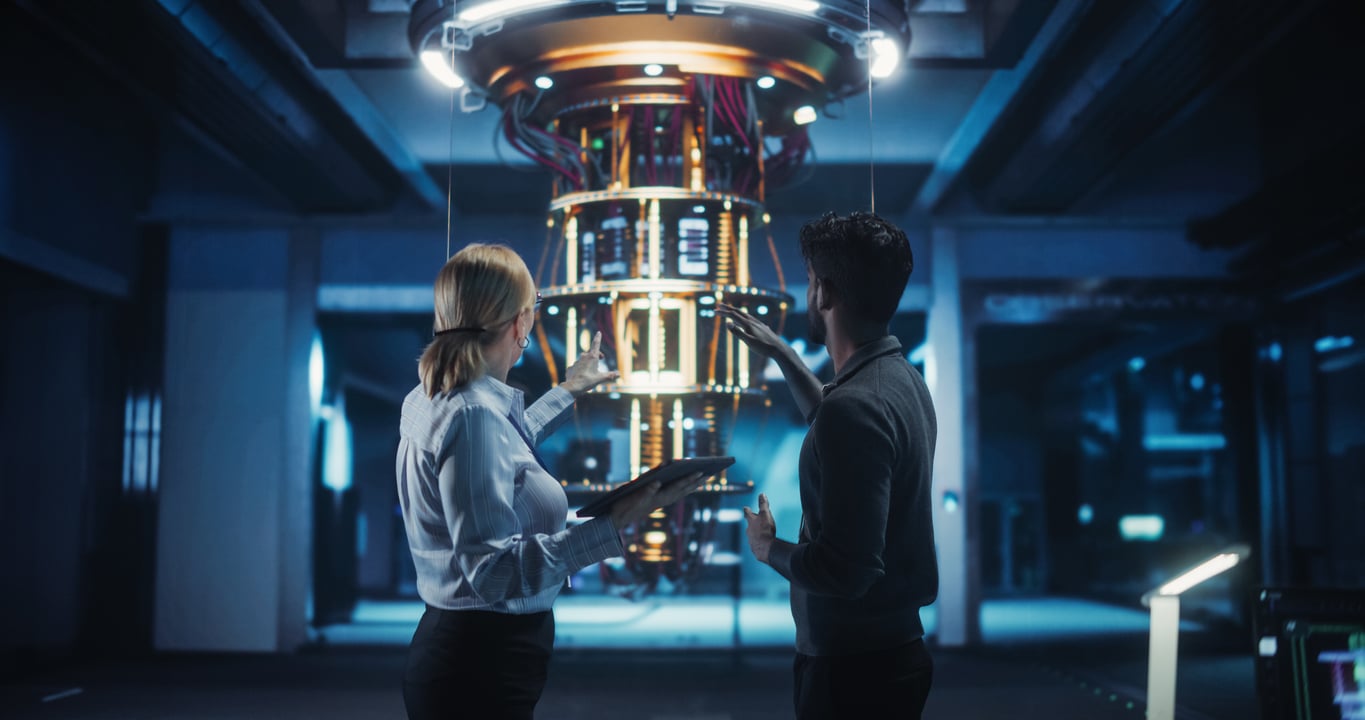
Image source: The Motley Fool.
DATE
Monday, May 11, 2026 at 4:30 p.m. ET
CALL PARTICIPANTS
- Chief Executive Officer — Yuping Huang
- Chief Financial Officer — Christopher Roberts
TAKEAWAYS
- Revenue -- $3.7 million, rising sharply from $39 thousand due to acquisitions.
- Ex-Acquisition Revenue -- $204 thousand, derived from foundry orders and an R&D subcontract with NASA.
- Contract Backlog -- $16 million reported at quarter-end.
- Operating Expenses -- $19.8 million, compared to $8.3 million, driven by higher staff costs and M&A expenses.
- Sales and Marketing Expenses -- $1.6 million, up from $700 thousand, primarily due to employee compensation and expanded customer engagement.
- General and Administrative Expenses -- $11.3 million, up from $4.6 million, mainly because of $6 million in M&A-related costs for the NuCrypt and LSI deals.
- Net Loss -- $4.1 million, or $0.02 per share, compared to prior net income of $17 million which was related to a non-cash derivative liability gain in 2025.
- Cash, Cash Equivalents, and Investments -- $1.4 billion at March 31, 2026, versus $1.5 billion at year-end 2025.
- Interest Income -- $13.5 million, up from $1.7 million, indicating higher returns on invested assets.
- Total Assets -- $1.6 billion, stable compared to year-end 2025 data.
- Stockholders' Equity -- $1.6 billion at the start of 2026, unchanged from prior year-end.
- M&A Activity -- Acquisitions of Lumina Semiconductor, Inc. and NuCrypt LLC completed, leading to increased manufacturing, photonics, and quantum communication capabilities.
- Fab One Operations -- Tempe, Arizona facility initiated small-batch manufacturing and generated early revenue but is primarily positioned for R&D.
- Fab Two Progress -- Planning phase for a second, higher-volume foundry to support scalable quantum manufacturing.
- Dirac-3 Commercial Partnership -- QCI Dirac-3 machine placed on Quantum Corridor’s quantum-safe network, representing the first known commercial data center deployment for this product.
Need a quote from a Motley Fool analyst? Email [email protected]
RISKS
- Chief Financial Officer Roberts said, "Gross margins came in pretty low. What is driving that is underutilization. As you probably understand, the chip business is very capital intensive, and the capital equipment, once you turn it on and start using it, you have to amortize that. When utilization of the facility falls below a certain point, you just have a lot of cost with relatively little revenue to offset it. That affected the gross margins in Q1. We started recognizing revenue in Fab One, but that required us to recognize a lot of the production overhead costs, which is part of accounting. Same thing with Lumina: they are coming out of the Lumina technology bankruptcy and going through a phase where the production volume was a little on the low side, so there is a lot of unabsorbed cost that hit the gross margins," citing both Fab One and Lumina operations as underutilized and negatively impacting profitability.
- Roberts stated, "M&A costs were close to $6 million in the first quarter. There are a lot of legal fees, due diligence fees, and banker fees. It is an expensive process, and that caused a spike in G&A."
- Management indicated that Fab One's contribution remains "several orders of magnitude below what we are seeing from Lumina, and it probably will remain considerably smaller," signaling limited near-term revenue impact from this facility.
- Yuping Huang said, "We have not started to make the prototypes yet; instead, we are testing our photonic integrated circuits at this time," explicitly acknowledging that foundational engineering on gate-based quantum technology is incomplete and commercial timelines remain uncertain.
SUMMARY
Quantum Computing (QUBT -5.85%) reported transformational top-line growth through the recent acquisitions of Lumina Semiconductor, Inc. and NuCrypt LLC, with these additions now driving the bulk of revenue and broadening its portfolio in photonics and quantum communications. Management emphasized ongoing integration efforts and disclosed a substantial contract backlog, suggesting initial traction in commercial and government engagements but refrained from issuing precise forward guidance. The company advanced its dual foundry strategy, with Fab One supporting R&D and Fab Two in planning for higher-scale manufacturing, while simultaneously highlighting ongoing engineering hurdles in its gate-based quantum computing initiatives. Executives cited significant M&A and integration-related costs leading to elevated operating expenses and depressed gross margins for the period, and maintained confidence in accessing new markets via newly acquired international and defense-sector pipelines.
- Yuping Huang described the core engineering challenge for gate-based machines as "other half is that we need to increase the quality factor of our microring resonators to above 10 million. Right now, we are at around 2 million."
- Roberts stated, "I do not anticipate a lot of direct cost savings from redundancies. All the companies were operating with fairly lean back-office staff, but we are finding synergistic activity between the different teams that will help us grow and integrate."
- Photonic component requirements for quantum applications were detailed: "you have to start with a very high-quality laser with narrow linewidth and with almost zero phase noise, especially in the wavelength channels of the entangled photons."
- The company highlighted customer response to acquisitions as "The reaction of the market has been positive, and our sales activity reflects that," with business development momentum cited but no explicit near-term revenue forecasts offered.
INDUSTRY GLOSSARY
- Fab: Abbreviation for semiconductor fabrication facility, where integrated circuits or photonic devices are manufactured.
- Parametric Down-Conversion: A quantum optics process where a photon is converted into a pair of lower-energy entangled photons, central to generating quantum entanglement.
- Microring Resonator: A type of photonic device used to manipulate light on a chip, with its "quality factor" indicating efficiency and loss levels, relevant for photon-photon interactions in quantum circuits.
- Dirac-3: Quantum Computing, Inc.'s proprietary quantum optimization machine, referenced as the first installed in a commercial quantum data center setting.
Full Conference Call Transcript
Yuping Huang: Good afternoon, and thank you for joining us for the Quantum Computing, Inc. first quarter 2026 earnings call. We made meaningful progress in 2026 executing on our strategic initiatives and furthering our mission of delivering accessible, scalable, and cost-effective quantum machines and photonic solutions for practical use across high-growth markets that include high performance computing, artificial intelligence, cybersecurity, aerospace and defense, and advanced sensing and imaging. We completed two key transactions during the quarter, closing the acquisitions of Lumina Semiconductor, Inc. and NuCrypt LLC. Lumina Semiconductor, which I will refer to as LSI going forward, represents a significant milestone in Quantum Computing, Inc.’s strategy to build a vertically integrated, product-driven photonics and quantum technology platform.
LSI brings established capabilities in lasers, detectors, advanced packaging, and testing, has a strong photonics customer base, and has broad R&D and manufacturing capabilities that we believe strengthen our ability to move from small batch to higher-volume production. Included in LSI’s portfolio are three key subsidiaries. The first is Freedom Photonics. Freedom Photonics is a leading-edge R&D and manufacturing facility that provides unique photonic components, modules, and subsystems, and it is recognized for world-class semiconductor laser technology with approximately 25 issued and pending patents. The second is EM4. EM4 is a Class 10 thousand certified, humidity-controlled cleanroom facility and a leading provider of subsystem design and manufacturing, offering comprehensive photonic and fiber module solutions.
The EM4 facility is a major supplier serving U.S. government programs and European defense and space markets. And finally, Opto Gration has a chip manufacturing facility and a device assembly and testing facility specializing in design, assembly, testing, and low-volume component production. We are currently integrating LSI, and we are excited to onboard their experienced team of operators, engineers, and scientists to expand our depth of talent and execution capacity. We are focused on serving and expanding LSI’s existing client base and utilizing their technology and products to drive quantum commercialization in our target markets. The second acquisition completed in the quarter is NuCrypt.
NuCrypt’s primary patent portfolio spans quantum optics, RF photonics, and photonic signal processing, which can generate, measure, and distribute entangled photons over fiber optic cables. Organizations such as NASA, the U.S. Army Research Laboratory, and major global research universities as customers have used NuCrypt’s technology. NuCrypt’s suite of quantum communications systems and products will enable us to further advance our technology roadmap while bolstering our product and solutions portfolio, with a goal of further improving the performance, robustness, and scalability of our technology. We announced a key partnership with Quantum Corridor, which placed a QCI Dirac-3 quantum optimization machine on Quantum Corridor’s network, an interstate quantum-safe commercial communication network in North America.
The optimization machine is intended to provide enhanced, secure, and on-demand direct access for institutions and commercial customers on Quantum Corridor’s network. We believe this is the first data center installation of a Dirac machine and the first installation of its kind in a commercial data center environment. This collaboration marks a significant step forward in our commercial deployment strategy, expanding practical access to a quantum infrastructure for both academic and enterprise users and reflecting our commercial strategy to make high performance quantum solutions readily available in IT ecosystems. On the foundry front, our chief flagship R&D and manufacturing facility in Tempe, Arizona, also known as our Fab One, has been ramping up small-batch manufacturing.
The foundry’s capabilities include nanofabrication and inspection, multi-physics simulation, in-house design and dicing, and prototype packaging. While the facility has begun generating early revenue, it is important to note that its primary use is as a research and development facility. We are actively in the planning phase and assessing options for a Fab Two facility, a second, much larger foundry which can support higher volume production to extend our long-term manufacturing capacity and enable widespread deployment of quantum-powered hardware. It is our intent that Fab Two will be where quantum manufacturing becomes scalable. We look forward to keeping you apprised concerning our Fab Two strategy and timelines as it progresses.
We have made progress on our technology roadmap as we work toward our commercial strategy of bringing quantum products to a broad market by evolving from a technology innovator into a full-scale manufacturer capable of delivering quantum-enabled systems at industrial scale. It is becoming increasingly clear that we are well positioned in the marketplace. We believe we have a strong quantum optics and integrated photonics foundation that enables affordable and deployable quantum hardware. By focusing on quantum photonics, our technology has the ability to operate at room temperature, dramatically reducing system footprint, complexity, cost, and power requirements.
We are following a strategy focused on manufacturing built for scale as we further refine our Fab One facility and advance planning on Fab Two. And finally, we believe we are gaining traction across strategic partnerships and government collaboration. Our guiding principles of practicality first, scalability by design, accessibility for all, and innovation with a purpose remain at the core of everything we do as we build the future of quantum for everyone. I will now turn the call over to Christopher Roberts, our Chief Financial Officer, to discuss our first quarter 2026 financials.
Christopher Roberts: Thank you, Yuping. I am pleased to announce that revenue for the first quarter totaled $3.7 million compared to $39 thousand in the prior-year quarter. The year-over-year increase was driven primarily by the acquisition of Lumina Semiconductor in early February and, to a lesser extent, revenue from the acquisition of NuCrypt in early March. Excluding the LSI and NuCrypt contributions, Quantum Computing, Inc. revenue for the first quarter totaled $204 thousand, consisting primarily of deliveries of foundry orders and work on an R&D subcontract for NASA. Operating expenses for the first quarter totaled $19.8 million compared to $8.3 million in the same quarter last year.
The increase in operating expenses was due to a substantial increase in staff, including administrative, technicians, engineering, and scientific, which resulted in increased R&D expenses, product development, and sales and marketing expenses. Sales and marketing expenses for the quarter were $1.6 million compared to $700 thousand in the prior year, increasing primarily as a result of employee compensation costs, customer lead generation activities, trade show participation, advertising, and other marketing and selling costs. General and administrative expenses for the quarter were $11.3 million, compared to $4.6 million in the prior year, increasing primarily due to substantial M&A transaction expenses in the quarter for the NuCrypt and LSI transactions.
We reported a net loss of $4.1 million for the first quarter, or $0.02 per share, compared to net income of $17 million in 2025, or $0.13 per share. To put this change in the proper context, as previously reported, the $17 million net income in 2025 was primarily attributable to a $23.6 million non-cash gain on the mark-to-market of the company's derivative liability, which relates to warrants issued for our merger with QPhoton in June 2022. Our balance sheet continues to be strong. We reported cash, cash equivalents, and investments of $1.4 billion at 03/31/2026, compared to $1.5 billion at 12/31/2025. Interest income in 2026 was $13.5 million, up from $1.7 million in the prior-year period.
At 03/31/2026, total assets were $1.6 billion, relatively unchanged compared to 12/31/2025. Stockholders' equity was also $1.6 billion at 01/2026, again essentially unchanged compared to year-end 2025. Our contract backlog as of March 31 was strong at $16 million. I will now turn the call back over to Yuping.
Yuping Huang: Thank you, Chris. As we move through the remainder of the year, we are intently focused on investing in our team across engineering, research, and production; converting a growing pipeline of commercial and government engagement into recurring revenue; strengthening our fabrication capabilities; and executing on both organic and inorganic growth opportunities to drive long-term value creation. We have a very strong balance sheet and healthy backlog, and we are energized by the path in front of us as we continue advancing our mission of putting quantum-enabled solutions into the hands of people. As always, thank you for your ongoing support. We look forward to keeping you apprised of our progress as we continue to move through the year.
We will now open the call for questions. Operator, please go ahead.
Operator: Thank you. At this time, we will be conducting a question-and-answer session. You may press 2 if you would like to remove your question from the queue. One moment, please, while we poll for questions.
Operator: The first question today is coming from John McPeak from Rosenblatt Securities. John, your line is live.
John McPeak: Thank you, and congrats on completing the acquisitions, Chris and Yuping.
Christopher Roberts: Thank you, John.
Yuping Huang: Thank you.
John McPeak: One question forks into two. Where are we with the R&D effort on the next Dirac rack and then also your gate-based quantum computer? Maybe you could just talk a little bit about that, Yuping.
Yuping Huang: Yes. We have made very good progress on the next version of the Dirac machine. In fact, we are in the phase of internal testing, and every day when I come to the lab, people are telling me exciting new results. I hope that we will be able to complete the last steps and put this in front of early users. For the gate-based machine, we are making good progress on two fronts. One front is that we continue our engineering designs so that we can push up our gate fidelity under the theoretical framework.
As we have discussed before, John, we have spent quite a few years on this, and we believe that we have figured everything out on the theoretical and engineering side to construct a gate-based machine. On the other hand, to realize photon-photon interaction gates, it is crucial for us to get extremely high-quality photonic circuits in thin-film lithium niobate based on our patented technology. On the fab side, we have made good progress in optimizing our recipe so that we can meet those very high requirements for the photons to interact strongly with each other. So on the gate-based machine, we have made good progress, but there is still some way ahead of us to test our prototypes.
We have not started to make the prototypes yet; instead, we are testing our photonic integrated circuits at this time.
John McPeak: That modality looks like, for the other companies that are attempting to produce gate-based photonic computers, they are talking a fair ways out because of the technology you are talking about. Do you feel like you will be in the mix when other companies are starting to deliver theirs?
Yuping Huang: Let me put it this way, John. We chose our gate-based approach to be scalable. Instead of trying to demonstrate some proof of concept, from the very beginning we have designed our gate-based machine so that once we can test the principle on the prototype, we can quickly scale up in terms of both the gate circuit depth and the number of qubits. Right now, we are looking at overcoming the last and final hurdle on the engineering side, and with that overcome, we should be able to quickly ramp up.
This is why, although we started relatively later than some other players on gate-based machines, I am confident that as we figure out the final steps of engineering, we can quickly catch up. The advantage of our approach is that it is very scalable, it runs at room temperature, and everything is chip-integrated.
John McPeak: Alright. I look forward to hearing more in the future. Thank you. I will get back in the queue.
Yuping Huang: Thank you, John.
Operator: The next question is coming from Maxwell Michaelis from Lake Street Capital.
Maxwell Michaelis: Hey, thanks for taking my questions. Thanks for sharing some of the data around backlog. It was $16 million at the end of the quarter. Is there any way you can give us insight on how that has trended now that we are a little deeper into Q2? I know you are not giving specific guidance, but maybe a little bit of help on how that backlog has trended throughout the past couple of weeks?
Christopher Roberts: What we are finding, Max, is that the customer community is very pleased with the combination of the companies. Some of the risk that was associated with the Luminar bankruptcy has dissipated. We are pursuing a lot of opportunities. There is nothing I can specifically announce today, but what I will say is that we are seeing a pickup in our business development activity and the pipeline, and I think we will have a lot more going forward. The reaction of the market has been positive, and our sales activity reflects that.
Maxwell Michaelis: Awesome. And then last one from me. So Lumina and then NuCrypt were the two acquisitions. Give us an idea on what some of the areas you are headed toward next. Probably cannot share a lot, but give us an idea on what is at the top of mind for you in terms of importance in filling out your platform.
Yuping Huang: I can answer this, Max. We have announced that over the next few years we will focus on the transition from a tech innovation company to a volume production company. We have been very happy with the acquisition of Lumina Semi, and NuCrypt really enhances our depth and breadth of technology, engineering, and manufacturing capabilities. Going forward, we will continue to execute our roadmap as we published on our website last year. We are looking to execute our Fab Two plan, and I did make a promise that we will get our Fab Two started. This is what we are focusing on now, and it looks like we have some pretty exciting development on that front as well.
We hope to keep the community updated on that as we make progress.
Maxwell Michaelis: Alright. Thanks, guys.
Yuping Huang: Thank you, Max.
Operator: Once again, it will be star one on your phone at any time if you wish to ask a question today. The next question is coming from Wedbush Securities. Your line is live.
Analyst: Thank you, and thanks for taking my questions. I need to add on to what Max was asking about LSI and NuCrypt. On those integrations, you mentioned these companies are bringing established capabilities in lasers, detectors, advanced packaging, and broad R&D and manufacturing capabilities. Can you give us a sense of the financial synergies, and more importantly, the technical synergies that you expect to realize with these two recent acquisitions? How are the integrations coming along?
Yuping Huang: Sure. Let me answer the question on the technical synergy, and Chris can answer the financial synergy. On the tech side, as we discussed in the past, our goal is to develop complete quantum products and solutions. For that, we need not only our core quantum nonlinear optical technology and circuits, but also photonics products and controlling electronics, for example. With Lumina Semi, they have very strong capabilities in lasers, photodiodes, optical packaging, and testing. We have launched a handful of initiatives leveraging their team and manufacturing capabilities to advance our quantum device and systems development. In the meantime, we are working with them to develop and commercialize photonics for quantum.
As many of you know, quantum technology requires specialty photonic components and circuits, and now we have a team that understands both photonics and quantum. We are in a unique position to provide solutions and become a supplier for photonics for quantum. Regarding NuCrypt, we already have very high synergy in the areas of quantum communications technology and systems. Our approach to quantum communication is complementary to NuCrypt’s. Together we offer a complete toolbox and a whole suite of quantum communications technology that should be able to meet the needs of the majority of customers. Chris, would you talk about the synergy on the other side?
Christopher Roberts: Sure. It is a really good question. The short answer is that the companies are all small, so there is not a big back-office processing center we can consolidate with another one. However, now that we are close to 200 people, we are able to get better bids on things like employee benefits, and insurance is a little bit more cost effective. There are some things that benefit from scale. The other part that touches on finance but also rolls into what Yuping was talking about is business development.
As a combined entity, we are able to go after some very interesting opportunities by combining either the core Quantum Computing, Inc. technology with the NuCrypt technology or with the LSI technology, or some combination of those. We are able to go after more business than we were before, so there is a synergy there. I do not anticipate a lot of direct cost savings from redundancies. All the companies were operating with fairly lean back-office staff, but we are finding synergistic activity between the different teams that will help us grow and integrate.
The skill sets of the financial, legal, and contracts staff of the different companies are complementary, they work well together, and they are making us more effective. I hope that answers your question.
Analyst: It does, and thank you both for the very comprehensive answers. Last quick one from me. On Fab One, you mentioned you are ramping small-batch manufacturing and it has begun to generate early revenue. Can you give us a sense of the expected ramp in revenue from here through the rest of the year and into 2026? Can you compare that to the revenue you expect to generate from the LSI acquisition, which I believe you had pointed to as $20 million to $25 million in annual run rate? Beyond that, is there any other contribution from your Fab One manufacturing revenue?
Christopher Roberts: Let me take that one. As we disclosed, of our $200-and-some-thousand revenue in the prior period, $120-and-some-thousand was directly from foundry-related sales, which is a four- to five-fold increase over 2025. As we get better at processing these advanced circuit designs, we are confident that is going to continue to grow, probably not at a dramatic pace, but we are getting better at it. Putting together a chip fabrication facility is not just a matter of plugging in the machines and turning them on. There is a lot of know-how and skill that goes into producing these advanced prototype chipsets.
The contribution of the fab is several orders of magnitude below what we are seeing from Lumina, and it probably will remain considerably smaller. But we expect that to grow as we successfully deliver these prototype chips, interact with customers, hopefully get follow-on orders, and take it from there.
Yuping Huang: I just want to add that we did not design Fab One to become the engine of revenue. In our strategic plan, we are looking at Fab One as our engine for innovation and chip production validation, a necessary and very helpful step toward Fab Two. We are using Fab One to understand better what it takes for us to get to A1 production of chips. We need to first develop and stabilize lots of recipes. As Chris said, it is not just turning on the machine and automatically getting a lot of chips. There is a lot of work to develop the know-how and later transfer that know-how to our Fab Two.
Analyst: Understood. Thank you so much.
Yuping Huang: Thank you.
Operator: The next question will be from Troy Jensen from Cantor Fitzgerald. Troy, your line is live.
Troy Jensen: Hey, thanks for sneaking me in here. A couple of questions for Chris. First, on gross margins, I am thinking there might have been some one-time stuff in March. Going forward, as LSI is fully integrated and we have a full quarter, are gross margins in the 25% to 35% range? Any help on that would be great.
Christopher Roberts: Sure, appreciate you picking up on that. Gross margins came in pretty low. What is driving that is underutilization. As you probably understand, the chip business is very capital intensive, and the capital equipment, once you turn it on and start using it, you have to amortize that. When utilization of the facility falls below a certain point, you just have a lot of cost with relatively little revenue to offset it. That affected the gross margins in Q1. We started recognizing revenue in Fab One, but that required us to recognize a lot of the production overhead costs, which is part of accounting.
Same thing with Lumina: they are coming out of the Lumina technology bankruptcy and going through a phase where the production volume was a little on the low side, so there is a lot of unabsorbed cost that hit the gross margins. We should be able to get back to 20% to 30% as volume picks up, but I cannot really tell you exactly how long it is going to take to get there.
Troy Jensen: Understood. That was helpful. And can you give a little color on the OpEx line? You mentioned a lot of M&A-related expense in G&A. If you strip that out and think of a normal G&A quarter—and on the flip side, R&D should go up because you have a full quarter of LSI—just thoughts on OpEx sequentially here?
Christopher Roberts: M&A costs were close to $6 million in the first quarter. There are a lot of legal fees, due diligence fees, and banker fees. It is an expensive process, and that caused a spike in G&A. In terms of other run rate, keep in mind that in the first quarter we added the management cost, or G&A cost, of Lumina and NuCrypt to the total. There are more people and more G&A-related expenses. The increase was in line with what we would expect given that Quantum Computing, Inc.’s core staff was 75 people and we brought on another 100 people in the first quarter.
Most of the costs, other than the M&A-related external costs, are driven by the increase in headcount.
Troy Jensen: Got it. Alright, guys. Thanks. Good luck going forward.
Christopher Roberts: Thank you. Appreciate your joining the call.
Yuping Huang: Thank you, Troy.
Operator: Thank you. The next question will be from Northland Capital. Your line is live.
Analyst: Thank you, and congrats on the acquisition, especially the Lumina one. Very nice. Just to put a point on it, can you explicitly say what is the new quarterly OpEx run rate with these acquisitions now folded in?
Christopher Roberts: I do not have that number at this point, so I am going to dodge that question for the moment.
Analyst: Alright, that is fine. Yuping, can you describe the final engineering hurdle in more detail that is currently being worked on, related to one of the questions asked earlier?
Christopher Roberts: Is that regarding the Dirac-3 capability hurdle or the gate model hurdle?
Analyst: Gate model hurdle.
Yuping Huang: Okay, the gate model hurdle. Very good question. I have been thinking about this question of how to build a room-temperature quantum computer for over ten years. In fact, it is close to fifteen years. I believe we have figured out everything on the technology and physics side, but the last remaining hurdle is on the engineering side. Through our validated simulation and based on many of our proof-of-concept experiments, we have identified that we have to achieve five pretty extreme conditions for the photons to interact strongly with each other—that is, to bring nonlinear optics to the single-photon level. So far, we have achieved four and a half.
The other half is that we need to increase the quality factor of our microring resonators to above 10 million. Right now, we are at around 2 million. We have the recipe and have done a lot of tests to find a way to get it to 10 million. I am confident we can achieve this, but we need to give our engineers in Fab One a little more time so they can consistently achieve over 10 million on the chips we make, because eventually it is not that we need just one gate—we need to integrate tens to hundreds of gates on a single integrated square chip. So this is the last engineering hurdle.
Analyst: Okay, that is great. Thank you for that detail. You also mentioned that there are some specialty photonics components for quantum. Which particular components are specific to quantum?
Yuping Huang: For example, the way we create quantum entanglement in photonics is by using a laser to drive what people call the spontaneous parametric down-conversion process. In order to have very high purity in the generated entangled photon pairs, you have to start with a very high-quality laser with narrow linewidth and with almost zero phase noise, especially in the wavelength channels of the entangled photons. You have to make sure the laser itself is very clean. This requirement is very stringent and often pertains specifically to quantum entanglement generation. Another is that, as you know, for quantum we have to minimize losses. If a photon is lost, it is lost and the game is over.
We need to minimize loss all the way through the transmission line. This is hard and is also a unique requirement for quantum. There are other special requirements for photonic devices suitable for quantum applications.
Analyst: Thank you very much for that explanation.
Yuping Huang: Thank you.
Operator: The next question will be from Ed Woo from Ascendiant Capital. Ed, your line is live.
Ed Woo: Congratulations on all the progress. My question is, Quantum Computing, Inc. has typically focused on domestic opportunities. Will the acquisition of NuCrypt and LSI diversify your potential revenue and geographic reach?
Yuping Huang: Yes. In fact, NuCrypt was one of the very first companies in the U.S. to start commercializing quantum communication technology. They have sold their product to quite a few countries in the world, and we plan to tap into those successes and use that pipeline to expand our overseas commercial presence. EM4 already has a strong base in defense and aerospace, not only in the U.S. but also in Europe. This is also an area that we will continue to support and potentially grow, and we will utilize those pipelines to quickly expand our quantum product market.
Ed Woo: Thanks for answering my questions, and I wish you good luck.
Yuping Huang: Thank you very much, Ed.
Operator: This does conclude today’s Q&A. I will now turn the call over to management for final remarks.
Yuping Huang: Thank you for your time. We really appreciate you joining our call and your questions. Should you have any further questions, please feel free to reach out to our investor relations. I wish everybody a great rest of your day. Thank you.
Operator: Thank you. This does conclude today’s conference. You may disconnect your lines at this time. Thank you for your participation.