Are you looking to turn your hard-earned wages into a nice nest egg for later in life? If you're reading this, then you probably are. And if you're reading this, you also likely know the stock market is the best way to outgrow the impact of inflation. Savings accounts, CDs, and even corporate bonds just aren't up to the job.
The thing is, reaping nice gains from stocks doesn't require a lot of time, effort, or maintenance. You're arguably better served by being a truly passive investor and simply leaving things alone for years on end. Here's an easy recipe for multiplying your investments by a factor of 10 -- and it doesn't even require starting with a big chunk of cash.
1. Buy into the broad market each and every year
There are several ways to skin a proverbial cat, but the easiest way is also arguably the best way. That's buying into a broad market index like the S&P 500 with an instrument like the SPDR S&P 500 ETF Trust (SPY -0.35%). This index fund offers you balanced exposure to 500 of the world's largest companies' stocks, effectively allowing you to participate in their long-term growth, which averages 10% per year. Some years are better, and others are worse. Over time, however, you can expect to average a gain of around 10% per year.

NYSEMKT: SPY
Key Data Points
The key is making regular investments, even when doing so feels uncomfortable, and even if doing so means you have to cut back on some of your discretionary spending. As you'll see in a moment, a seemingly modest investment made consistently can become a surprisingly large sum of money later. Likewise, failing to make this contribution year in and year out can dramatically eat into your eventual nest egg.
Still too much of a hassle? Note that most brokerage firms can automate the process of regularly moving money from a checking or savings account to your investment account and also automate the actual annual (or monthly) investment in a fund.
2. Reinvest dividends and any capital gains
When you're buying a stock or a fund, you'll usually have the option at the time the trade's being placed to reinvest any dividends that position pays out into more of the same stock or same fund. Choose "yes" when given the choice, and if your position is already established, contact your broker -- or log in to your brokerage account -- and switch to this setting.
Sure, it's tempting to simply accept dividend payments in cash. You'll have access to this spendable money as it comes in, even if your ultimate goal is using these payments to buy more stocks or purchase other mutual funds. The thing is, too many investors never really get around to doing that, missing an important growth opportunity by sitting idly on their cash or cash-like holdings.
Here's an example that just might motivate you to make this one-time switch: While the S&P 500's average annual return was an impressive 11.4% over the past 10 years, that figure rises to 13.5% if you had reinvested all of the dividends you collected over that period. That's a huge difference over time.
3. Leave it alone for as long as possible
Last but not least (and this is the tough one), do step No. 1 for decades, making sure step No. 2 applies to any new as well as any old money put into retirement savings.
If you've set up your brokerage accounts and automated investments properly, the only thing you'll have to do to successfully complete step No. 3 is, well, nothing. Assuming a 10% annual return for the S&P 500, a typical career-long stretch should put your portfolio's value somewhere on the order of 10 times your total contributions over that time span.
Surprised? Don't be. The graphic below illustrates how an annual investment of $5,000 made for 36 consecutive years -- $180,000 of your own contributions -- will be worth around $1.8 million at the end of that time frame.
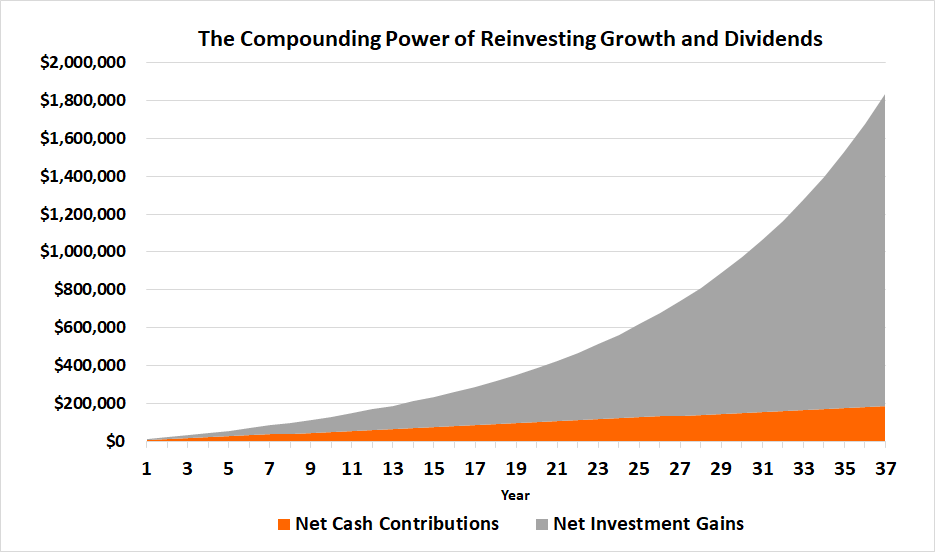
Calculations by author via Calculator.net. Chart by author.
It's called compounding. In this case, what's notably compounded is your past earnings, whether they came from dividends or capital appreciation. That is to say, the bulk of the growth here comes from your earnings, not your annual contributions, so the new gains on previous gains. For perspective, during the last year of this hypothetical 36-year stretch, the average 10% market gain would translate into net growth of over $163,000, dwarfing the final year's new-cash contribution of $5,000.
Of course, the sooner you start earning anything, the more that growth can help you in the future.
Less is more
The formula isn't a complicated one. In fact, investors who make a point of keeping things simple often tend to achieve better results; the quest for market-beating returns by frequently trading individual stocks (ironically) often leads to market-lagging performance. Index funds solve that problem quite nicely.
It also wouldn't be wrong to set up your scheduled deposits, investments, and reinvestments in index funds and then not look back for years on end. This approach circumvents the risk of trying to time the market -- automation helps enormously in this regard.
The toughest part, then, is getting started as early as you can and staying committed to your automated plan for as many years as you feasibly can. Even if you have to make some tough spending choices to make it happen, in the long run it's worth the sacrifice.