In the artificial intelligence (AI) era, the companies striking gold are building and training AI models, integrating AI capabilities to enhance existing software (like Meta Platforms), and creating AI-powered data analytics (like Palantir Technologies).
Companies that sell picks and shovels can be attractive investments because they benefit from demand for gold mining, rather than relying on a lucky strike to win big. And in AI, the pick-and-shovel players have often been superior investments to companies that are monetizing AI within their operations.
For example, Nvidia, Broadcom, and Advanced Micro Devices make chips and associated infrastructure that are integral in data centers. Amazon Web Services, Microsoft, and Alphabet's Google Cloud are providing the computing power and storage necessary to train AI models and tools.
As good as these companies have been, there's an even simpler way to invest in AI for decades to come. You won't find this company in the S&P 500 because it's based out of a small city in the southern Netherlands. But it's the most valuable company in Europe. Its name is ASML Holding (ASML +2.07%), and without it, the pace of innovation in AI simply wouldn't be possible.
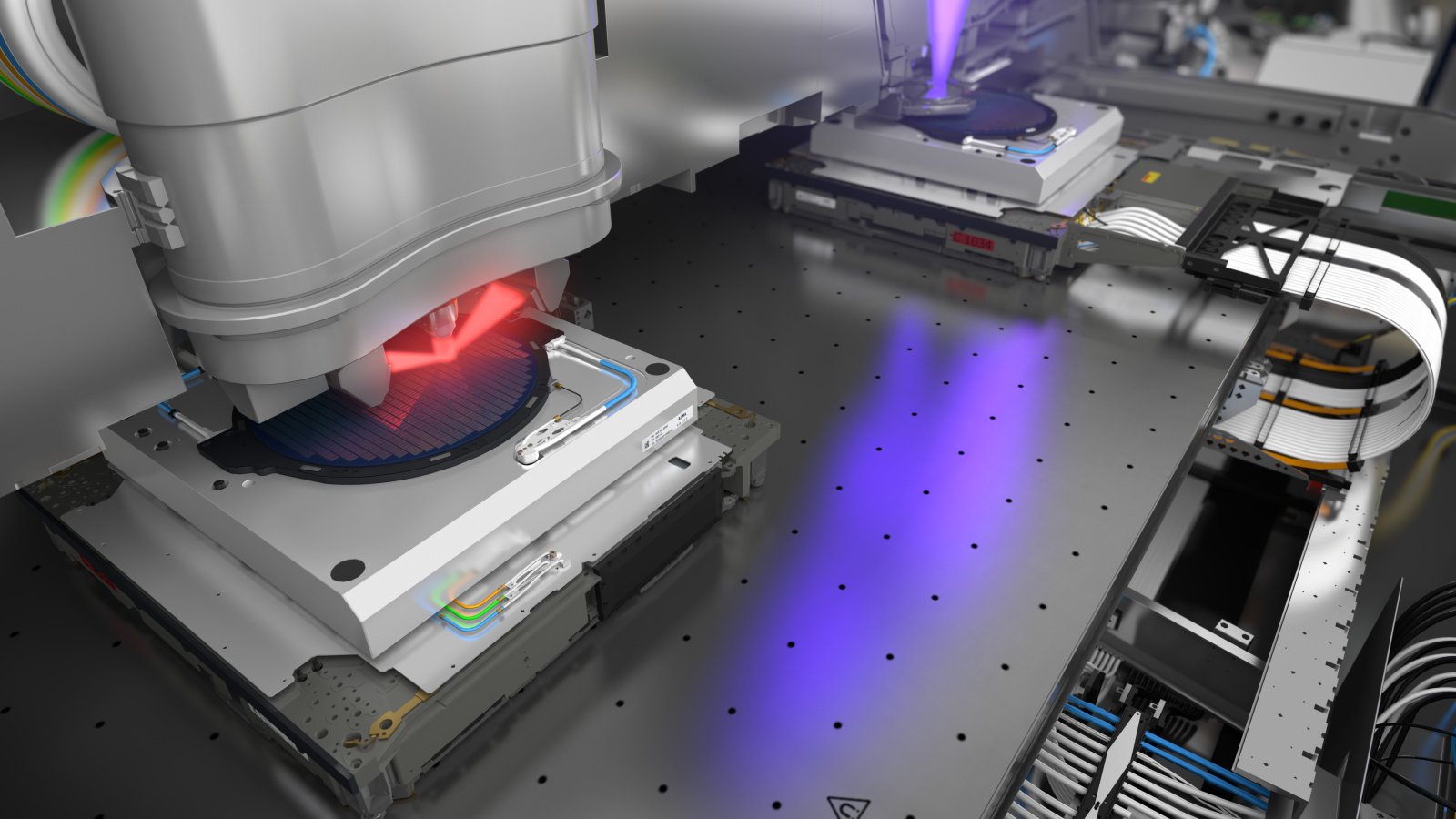
Image source: ASML.
ASML's role in chipmaking
Making AI chips involves arguably the most advanced manufacturing process in the world.
Semiconductor foundries -- like Taiwan Semiconductor Manufacturing, Samsung Electronics, and Intel -- operate fabs that include highly sophisticated machinery, such as deposition equipment made by Applied Materials and Lam Research, lithography machines made by ASML, plasma etching machines (Lam Research's specialty), polishing machines, metal deposition, process control solutions made by companies like KLA, and more.
Each step in semiconductor manufacturing is a marvel in its own right. But lithography is the most critical step. And while there are other companies that can compete with ASML on its less advanced deep ultraviolet (DUV) machines, no other company comes close to the precision of the extreme ultraviolet (EUV) machines.

NASDAQ: ASML
Key Data Points
Pushing the limits of lithography technology
ASML's EUV machines reflect light using mirrors instead of refracting it with lenses. This process enables ASML to print circuit designs layer by layer onto silicon wafers with unparalleled precision, which is crucial for packing more transistors onto a microchip and advancing Moore's Law. EUV machines are crucial for producing today's most advanced graphics processing units (GPUs), central processing units, and dynamic random-access memory (DRAM) chips, which AI models use to store and quickly access data.
These EUV machines are needed to produce chips with nodes below 7 nanometers (nm) in high volume and at low cost. DUV machines simply can't handle these workloads unless they use techniques like multi-patterning, which exposes the silicon wafer multiple times. However, this process is less efficient and can be more costly at high volumes.
ASML has three different classes of NXE lithography systems designed to produce logic and memory chips in high volume at nodes ranging from 7nm to 5nm, 5nm to 3nm, and then 2nm. The machines have a numerical aperture (NA) of 0.33. But ASML's high-NA machines have NA ratings of 0.55.
The difference between DUV and EUV is that EUV uses 13.5nm light, which can print features with resolutions that are unattainable with wider 193nm DUV light. High-NA takes the process a step further by increasing the resolution. ASML's EXE platform (high-NA) can print transistors 1.7 times smaller, resulting in 2.9 times higher transitory density than the EUV NXE systems.
For now, this level of precision is a bit overkill. In its latest quarter, ASML booked sales of just nine EUV machines -- one of which was a high-NA system -- compared to over 50 DUV unit sales.
ASML is critical for producing next-generation AI chips
ASML has a clear roadmap for monetizing AI for decades to come. Its EUV machines are high-margin and are increasingly being relied on for advanced chips. And its high-NA machines will be needed as chip designers rely on even more precise processes.
Nvidia's next-generation GPU -- Rubin, which is a follow-up to Blackwell -- will use Taiwan Semi's 3nm process. Rubin Ultra is expected to be released in 2027 using Taiwan Semi's 2nm process node, whereas Blackwell uses a 4nm class process. Similarly, AMD's Instinct MI450 GPU will use Taiwan Semi's 2nm process.
More powerful GPUs pack more transistors per microchip, which increases transistor density and enhances output. However, to achieve this, chip designers rely on fabs with processes that can handle this level of precision.
And in all of those processes, regardless of the fab, ASML EUV machines are center stage. As the provider of EUV machines and next-generation high-NA EUV machines, ASML is extremely well positioned to capitalize on the push toward smaller and more powerful AI chips.
The ultimate way to capitalize on the AI gold rush
ASML is the ultimate "pick-and-shovel" stock for the AI era because it has a monopoly on the machines needed to produce today's most advanced AI chips at scale, as well as upcoming generations of AI chips.
Despite its advantages, ASML would be significantly impacted by changes in trade policy that could limit its exports to key markets. It's also prone to a downturn in the AI investment cycle, as ASML's future growth depends on chip manufacturers upgrading existing fabs with EUV systems and outfitting new fabs with the latest semiconductor equipment.
A big advantage for ASML is that it isn't a pure-play AI stock. Its machines, especially DUV, are used to produce a wide range of chips for various end markets. And a major part of its business is servicing its existing equipment. In its latest quarter, around 27% of sales were related to managing its installed base rather than selling new and used equipment.
All told, ASML is a straightforward way to invest in the overall growth of global semiconductor demand and AI, rather than betting on a specific chipmaker, cloud computing giant, or software company.