

Robinhood Markets (HOOD +2.86%) stock is still up by an eye-popping 225% year to date, but it's also in the midst of a correction, having sunk by about 20% from the peak it hit in October. The company operates a commission-free investing platform that is popular among younger investors who want to trade stocks, options, futures, and cryptocurrencies.
In addition, in August, the company signed an agreement with Kalshi to bring sports prediction markets to the platform, giving it a whole new revenue stream. The deal got Wall Street talking, adding fuel to the rally in Robinhood stock.
Despite some of the tailwinds in Robinhood's business, the majority of its revenue still comes from clients engaging in risky trading practices, which history suggests aren't sustainable. Further, the stock is trading at a sky-high valuation that could limit its upside from here.

Image source: Getty Images.
Cryptocurrency and options trading are fueling Robinhood's growth
The bulk of Robinhood's revenue comes from processing investment transactions on behalf of its clients. In my opinion, the composition of this transaction-based revenue is quite concerning. During the third quarter, it came in at a record $730 million, but $572 million was attributed to cryptocurrency trading ($268 million) and options trading ($304 million).
Its cryptocurrency business is extremely volatile. Back in the second quarter of 2021, its crypto revenue soared by 4,560% year over year and accounted for half of its total transaction revenue. However, a year later, that revenue stream had plunged by 75% as that crypto boom ran out of steam.
In the final quarter of 2024, Robinhood's crypto revenue soared to a new high of $368 million, then plummeted by more than 50% by the second quarter of 2025. And though it rebounded in the third quarter, I think another sharp decline is inevitable given the downtrends in some of the industry's most popular coins and tokens, which could push many investors onto the sidelines. For example, Dogecoin (DOGE +2.77%) is down 68% from its 52-week high, XRP (XRP +1.33%) is down 45%, and even Bitcoin (BTC +2.39%) has lost 32% of its peak value.

Image source: Robinhood Markets.
Options trading is another high-risk practice, because it involves making directional bets that often have all-or-nothing outcomes, especially when the contracts are very short-dated. Robinhood's options trading revenue typically grows when the stock market is rising, but declines sharply when markets fall because it becomes harder for traders to make money with that strategy.
The S&P 500 (^GSPC +0.19%) is currently near an all-time high, so it's no surprise Robinhood is bringing in a record amount of options revenue. However, when the tide eventually turns, the options and crypto businesses are likely to drag down the company's financial results, as they have in the past.

NASDAQ: HOOD
Key Data Points
Prediction markets are still a tiny part of the business
Prediction platforms like Kalshi offer an alternative to traditional sports betting services. They let gamblers trade in and out of contracts (like shares) that represent the likelihood of a specific event, such as the outcome of a football game. This is a bit different from placing a regular sports bet, which has a binary win-or-lose outcome.
But despite the hype surrounding Robinhood's entry into the prediction industry, it's a negligible part of the business. During the third quarter, it was generating about $115 million in annualized revenue from prediction markets, which would represent just 2.5% of the $4.5 billion in total revenue the company is expected to produce in 2025 (according to Wall Street's average estimate, provided by Yahoo! Finance).
On the plus side, that figure more than doubled from just three months earlier, so its prediction business is growing quickly. According to Grand View Research, the U.S. sports betting industry is worth about $20 billion annually, so Robinhood will have a big opportunity as it tried to capture more of that pie.
Trading at a lofty valuation
No matter how quickly Robinhood's prediction market revenue is growing, investors should still be cautious about buying its stock at the current level. It's trading at a price-to-sales (P/S) ratio of 27.7, which is more than double its average of 10.9 since it went public in 2021.
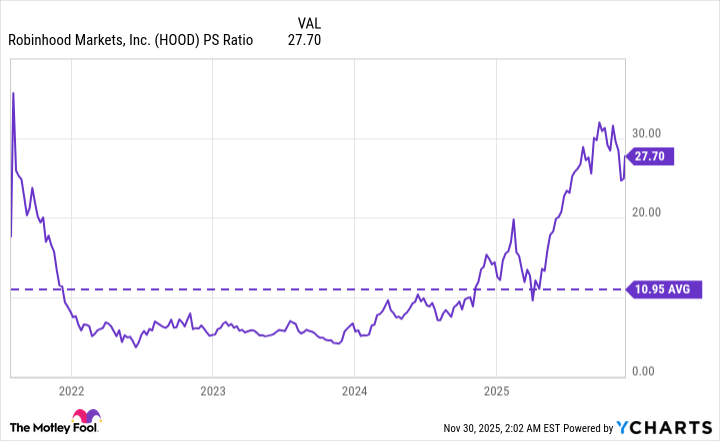
HOOD PS Ratio data by YCharts.
Robinhood would have to find a significant amount of new revenue in a short period of time to justify that valuation. If it doesn't, and the market revalues it back to a level in line with its long-term average P/S ratio, it could plummet as much as 60%. The stock crashed by more than 85% between August 2021 and June 2022 after a bull run in crypto and stocks faded, so it's certainly no stranger to sharp declines.
Prediction markets might not be the magic bullet investors are looking for in the short term. Kalshi was recently valued at just $11 billion in a private funding round. Robinhood's market capitalization is $115 billion as I write this, so it's hard to imagine this partnership making a noteworthy impact on the company's finances fast enough to warrant its lofty P/S ratio.
With all that in mind, I don't think the recent correction in Robinhood stock represents a buying opportunity.
