For the better part of the last three years, no trend has garnered more investor attention or capital on Wall Street than artificial intelligence (AI). Giving software and systems the tools to make split-second decisions and empowering them to become more efficient at their tasks over time, all without the need for human intervention, is a potential game changer for a host of industries around the globe.
Arguably, no two companies have been bigger beneficiaries of the rise of AI than graphics processing unit (GPU) titan Nvidia (NVDA 4.42%) and data-mining specialist Palantir Technologies (PLTR 1.42%). Since the beginning of 2023, Nvidia has added more than $4 trillion in market value, while shares of Palantir have skyrocketed by over 2,700%.
Although investors are expecting more of the same in 2026, the actions of those who know Nvidia and Palantir best tell a different story.

Image source: Getty Images.
Nvidia and Palantir have become the face of the AI revolution
What's allowed these two goliaths to stand out is their seemingly sustainable moats, which are hard to come by on Wall Street.
Nvidia's GPUs act as the brains of AI data centers and are the undisputed top choice by businesses. According to some analysts, Nvidia's chips account for more than 90% of all GPUs currently deployed in AI-accelerated data centers.
Even more important, Nvidia's AI hardware is unrivaled in terms of its compute abilities. Despite growing external competition, Nvidia's three most prominent generations of GPUs (Hopper, Blackwell, and Blackwell Ultra) are superior to other chips, which is allowing Nvidia to charge a premium price of $30,000 to $40,000 for each of its high-end GPUs. This has translated into a sky-high gross margin that's approaching the mid-70% range.
Don't overlook Nvidia's CUDA platform, either. This is the software toolkit developers use to maximize the compute potential of their Nvidia GPUs, including the building and training of large language models. CUDA is ensuring that businesses remain loyal to Nvidia's ecosystem of products and services.

NASDAQ: PLTR
Key Data Points
Meanwhile, Palantir Technologies' AI- and machine learning-powered Gotham and Foundry software-as-a-service (SaaS) platforms lack one-for-one replacements at scale.
Gotham is Palantir's SaaS platform that assists in the planning and execution of military missions for the U.S. government and its allies. Many of the contracts Gotham secures cover four or five years, resulting in highly predictable operating cash flow. This is also the segment that generates the lion's share of Palantir's profit.
Foundry is the company's subscription-based platform that helps businesses make sense of their data. Since it's a relatively new segment, compared to Gotham, it's expected to generate substantial revenue growth for the foreseeable future.
But when things seem too good to be true on Wall Street -- even for Wall Street's AI darlings -- they often are.

Image source: Getty Images.
Insiders at Nvidia and Palantir have sounded a warning
Although every next-big-thing innovation and technology faces potential hurdles, perhaps the biggest red flag for the rise of AI comes from within.
While investors wait impatiently for positive commentary from Nvidia CEO Jensen Huang and Palantir's boss Alex Karp, insiders at both companies have been sending shockwaves through Wall Street with their actions.
An "insider" is a member of the executive team, board of directors, or a beneficial owner of at least 10% of a company's outstanding shares. These are individuals who may have access to non-public information.
According to the law, insiders are required to file Form 4 with the Securities and Exchange Commission (SEC) no later than two business days after transacting in their company's stock. In simple terms, anytime an insider buys or sells shares of their company's stock, or exercises an option contract, they're required to file Form 4 and report it to the SEC. Though this is primarily done for the sake of transparency and to avoid instances of insider trading, Form 4 filings can sometimes speak volumes.

NASDAQ: NVDA
Key Data Points
Over the trailing five-year period, as of Dec. 5, insiders haven't been reluctant to sell their shares at Nvidia or Palantir. Cumulative net-selling activity for both companies is as follows:
- Nvidia: $5.4 billion in net stock sold by insiders
- Palantir Technologies: $7.2 billion in net stock sold by insiders
Collectively, insiders at both companies have dumped approximately $12.6 billion worth of their respective stock since early December 2020.
The catch is that not all insider selling is necessarily bad. Most executives and board members at Nvidia and Palantir receive a good chunk of their compensation in the form of stock and/or options. To cover the federal and/or state tax liability that comes with this compensation, insiders often sell a portion of their holdings. Tax-based selling isn't something that investors should be worried about.
What might be even more concerning is the unwillingness of insiders to purchase shares of their company's stock. Not one high-ranking executive or board member at Nvidia has spent a dime to buy their company's stock over the last five years. Meanwhile, just one insider purchase at Palantir, totaling about $1.16 million, has been made by an executive or director dating back to the company's public debut on Sept. 30, 2020.
Insiders at these companies are sending a clear message that their respective shares aren't attractively priced.
Although valuation is entirely subjective, history doesn't mince words when it comes to how pricey Nvidia and Palantir are amid an already expensive stock market. Historical precedent shows that megacap companies at the leading edge of next-big-thing trends haven't been able to sustain price-to-sales (P/S) ratios above 30 over the last three decades. Think of this as a line in the sand that helps investors identify bubbles before they burst.
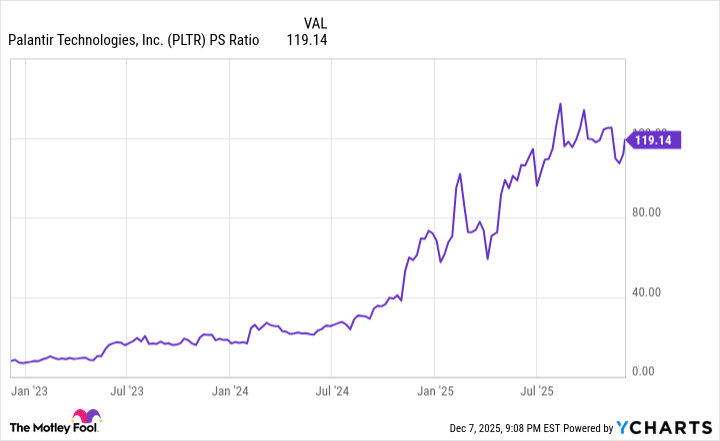
PLTR PS Ratio data by YCharts.
Prior to reporting its fiscal third-quarter operating results in November, Nvidia's P/S ratio surpassed 30. As for Palantir, its trailing 12-month P/S ratio is currently 119, and that's not a typo. There's virtually no sales or earnings growth rate that can support such aggressive valuation premiums for these two AI darlings.
There's also the very real possibility of history repeating itself in 2026. Since the proliferation of the internet in the mid-1990s, every game-changing technology and hyped innovation has navigated through a bubble-bursting event. In other words, investors have demonstrated a pattern of overestimating the adoption, utility, and optimization of new technologies, which has eventually led to lofty expectations not being met.
If an AI bubble does form and burst in the new year, Nvidia and Palantir stocks would likely be hit hard.